
Anthropic (ANT) opened at $111.50 a share in its Nasdaq debut Thursday, 34% above the $83 offer price for its $81.3bn IPO, which was upsized to 980m shares, CNBC reported.
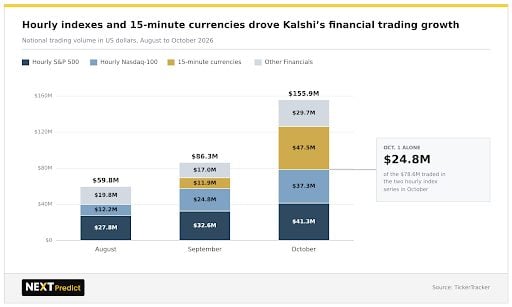
On Kalshi, notional trading volume in hourly S&P 500 and Nasdaq-100 contracts reached $78.6m in October, up 96% from August, according to TickerTracker data.
Anthropic’s IPO comes at a time when traders are increasingly using prediction markets to take positions on the stock market without buying shares. On Kalshi alone, they can trade on when a company will go public, where the S&P 500 will trade within the hour and, soon, on Anthropic’s share price itself through perpetual futures.
So far, though, the growth is concentrated in a handful of short-dated contracts: two hourly stock-index markets and five 15-minute currency markets accounted for nearly 90% of the growth in Kalshi’s financial trading volume from August to October.
Anthropic IPO markets offered another way in
Volume in Kalshi’s Anthropic IPO timing series rose from $758,000 in August to nearly $2m in October. Another $3.1m traded in the first 18 days of November, bringing volume since Aug. 1 to $6.8m across the available deadlines. TickerTracker, a third-party tracker built on Kalshi’s public market data, counts each contract traded as $1 of volume, regardless of its price.
Under Kalshi’s rules, the SEC declaring the registration effective was enough to settle the question. That happened Wednesday, the same day Anthropic priced its shares above its initial $70 to $78 range. The Nov. 16 contract settled No and the Nov. 20 contract settled Yes.
Kalshi settled its market on whether Anthropic or OpenAI would confirm an IPO first in Anthropic’s favor. That market drew $177,000 in trading from Aug. 1 through Nov. 18.
A separate market on which bank would serve as Anthropic’s lead-left underwriter drew $190,000 over the same period. Kalshi marked Goldman Sachs Yes. The final prospectus lists Goldman Sachs first, alongside Morgan Stanley.
Polymarket has also listed markets on Anthropic and OpenAI valuations.
Nasdaq-100 closes the gap on the S&P 500
In August, Kalshi’s hourly S&P 500 contracts drew more than twice the volume of its hourly Nasdaq-100 contracts. By October, just $4m separated them. S&P 500 volume rose 49% from August to October, reaching $41.3m, while Nasdaq-100 volume more than tripled to $37.3m.
Together, the two series went from $40m in August to $57.4m in September and $78.6m in October. Almost a third of October’s total traded on the first day of the month. On Oct. 1, Kalshi’s Financials category traded $30.8m, and the two index series accounted for about 80% of it: $14.8m in hourly Nasdaq-100 contracts and $10m in S&P 500 contracts.
The session came as the 10-year Treasury yield touched its highest level since 2002, Quartz reported, and the Nasdaq-100 closed at a record, according to Bloomberg. Even with that day set aside, the two series traded $53.8m for the rest of October, 34% more than in all of August.
The hourly contracts let a trader take a small position on whether an index will be above a particular level at a set time. Someone who buys one Yes contract for 40 cents can earn 60 cents before fees if it settles Yes or lose the 40 cents plus fees if it settles No. Under TickerTracker’s methodology, that 40-cent purchase counts as $1 of trading volume.
Five currency markets account for half the growth in Financials
The five 15-minute currency series NEXTPredict.io examined recorded no trading volume in August. In September, contracts on the euro, yen and British pound against the US dollar drew $11.9m in trading.
In October, the Australian and Canadian dollar contracts also saw trading, and volume across the five reached $47.5m. That was a bigger dollar gain than the $38.6m the hourly index pair added over the same two months.
Between them, the five currency series and two hourly index series accounted for almost 90% of the $96.1m increase in Kalshi’s Financials category from August to October. Combined volume in the two hourly index series nearly doubled, even as their share of the category fell from 67% to 50%.
Kalshi also set a platform-wide volume record in October.
Longer-dated index markets saw little of that growth. Four daily and annual S&P 500 and Nasdaq-100 range series traded $4.6m combined in October, up just 3% from August. Treasury yield and spread contracts more than doubled over that period but accounted for less than 4% of October’s Financials volume.
Index trading held its pace into November
Set aside Oct. 1, and the remaining 12 sessions in October’s first 13 averaged $2.71m. November’s first 13 sessions averaged $2.82m, about 4% higher.
Without that adjustment, November appears to lag: $36.6m in its first 13 US stock-market sessions against $57.3m in October’s first 13. By Nov. 18, the Financials category as a whole had already traded $172m, above October’s $155.9m, and the five currency series had cleared their October total at $51.2m. A separate 15-minute S&P 500 series also recorded $7.9m through Nov. 18 after showing no volume in October.
Single-company markets could outtrade the indexes, too. From Nov. 1 through Nov. 18, Kalshi’s markets on Nvidia’s next CEO and the CEO’s departure drew $46.5m combined, nearly $10m more than the two hourly index series.
Kalshi plans an Anthropic stock perp for Nov. 23
Kalshi is now preparing to offer a way to trade Anthropic’s share price. Its ANT perpetual future is scheduled for Nov. 23, subject to regulatory approval, after the exchange added 36 single-stock perps on Wednesday. Kalshi previously filed to list perps on qualifying newly public companies as soon as two business days after their debut.
Kalshi also plans to let customers trade stocks and ETFs following its acquisition of broker-dealer FB Securities.
A customer who buys ANT shares through a broker owns part of Anthropic. A stock perp tracks the share price without conveying ownership or paying a fixed $1 on an outcome. It has no set expiration, and leverage can magnify losses enough for a trader’s position to be liquidated.
Kalshi says its US-regulated perps offer lower leverage than offshore alternatives, calling its 15.5% minimum margin “a materially more conservative leverage profile” in its Nov. 17 filings with the Commodity Futures Trading Commission (CFTC).
Single-stock perp markets under scrutiny
A trade group backed by Cboe and Citadel Securities is challenging the CFTC’s authority to allow retail trading in single-stock perps.
On Nov. 3, a federal judge wrote that Capital Markets Alliance Association was “likely to succeed on the merits” of its claim that the CFTC lacks that authority. Still, she denied the request for a temporary restraining order, finding that the group had failed to show likely irreparable harm. The request for a preliminary injunction is still pending.
At Tuesday’s Senate confirmation hearing, CFTC nominee Matthew Rowland said “retail customers increasingly participate in our markets, creating the need to re-examine and strengthen our customer protection rules.” He said the agency should consider stronger rules on how platforms advertise to customers and how they handle conflicts of interest. Sen. Michael Bennet pointed to the strain on the agency: “Between 2024 and this year, the number of contracts listed for trading has increased 167%,” he said, while “the CFTC has lost about 25% of the staff.”
Kalshi did not respond by publication time to our questions about its equities markets volume growth. This story will be updated if Kalshi responds.
Kalshi’s plans for more stock-linked products will give retail traders more ways to take positions as regulators weigh how those products are marketed and what protections customers need.