
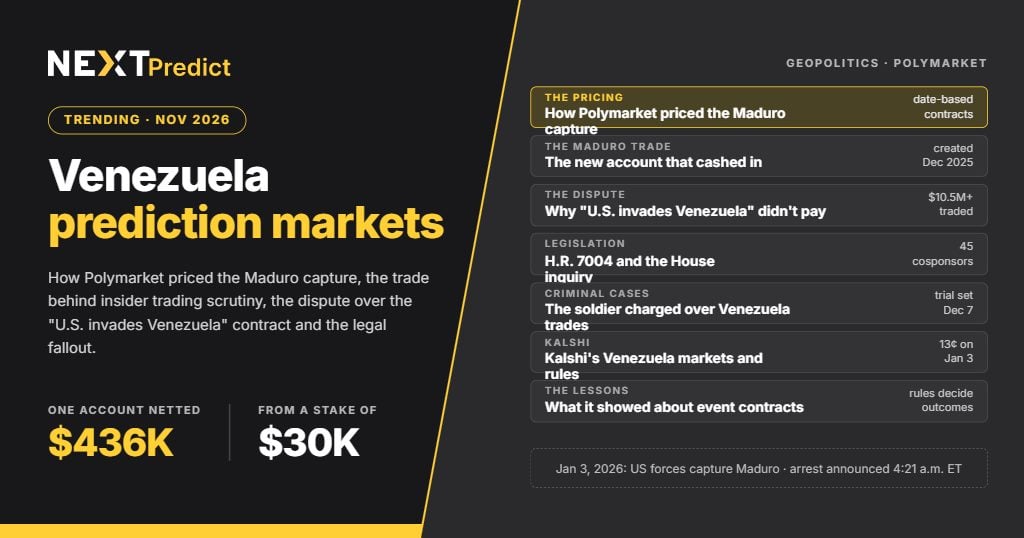
A new Polymarket account netted $436,759.61 on a $30,000 stake after Nicolás Maduro’s capture on January 3, 2026, Axios reported. Polymarket’s market on Maduro leaving power had climbed before 10 p.m. Eastern the previous night, ahead of any public announcement.
This page sets out how Polymarket and Kalshi priced the Venezuela story and the insider trading scrutiny that followed. It also covers the dispute over Polymarket’s “U.S. invades Venezuela” resolution and the legal and legislative consequences.
How Polymarket Priced Venezuela Around the Capture
Polymarket listed several Venezuela contract families in the months before Nicolás Maduro’s capture, as our geopolitics hub tracks.
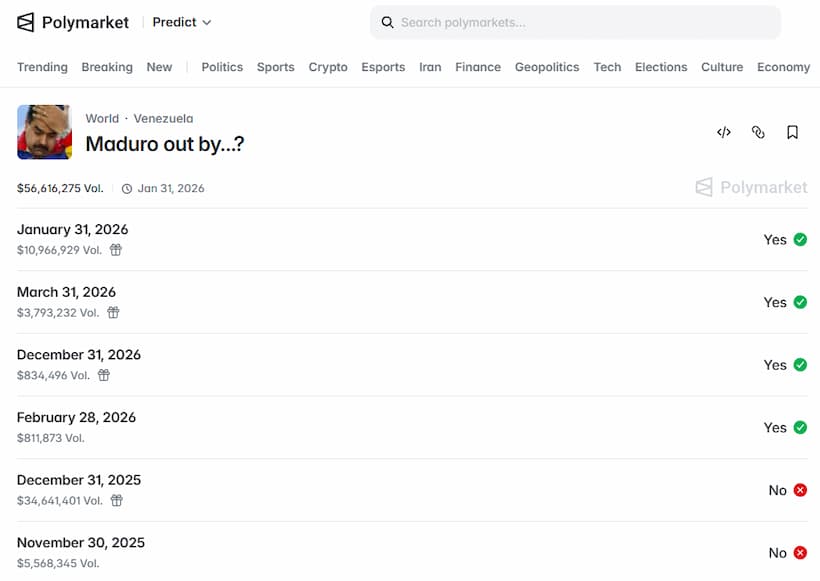
The “Maduro out by…?” event offered date-based contracts from November 30, 2025 through December 31, 2026. “US x Venezuela military engagement by…?” drew about $87.4 million across dates from September 30, 2025 onward. A separate “Will the U.S. invade Venezuela by…?” event covered offensives aimed at controlling Venezuelan territory.
Each date traded as its own contract, priced as the implied probability of the event by that deadline, which our pricing explainer covers. Axios reported the Maduro-out contract had hovered in the low single digits for weeks before January 2.
On January 3, 2026, US forces seized Maduro and his wife and flew them out of Venezuela, the Associated Press reported. They faced a Justice Department indictment on narco-terrorism conspiracy charges and landed in New York that evening. Polymarket opened its “Maduro in U.S. custody by January 31?” contract at 2:48 a.m. Eastern that morning, so it did not exist before the operation.
The Maduro Polymarket Trade
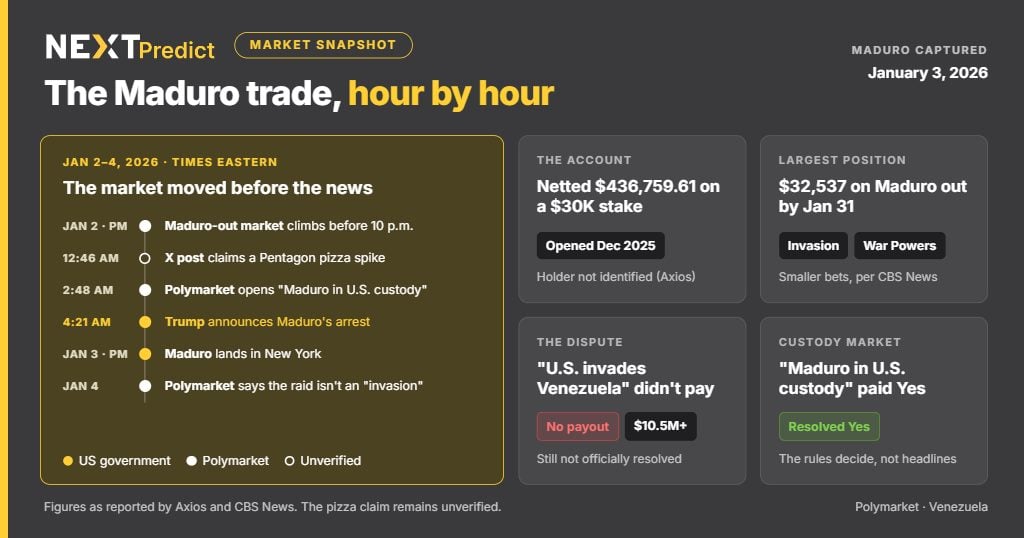
A Polymarket account created in December 2025 placed roughly $30,000 to $34,000 on Venezuela-related contracts before the operation. Its largest position was $32,537 on Maduro being out by January 31, 2026, CBS News reported.
Smaller positions covered a US invasion, use of the War Powers Act and US forces landing in Venezuela. The trades came shortly before President Trump announced Maduro’s arrest at 4:21 a.m. Eastern on January 3.
Axios reported the account netted $436,759.61 after Maduro entered US custody, a figure CBS and Fortune repeated. Axios put the stake at $30,000, while the positions CBS itemized total about $34,000. An archived snapshot circulating on social media showed $407,920.12, according to Gizmodo.
None of the reporting identified the account holder, and Polymarket did not respond to CBS’s request for comment at the time. Our insider trading explainer covers the wider issue.
A different explanation for the market’s timing circulated online. At 12:46 a.m. ET on January 3, an X account claimed a 700% activity spike at a Pentagon-area Papa John’s pizzeria. Polymarket’s own newsletter later featured the claim, which remains unverified and was not tied to the $436,759.61 account.
The Dispute Over Polymarket’s Invasion Contracts
Polymarket did not pay out on its “Will the U.S. invade Venezuela by…?” contracts after Maduro’s capture. The Financial Times and the Guardian reported the decision in early January, with over $10.5 million traded on the Venezuela war odds event contracts.
The contract rules require the US to commence “a military offensive intended to establish control over any portion of Venezuela.” On January 4, Polymarket said the capture mission did not meet that standard, adding that Trump’s statement saying the US would “run” Venezuela “does not alone qualify” the raid as an invasion.
Traders holding “Yes” positions argued a military incursion and the removal of a head of state should count with some even accusing Polymarket of changing the rules after the fact. The market’s end date passed on March 31, 2026, and its page showed it as not officially resolved on November 9, 2026.
The contract’s own definition of the event decides the outcome, not the public’s understanding of it. A headline event resolves a contract only if it meets every condition the rules set. Polymarket’s separate “Maduro in U.S. custody by January 31?” contract resolved “Yes” within days of the capture, after a dispute over the proposed outcome.
Legislation and Investigations After the Trade
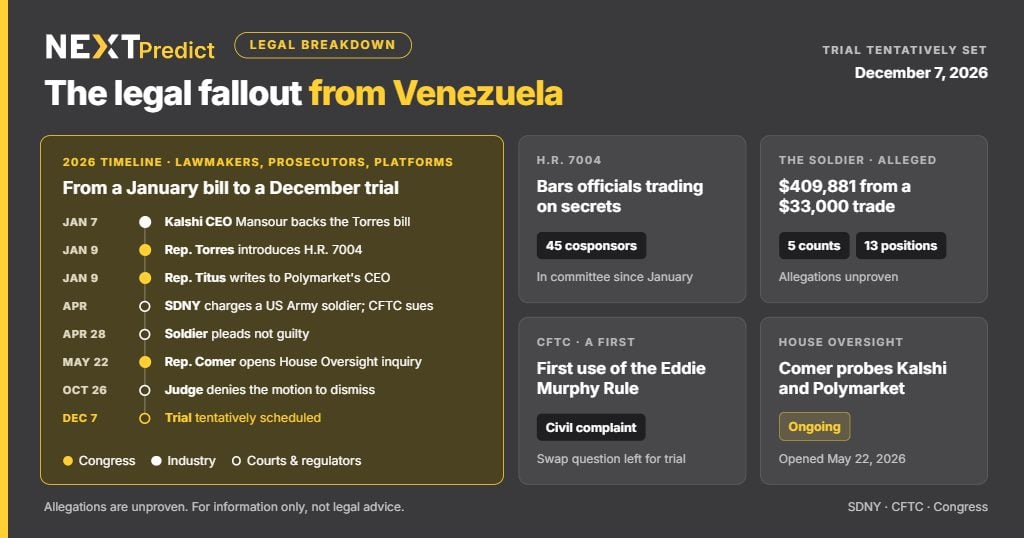
Rep. Ritchie Torres introduced the Public Integrity in Financial Prediction Markets Act of 2026 on January 9, 2026. H.R. 7004 would bar federal elected officials, political appointees and executive branch employees from trading on non-public information. There were 30 House Democrats reported as cosponsors by January 13, and the official bill record now lists 45.
Rep. Dina Titus, one of the cosponsors, sent a letter to Polymarket chief executive Shayne Coplan on January 9 asking how many accounts Polymarket had “suspended, restricted, or terminated” for insider trading and set a three-week deadline.
Kalshi chief executive Tarek Mansour endorsed the Torres bill on January 7, insisting Kalshi already bans the conduct the bill targets and simply does not stand for insider trading on its prediction market app.
On May 22, 2026, House Oversight Chairman James Comer opened an inquiry into insider trading on Kalshi and Polymarket. The bill remains in committee with no action since its January referral, meaning the investigation is still ongoing and unresolved.
Criminal Cases Linked to the Venezuela Operation
In April 2026, SDNY prosecutors charged a US Army soldier over Polymarket trades on Venezuela. The indictment alleges he used classified information about the operation to earn $409,881 from a $33,000 staked trade. His 13 positions covered Maduro leaving office and US forces being active in Venezuela by January 31.
The US soldier faces five counts, including commodities fraud, wire fraud and an unlawful monetary transaction. The CFTC filed a parallel civil complaint, its first insider trading case involving event contracts.
The case marks the CFTC’s first use of the Eddie Murphy rule, which bars misappropriating non-public government information. The defense argued Polymarket’s contracts are not swaps under the Commodity Exchange Act. Judge Margaret Garnett found he had not shown this as a matter of law, leaving the question open for trial.
He pleaded not guilty on April 28, 2026. A judge denied his motion to dismiss on October 26, and a trial is tentatively set for December 7, 2026. The allegations remain unproven, and he is presumed innocent unless convicted.
A separate SDNY case charged a Google engineer over Polymarket trades on confidential search data in May 2026.
Kalshi and Other Venezuela Markets
Kalshi lists its own Venezuela markets, including “Nicolás Maduro out?” and “Who will officially lead Venezuela at the end of 2026?” Axios reported Kalshi’s market on Maduro leaving office before February traded near 13¢ on January 3.
Kalshi’s rules bar trading on material non-public information and by anyone with influence over an outcome. Its published policy also prohibits government employees with access to non-public information from trading relevant markets. In addition, Kalshi blocks members of Congress from joining the platform, according to the same page.
Kalshi also said its rulebook prohibits trading on material non-public information by insiders or decision-makers, with Kalshi CEO Tarek Mansour saying Kalshi treats such trading as a financial crime regardless of the trader’s role.
In February 2026, Kalshi added Solidus Labs as a surveillance partner and named Robert DeNault head of enforcement. NEXTPredict’s report placed the move in the context of large positions on Maduro’s exit. In June, Kalshi began collecting employment information before users trade in markets with elevated insider risk.
For another geopolitical market that drew scrutiny, see our Iran coverage.
What the Venezuela Episode Showed About Event Contracts
Three main lessons and points emerged from the Venezuela episode. First, government actions involve information held by very few people, and event contracts on those actions price that gap directly.
Second, a contract’s written definition decides its outcome, not public understanding, as the invasion dispute showed. Third, regulators and lawmakers moved within months, from a January bill to April charges and a May congressional inquiry.
Federal oversight sits with the CFTC, as our regulation hub sets out, with our coverage of calls for geopolitical frameworks tracking how these markets are developing too.
Conclusion
Polymarket’s Venezuela contracts drew scrutiny after a new account netted a reported $436,759.61 around Maduro’s capture on January 3, 2026. Polymarket declined to pay out on its invasion contracts, and a US soldier faces charges over separate alleged trades. Lawmakers responded with a January bill, a letter to Polymarket’s chief executive and a May congressional inquiry.
Our geopolitics hub tracks open Venezuela prediction markets.
Last verified: November 9, 2026.
Frequently Asked Questions
What did Polymarket say about Venezuela before the capture of Maduro?
Polymarket listed “Maduro out by…?” contracts on whether Maduro would leave power by set dates. It also ran “US x Venezuela military engagement by…?” contracts across dates from September 2025.
A separate “Will the U.S. invade Venezuela by…?” event covered offensives aimed at controlling Venezuelan territory. Its “Maduro in U.S. custody by January 31?” contract opened on January 3, 2026, during the operation.
How much did the Polymarket trader make on the Maduro trade?
A newly created account netted $436,759.61 after Maduro’s capture, Axios reported, on a stake of about $30,000. CBS News itemized positions totaling about $34,000, led by $32,537 on Maduro leaving office by January 31. The reporting did not identify the account holder.
Why did Polymarket refuse to pay on invasion contracts?
Polymarket said the contracts required “a military offensive intended to establish control over any portion of Venezuela.” It said the capture raid did not meet that standard. The Financial Times and the Guardian reported the decision in early January, with over $10.5 million traded.
Has anyone been charged over trades on the Venezuela operation?
Yes. Federal prosecutors charged a US Army soldier in April 2026 over Polymarket trades on the operation. The indictment alleges he used classified information to earn $409,881. As of November 9, 2026, he has pleaded not guilty, and a trial is tentatively set for December 7, 2026.
Is there a law against insider trading on prediction markets?
Yes. The CFTC treats event contracts as swaps and applies the Commodity Exchange Act’s anti-fraud rules to trading on misappropriated information. A separate provision, known as the Eddie Murphy rule, bars trading on non-public government information.
Resources: Polymarket | Associated Press | Forbes | Cryptonews | X | Axios | CFTC | Bloomberg | Decrypt | Kalshi