
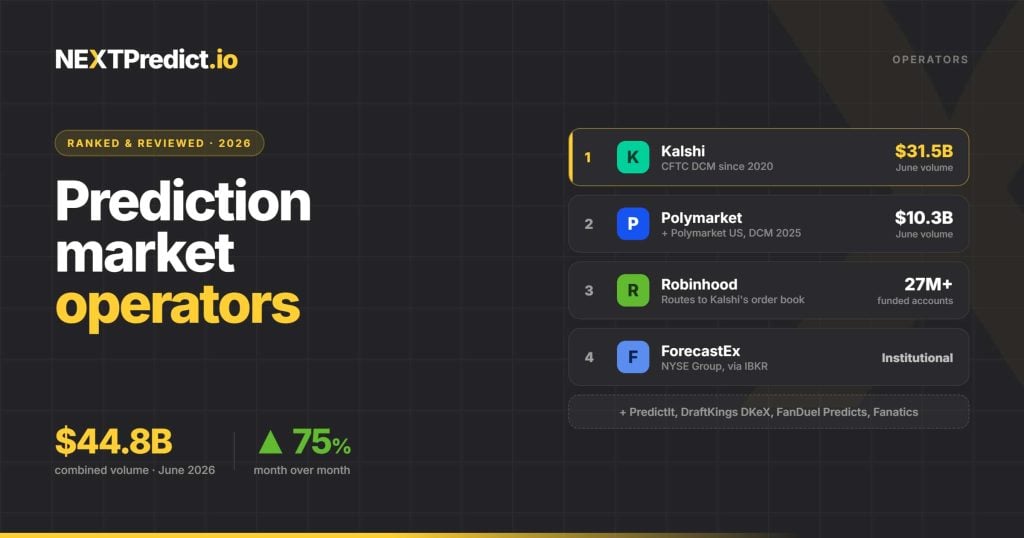
Kalshi, Polymarket, and Polymarket US cleared a combined $44.8 billion in trading volume in June 2026. That is up 75% from May’s $25.7 billion, according to The Block. Two years ago, combined monthly volume across the category sat under $5 billion. The scale has changed faster than the number of serious venues has grown.
Prediction market platforms are the exchanges, brokerages, and distribution platforms that list, price, and settle event contracts tied to real-world outcomes. They act as market infrastructure, not bookmakers. You trade against other participants, not against the house. Kalshi and Polymarket lead the category, but six operators now account for nearly all US-accessible volume.
The field has split into three tiers. CFTC-designated exchanges compete alongside brokerage front ends, an institutional venue, and a shrinking no-action-letter platform. Each carries its own licensing structure, fee model, and regulatory posture. Kalshi and Polymarket alone account for roughly 86% of that flow, based on May 2026 data from Binance Research.
This page serves three readers: US traders comparing where to open an account, professionals tracking the category from finance, media, or policy, and B2B researchers who need independent analysis of prediction market operators. It ranks the operators that matter and compares fees, market structure, and regulatory status. For the broader category, including what you can trade on prediction markets and how prediction market apps work, see our other hubs.
The Platform Field, By Tier
Three tiers define who can legally list an event contract in the United States.
|
Tier |
What It Does |
Who’s In It |
Regulatory Basis |
|
Designated Contract Markets (DCMs) |
Creates and self-certifies its own contracts, clears trades directly |
Kalshi (since 2020), Polymarket US (QCX LLC, since December 3, 2025), Aristotle Exchange (DCM/DCO since September 2025, acquired by Underdog in March 2026) |
CFTC Designated Contract Market status |
|
Distribution platforms |
Routes order flow into a DCM’s order book, or offers parallel institutional access |
Robinhood Event Contracts and Webull (both route into Kalshi), ForecastEx (NYSE Group, via Interactive Brokers), CME Group’s event-contract listings |
Partner or introducing-broker arrangement with a DCM |
|
Outside the DCM structure |
Operates offshore, under a legacy exemption, or as a new post-2024 entrant |
Polymarket’s international platform (Polygon, USDC, no CFTC registration), PredictIt (CFTC no-action letter, amended July 2025), DraftKings DKeX, FanDuel Predicts, Fanatics Markets |
No DCM status, a no-action letter, or a newly built catalog |
Sportsbook operators including DraftKings, FanDuel, and Fanatics moved into this tier after the 2024 through 2026 court rulings on CFTC jurisdiction opened sports event contracts to broader competition. You can keep track of each ruling on our Legal & Regulatory news page as it develops.
How to Evaluate a Prediction Market Platform
Every platform on this page clears the same basic filter: it lists CFTC-regulated event contracts, or it discloses its offshore status plainly. These venues facilitate trading among participants rather than taking the other side of every trade. Beyond that, five factors separate a serious venue from a marketing wrapper.
- Regulatory status – Confirm whether the operator holds CFTC Designated Contract Market status, operates under a no-action letter, or sits offshore. Each carries different consumer protections.
- Fee structure – Cost models vary by design, not by accident. See the comparison below.
- Market breadth – Kalshi and Polymarket list the widest category range. ForecastEx and PredictIt run narrower, deeper catalogs in economics and politics.
- Liquidity and spread – A wide bid-ask spread erodes returns as much as an explicit fee, especially on longer-dated or thinly traded contracts. Prices reflect the market’s perceived probability of an outcome, not the operator’s view.
- Custody and settlement – Fiat operators settle in USD through bank transfer. Polymarket’s international platform settles in USDC, which adds a wallet and stablecoin layer to every trade.
|
Operator |
Fee Model |
|
Taker fee follows a formula: 7 cents x price x (1 minus price), peaking near 1.75% | |
|
Dynamic taker fee, from 0.75% on sports contracts to 1.80% on crypto contracts | |
|
Flat 10% profit fee plus a 5% withdrawal fee | |
|
Higher per-contract fee at retail size; more competitive at larger positions |
These are transaction charges for facilitating a trade, not bookmaker vig from taking the other side of your position.
Regulatory and Legal Status
The core legal question behind every operator on this page is still open. Event contracts are derivatives under federal law, not gambling products, and the CFTC asserts exclusive jurisdiction over the exchanges it designates. A growing number of states argue that sports-related contracts are unlicensed gambling subject to state law. Courts are actively split on the answer.
|
Action |
Date |
Outcome |
|
KalshiEX v. Flaherty (Third Circuit) |
April 6, 2026 |
First federal appellate ruling: the Commodity Exchange Act preempts New Jersey’s gambling law for Kalshi’s sports contracts (preliminary injunction only) |
|
Kalshi / Robinhood / Crypto.com v. Nevada Gaming Control Board (Ninth Circuit) |
Oral arguments April 16, 2026 |
District court reached the opposite conclusion; case remains on appeal |
|
CFTC v. Arizona, Connecticut, Illinois, New York, Wisconsin |
Filed April 2026 onward |
CFTC and DOJ argue state enforcement actions are preempted by federal law |
|
CFTC Advisory 26-08 |
March 12, 2026 |
Compliance guidance for sports-related event contracts |
|
Proposed Rule 40.11 amendments |
Proposed June 10, 2026 |
Three-step public interest test for event contracts; comment period closes July 27, 2026 |
We do not take a position on how these cases should resolve.
Featured Prediction Market Platforms
Six platforms account for nearly all US-accessible prediction market volume.
|
Operator |
Status |
June 2026 Volume |
Settles In |
Kalshi |
CFTC DCM |
$31.5B (+87.4% month over month) |
USD |
|
Polymarket (international) |
Offshore, no CFTC registration |
$10.26B (+45%) |
USDC |
|
CFTC DCM |
$3.04B |
USD | |
|
Robinhood Event Contracts |
Distributor, routes into Kalshi |
Mirrors Kalshi’s order book |
USD |
|
ForecastEx |
CFTC DCM (NYSE Group) |
Not separately disclosed |
USD |
|
PredictIt |
CFTC no-action letter |
Not separately disclosed |
USD |
Kalshi
This is the largest CFTC-regulated event-contract exchange in the country, and by most measures the largest prediction market operator overall. The exchange posted $31.5 billion in trading volume in June 2026, up 87.4% from May, according to The Block. Sports contracts drove most of that flow, though Kalshi also lists contracts tied to inflation, interest rates, and weather.
Kalshi earned its CFTC designation in November 2020. It raised $1 billion in May 2026 in a round led by Coatue Management at a $22 billion valuation. The company reports $178 billion in annualized trading volume and more than $1.5 billion in annualized revenue.
The operator settles in USD and clears through its own order book. It distributes through partner apps including Robinhood and Webull.
Polymarket
The largest prediction market platform globally, Polymarket is most associated with the category’s growth. Its international platform cleared $10.26 billion in trading volume in June 2026, up 45% from May, according to The Block. It runs on Polygon and settles trades in USDC, outside CFTC registration.
A separate CFTC-designated entity, Polymarket US, operated by QCX LLC, launched December 3, 2025. It runs a sports-first catalog with exchange partnerships across MLB, the NHL, and UFC, and cleared $3.04 billion in June 2026. Polymarket acquired QC Clearing for $112 million in July 2025 to secure that US-regulated path, a deal NEXTPredict covered at the time.
Polymarket’s international platform is backed by a $2 billion investment from Intercontinental Exchange. A Columbia University study estimated that roughly 25% of the platform’s historical volume reflected wash trading, concentrated in sports markets. The platform introduced anti-insider-trading measures in March 2026, alongside similar steps at Kalshi.
Robinhood Event Contracts
With Robinhood event contracts, Kalshi’s regulated order book is brought into the Robinhood app. That gives the brokerage’s more than 27 million funded accounts direct access to event contracts without a separate exchange account. There is no separate Robinhood account fee, though per-contract charges on the underlying Kalshi contracts still apply. Robinhood does not offer API access for event contracts, which rules out automated trading through the app.
Liquidity mirrors Kalshi’s own order book on every contract Robinhood lists, and a trade placed through Robinhood fills at the same market depth as one placed directly on Kalshi. Robinhood processed 8.8 billion event contracts in the first quarter of 2026 alone.
ForecastEx (Interactive Brokers)
The NYSE Group’s regulated event-contract exchange can be reached primarily through Interactive Brokers’ ForecastTrader interface. The venue targets institutional and active traders rather than casual users. Clients trade event contracts alongside stocks, options, and futures inside a single IBKR account. Interactive Brokers is the only operator on this page that also provides access to CME Group’s own event-contract listings, widening the effective catalog beyond ForecastEx’s native markets.
Per-contract fees run higher than Kalshi, Polymarket, or Robinhood at retail trade sizes, though the cost structure favors larger positions, where the per-dollar fee stays competitive. IBKR founder Thomas Peterffy has said midterm election contract trading alone would be enough to lift the firm’s 2026 revenue growth.
PredictIt
The oldest of active prediction market platforms covered on this page, PredictIt has been running since 2014 under a CFTC no-action letter rather than full Designated Contract Market status. The letter survived a legal challenge after the CFTC tried to withdraw it in 2022, and the CFTC issued an amended version in July 2025. That amendment raised the per-contract trader cap from $850 to $3,500 and removed the previous 5,000-trader limit per market, according to DeFi Rate’s reporting and the CFTC’s own filing.
PredictIt still charges a 10% profit fee plus a 5% withdrawal fee, the highest cost structure among the operators NEXTPredict tracks. Its catalog stays narrow and political, covering elections and legislative outcomes with a depth of down-ballot and historical contracts no competitor matches. That focus has kept it relevant for election prediction markets, where crowd-priced contracts often sharpen faster than traditional polling.
Aristotle Exchange, a separately owned CFTC-designated exchange and clearinghouse approved in September 2025, has no operational connection to PredictIt despite the shared founder. Underdog acquired Aristotle Exchange in March 2026 to build its own prediction market business.
Sportsbook Operators: DraftKings, FanDuel, and Fanatics
Sportsbook operators moved into event contracts following the 2024 through 2026 court rulings that opened sports-related contracts to CFTC oversight. DraftKings operates its own exchange product, DKeX. FanDuel Predicts offers a $25 bonus on sign-up. Fanatics Markets rounds out the group. Each layers event-contract trading onto an existing sportsbook user base rather than building a standalone brokerage relationship.
Coverage runs sports-first, mirroring the game and player-prop markets these companies already list as sportsbooks, with less depth than Kalshi or Polymarket outside that category. OG launched in February 2026 with a sports-markets focus, adding another sportsbook-adjacent name to watch. Independent reviewers rank the trading interface on these products behind Kalshi’s and Polymarket’s native apps as of mid-2026.
How to Choose a Platform for Prediction Markets
Choosing a platform is not the same question as choosing whether to trade event contracts at all. Prediction market trading carries financial risk, and you can lose money on speculative contracts. A few checks apply regardless of which operator you pick.
- Confirm state-level access before funding an account. CFTC-regulated status does not guarantee availability in every state, and several of the state actions covered above remain in active litigation.
- Match the operator to the category you want to trade. Kalshi and Polymarket cover the widest range. ForecastEx and PredictIt run deeper, narrower catalogs in economics and politics.
- Price the full round-trip cost, not the headline fee. Bid-ask spread on thin contracts often costs more than the posted taker fee.
Treat volume claims with the same skepticism you would apply to any self-reported metric. A Columbia University study estimated that roughly 25% of Polymarket’s historical volume reflected wash trading. A Kalshi executive has separately alleged wash trading above 70% on some Polymarket markets, a claim that remains unverified.
State the outcome plainly. Most prediction market traders lose money, and these contracts are speculative positions, not guaranteed returns. An April 2026 Bloomberg analysis of Dune Analytics trade data found that more than 100,000 Polymarket accounts have lost at least $1,000, more than double the number of accounts that have won that much.
Why NEXTPredict Tracks Platforms
We report on the prediction markets industry independently of any operator on this page. No ranking here reflects a partnership, referral arrangement, or promotional relationship. Each full review applies the same test: regulatory status, fee structure, market breadth, and where the operator’s own disclosures fall short.
For the daily numbers behind these operators, visit NEXTPredict’s news portal. For the people building this industry, NEXTPredict Summit NYC convenes operators, regulators, and traders at Convene 30 Hudson Yards, October 22 to 23, 2026.
Conclusion
The prediction market field has consolidated around two leaders and a handful of specialists. Kalshi and Polymarket account for roughly 86% of volume, but the regulatory questions around sports contracts, insider trading, and state jurisdiction remain unresolved heading into the second half of 2026. That makes the choice of operator inseparable from the choice of risk you are willing to take on, both as a trader and as a business watching the space.
Start with regulatory status, then fees, then market breadth. Confirm state access last, since it can change with a single court ruling. We update each operator profile as licenses, lawsuits, and volume figures shift, so check the individual reviews linked above before you commit capital.
Frequently Asked Questions
What is a prediction market platform?
A prediction market platform is an exchange, brokerage, or distribution platform that lists, prices, and settles event contracts tied to real-world outcomes. Some, like Kalshi, hold CFTC Designated Contract Market status and clear trades directly. Others, like Robinhood, distribute another operator’s contracts without running an independent exchange.
Which prediction market operators are regulated by the CFTC?
Kalshi, Polymarket US, and Aristotle Exchange hold CFTC Designated Contract Market status as of mid-2026. PredictIt operates under a separate CFTC no-action letter, not full DCM status. Polymarket’s original international platform is not CFTC-registered.
What is the difference between Kalshi vs Polymarket?
Kalshi is a CFTC-regulated exchange that settles in USD and clears trades through its own order book. Polymarket’s international platform runs on Polygon and settles in USDC outside CFTC registration, while its separate US entity launched in December 2025. Kalshi cleared more volume in June 2026, at $31.5 billion against Polymarket’s $10.26 billion.
Is Robinhood a prediction market platform?
Not independently. Robinhood Event Contracts routes order flow into Kalshi’s regulated order book through the Robinhood app. Pricing, liquidity, and settlement follow Kalshi’s rules, not Robinhood’s.
How do prediction market platform fees compare?
Kalshi’s taker fee follows a formula that peaks near 1.75%. Polymarket’s dynamic taker fee ranges from 0.75% on sports to 1.80% on crypto contracts. PredictIt charges a flat 10% profit fee plus a 5% withdrawal fee, the highest among operators covered here.
Are prediction markets legal in every state?
No single answer applies nationwide. As of mid-2026, the CFTC has sued five states, Arizona, Connecticut, Illinois, New York, and Wisconsin, arguing federal law preempts their enforcement actions. Courts have split on the question, so check an operator’s own state-availability list before funding an account.
Which prediction market platform has the most trading volume?
Kalshi cleared the most volume among individual operators in June 2026, at $31.5 billion, according to The Block. Combined with Polymarket’s international platform and Polymarket US, the category totaled $44.8 billion for the month.
Do prediction market traders make money?
Most do not. An April 2026 Bloomberg analysis found that over 100,000 Polymarket accounts have lost at least $1,000, more than double the number of accounts that have won that much. Returns concentrate in a small group of consistently profitable traders across every operator NEXTPredict tracks.
Sources: The Block | Pew Research Center | Yahoo Finance | Holland & Knight | PYMNTS | Bloomberg