
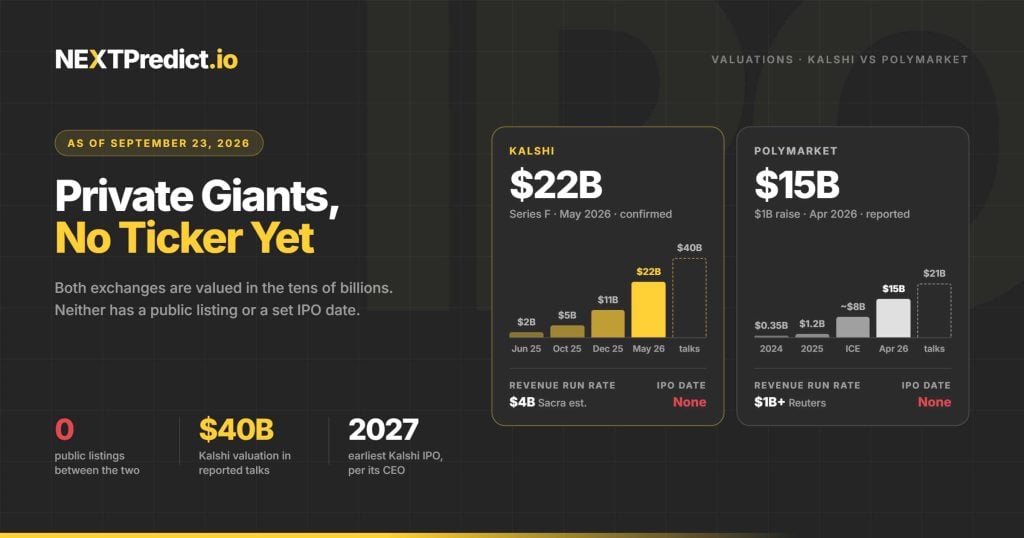
Neither Kalshi nor Polymarket is publicly traded, despite attracting significant investment and interest in potential IPOs. Investors cannot purchase either company’s shares through a standard brokerage account, while prices displayed on private-market websites are only indicative.
Kalshi’s latest completed financing valued it at $22 billion, while Polymarket raised capital at a reported $15 billion valuation before entering talks over a higher-valued round. This page examines private-share access, funding, valuations, revenue estimates and IPO signals while distinguishing completed transactions from proposed deals and third-party reporting.
Can You Buy Shares in Kalshi or Polymarket?
Neither Kalshi nor Polymarket offers publicly listed shares for purchase through an ordinary stock-market order. Investing in their equity requires access to a private transaction, subject to investor eligibility, available sellers and the terms of the offering.
Trading on either platform does not make someone a shareholder. In a prediction market, an event contract pays according to a specified outcome. Buying a position on an election or economic release gives the trader exposure to that event, not ownership of the business operating the exchange.
How private-share purchases work
Services such as Hiive, EquityZen and Nasdaq Private Market operate in the private-share market. A company profile or displayed price does not guarantee shares are available, a buyer qualifies, or a transaction will close. Access also differs between direct share purchases and investments through a fund holding private shares.
Many offerings restrict participation to accredited investors. The SEC’s accredited-investor guidance includes net worth above $1 million, excluding a primary residence, or annual income exceeding $200,000 individually or $300,000 with a spouse or spousal equivalent in each of the previous two years, with a reasonable expectation of the same this year. Certain professional credentials also qualify.
Accredited status does not guarantee access to a particular offering. Buyers still need to establish which securities they would own, the associated fees and any company approval required for a transfer.
The SEC’s private placement bulletin identifies several differences from public stocks:
- Liquidity: Buyers face restrictions on reselling shares and the possibility of holding them indefinitely
- Disclosure: Private offerings often provide less financial information than public securities
- Risk: Investors face the loss of their entire investment
A private-market quote also needs context. It might represent a seller’s asking price, an indicated bid or a platform estimate. It does not necessarily record a completed transaction. Share class, transfer restrictions, fees and fund structure affect what the buyer receives.
The SEC warns about pre-IPO investment scams, including offers involving companies with no impending public offering. The label “pre-IPO” describes a private investment, not a promise of an exit date.
Platform access and share ownership raise separate questions. NEXTPredict’s prediction market legal guide covers where users are permitted to trade event contracts.
How Has Kalshi’s Valuation Changed?
Kalshi’s latest company-announced funding round verified for this page valued the business at $22 billion. Its legal adviser, Cooley, confirmed the $1 billion Series F on May 7, 2026. Coatue led the round, with investors including Sequoia Capital, Andreessen Horowitz, Paradigm and Morgan Stanley.
The company’s earlier venture capital backing included a $30 million Series A announced on February 17, 2021. Sequoia led the round, with participation from Charles Schwab, Henry Kravis, SV Angel and existing investors including Neo and YC Continuity.
The Kalshi funding trajectory shows successive increases in the price investors assigned to the business:
|
Announcement |
Funding round |
Valuation |
|
$185 million Series C |
$2 billion | |
|
$300 million Series D |
$5 billion | |
|
$1 billion Series E |
$11 billion | |
|
$1 billion Series F |
$22 billion |
These dates mark announcements, rather than necessarily the first sale or final closing of every share in a round. The valuation measures the company’s negotiated value. The funding amount measures the capital raised in the transaction.
A separate Form D filed on August 25, 2026 reported $1,120,010,122 sold in an equity offering with a first-sale date of April 3. The filing listed a total offering amount of $1,499,997,894 and 71 investors.
The notice does not establish a new valuation or identify the entire amount as additional financing beyond the announced Series F. Adding those figures together would risk counting the same capital twice. Form D records an exempt securities offering, not an IPO registration.
Higher figures remain part of the fundraising discussion. Reuters Breakingviews reported on September 18 that Sequoia and Wellington Management were in talks to lead a $750 million investment at a $40 billion valuation, citing The Information. That is a reported proposed valuation, distinct from the confirmed $22 billion round.
How Has Polymarket’s Valuation Changed?
The latest proposed Polymarket valuation reported by Bloomberg is $21 billion on a post-money basis. Bloomberg reported on August 31, 2026, that 1789 Capital was leading a planned $1 billion round and expected to contribute around $300 million. The report described an ongoing financing and did not provide a company-confirmed closing date.
Earlier disclosures trace Polymarket’s progression from venture funding to investment from a major exchange group:
- May 14, 2024: Polymarket announced $70 million across two rounds, comprising a $25 million Series A led by General Catalyst and a $45 million Series B led by Founders Fund. Participants included Vitalik Buterin.
- A separate 2024 round: a $55 million investment led by Blockchain Capital valued Polymarket at $350 million, according to funding details later disclosed by CEO Shayne Coplan.
- 2025: Coplan also disclosed a $150 million round led by Founders Fund at a $1.2 billion valuation.
- October 7, 2025: Intercontinental Exchange announced an agreement to invest up to $2 billion at approximately $8 billion before the investment.
- March 27, 2026: ICE confirmed a further $600 million direct investment, following its initial $1 billion investment in October.
- April 2026: Polymarket raised $1 billion at a reported $15 billion valuation, according to Bloomberg reporting cited by Reuters.
The ICE announcement illustrates why headline commitments and completed funding require separate treatment. In March, ICE also anticipated buying up to $40 million of securities from existing holders. Its $600 million direct investment formed part of a broader Polymarket fundraising, so it should not automatically be added to the entire round as separate new capital.
Pre-money values a business before new investment. Post-money includes the new capital. ICE’s $8 billion figure and the reported $21 billion figure therefore need their respective labels.
Neither figure establishes a public share price. Private-round valuations reflect negotiated financing terms, while a secondary purchase depends on the specific shares or investment vehicle offered.
Kalshi and Polymarket Revenue Estimates
Publicly available financial information is uneven. Funding announcements disclose capital raised and valuations. They do not supply the full income statements investors normally receive from listed companies.
Research firm Sacra estimated Kalshi revenue at a $4 billion annualized run rate for July 2026. This is a third-party estimate. Kalshi declined to disclose a revenue range in its August Form D.
Polymarket revenue reporting includes Reuters’ June 26 report of more than $1 billion in annualized revenue, attributed to a person familiar with the matter. That is sourced financial reporting, not a published audited annual result.
The figures refer to different periods and disclosure methods. They do not support a precise comparison of full-year revenue, profit or margins.
Three distinctions help explain the numbers:
- Trading volume measures activity on a platform. It is not the amount the company earns.
- Revenue measures income from business activities, including applicable transaction fees. Customer deposits and contract payouts do not automatically become company revenue.
- Annualized revenue extrapolates a shorter period over a year. It is neither a completed year’s revenue nor a guarantee of future sales.
For example, annualizing one month assumes its pace continues for 12 months. A major tournament or election creates activity which does not necessarily recur evenly throughout the year.
Revenue also differs from profit. Staff, technology, marketing and other operating expenses affect earnings. Neither a large funding round nor a high revenue run rate establishes profitability.
For platform-level trading charges, see NEXTPredict’s Kalshi vs Polymarket fee comparison. Fee schedules and rebates affect the relationship between trading activity and revenue.
Are Kalshi and Polymarket Preparing for IPOs?
Neither company has publicly confirmed a firm IPO date as of September 23, 2026. Available reporting establishes interest and preparation, with different levels of confirmation for each business.
Kalshi IPO: What the company has said
CEO Tarek Mansour discussed the possibility of a future listing in a June 24 CNBC interview. CoinDesk’s account of the interview reported that he ruled out an IPO before 2027. He described the company as considering the question, rather than announcing a timetable.
His remarks establish management interest. They do not confirm a 2027 listing, an offer price or an exchange.
Polymarket IPO: What recent reporting shows
The Wall Street Journal reported on September 20 that Coplan had discussed preparing the business for a potential IPO in the following year during a June meeting with 1789 Capital co-founder Omeed Malik. The account relied on people familiar with the meeting, rather than a public listing announcement.
Polymarket also appointed Warren Jenson as CFO on September 10. Its announcement assigned him responsibility for finance, capital strategy and long-range planning. It did not announce an IPO date.
The distinction between private preparation and public disclosure matters. The SEC permits nonpublic review of draft registration statements. An absence of public IPO documents does not prove a company has held no confidential discussions or made no confidential submission.
For both businesses, an official prospectus and announced offering terms would provide firmer information than fundraising reports or executive hiring alone. An IPO prospectus would also provide audited financial statements, ownership details and detailed risk disclosures for readers assessing the proposed public investment.
Kalshi and Polymarket Financials at a Glance
Figures retain the dates and source qualifications discussed above.
|
Measure |
Kalshi |
Polymarket |
|
Public stock listing |
None |
None |
|
Latest completed funding valuation |
$22 billion, May 2026, company-announced |
$15 billion, April 2026, reported by Bloomberg via Reuters |
|
Later fundraising discussions |
$40 billion valuation talks, September 2026 |
$21 billion post-money valuation for an August 2026 financing reported in progress |
|
Revenue indicator |
$4 billion annualized, July 2026, Sacra estimate |
Over $1 billion annualized, June 2026, Reuters source |
|
Confirmed IPO date |
None |
None |
What to Watch for Next
Kalshi and Polymarket remain private companies. Their funding histories document substantial investment, but retail investors have no public stock listing through which to buy either business directly.
Completed rounds, fundraising discussions and private-market quotes carry different meanings. Annualized revenue describes a pace of activity, while audited annual accounts would offer a fuller view of financial performance.
For readers following either business, the relevant updates are completed funding announcements, dated financial disclosures and official listing documents. None removes the need to examine the terms of a specific private investment. Ownership rights and resale restrictions matter alongside the headline valuation, even when prominent institutions back the company.
NEXTPredict’s Kalshi review and Polymarket review explain the platforms and their products. The Economics hub covers economic prediction markets, including contracts tied to interest rates, inflation and jobs data. Those trading products are separate from ownership of the companies themselves.
Frequently Asked Questions
Is Kalshi stock publicly traded?
No. Kalshi remains privately held as of September 23, 2026. An ordinary brokerage order does not buy Kalshi equity on a public exchange. Private company profiles and indicative share prices on financial websites do not establish a public listing or guarantee shares are available.
Can I invest in Kalshi?
Eligible investors sometimes obtain private company exposure through funding rounds, secondary transactions or investment funds. Access depends on the offering, available shares and investor qualifications. Accredited status alone does not guarantee access to Kalshi equity. Trading event contracts through the Kalshi platform does not make a customer a shareholder. Some investments provide indirect exposure through a fund.
Is Kalshi going to IPO?
Kalshi has discussed a potential IPO, but has not confirmed a date. CEO Tarek Mansour said in June 2026 that a listing would not happen before 2027. That statement sets an earliest possible period, rather than a commitment to list during 2027.
What is Kalshi’s valuation?
Kalshi’s May 7, 2026 Series F announcement valued the company at $22 billion following a $1 billion funding round. September reporting described talks at $40 billion. The higher figure refers to proposed financing, rather than a completed round confirmed in the sources reviewed for this page.
Is Polymarket stock public?
No. Polymarket remains privately held as of September 23, 2026. Its customers trade event contracts, not ownership shares in the company. Private-share transactions involve separate eligibility, documentation and transfer conditions. There is no publicly listed Polymarket stock available through a standard exchange order.
What is Polymarket’s valuation?
Polymarket raised $1 billion at a reported $15 billion valuation in April 2026, according to Bloomberg reporting cited by Reuters. Bloomberg later reported that a planned $1 billion financing led by 1789 Capital would give the company a $21 billion post-money valuation. The August financing remained in progress and had not been confirmed as completed by Polymarket.
Resources: Business Wire | SEC Investor.gov | Reuters | The Block | ICE | Sacra | CoinDesk | PR Newswire