
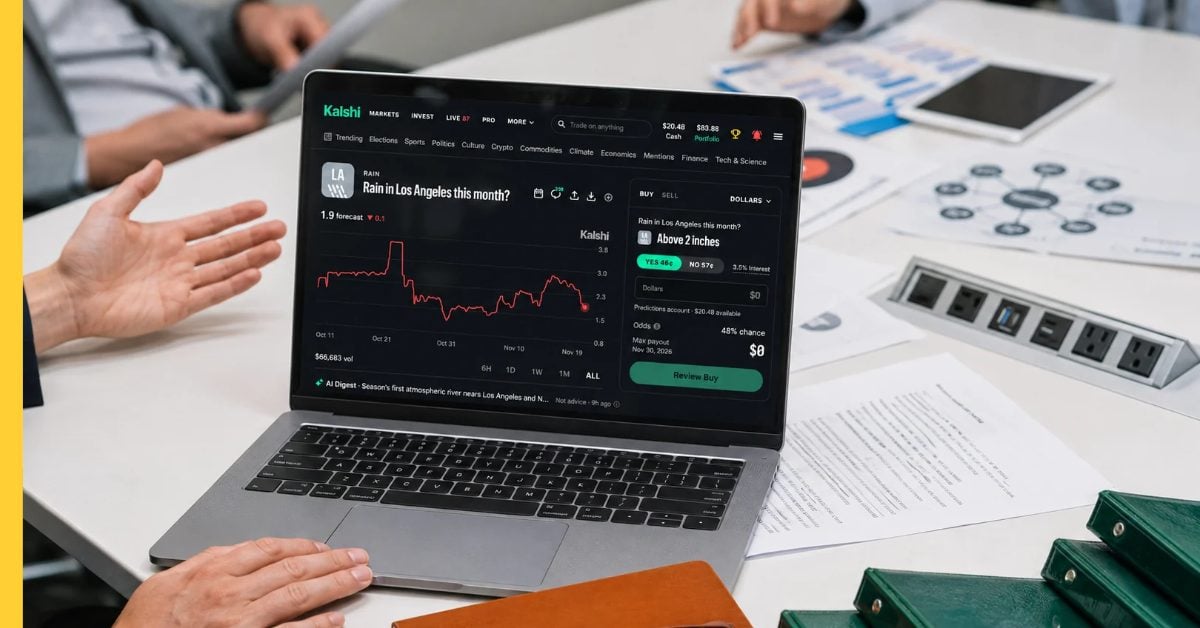
Kalshi is making the case that prediction markets serve a real economic purpose beyond speculation and entertainment, with several business owners telling federal regulators how event contracts have helped them hedge risks tied to sports, weather and other unpredictable events.
Promotional and event companies, bars and other merchants were among those supporting the Commodity Futures Trading Commission’s (CFTC) proposal to explicitly include event contracts in the federal definition of swaps. The rule would reinforce federal oversight of contracts tied to things like sports, politics, culture and weather, amid ongoing legal challenges from states seeking to regulate sports event contracts as gambling. Public comments on the rule for CFTC consideration closed Nov. 18.
The submissions describe businesses hedging against risks as varied as a shortened NBA Finals series, a World Cup cashback promotion and flight cancellations threatening a business conference.
Justin Robinson, owner of New York bar One4One, put $1,500 into a Kalshi contract that would pay $10,000 if the Knicks swept the Finals. Without a sweep, he wrote, there would be at least one more game, “which could bring our bar about $30,000 in sales.”
The sports-related examples are particularly relevant to the legal battle over whether sports event contracts qualify as swaps. The Commodity Exchange Act (CEA), the federal law governing derivatives markets, defines swaps to include certain contracts tied to events with a “potential financial, economic, or commercial consequence.” Federal appeals courts have split over whether sports outcomes meet that standard.
Kalshi has spent months promoting the commercial uses of event contracts, including sports markets, highlighting bars, retailers and other businesses on its small-business hedging website and social media. Several businesses featured in those promotions later submitted CFTC comments, including 28 Wishes, the Los Angeles ice cream shop that Kalshi profiled in August, before the rules were proposed.
Sports hedges meet a legal test
Sports contracts’ economic value has become a flashpoint in the courts. In the Fourth Circuit’s decision against Kalshi this week, Judge Stephanie Thacker concluded in a concurring opinion that sports contracts were not swaps. Dissenting Judge DeAndrea Gist Benjamin took the opposite view, pointing to financial risks for businesses near stadiums.
“Outcomes in professional and collegiate sports undeniably have economic consequences,” Benjamin wrote, citing ticket sales, broadcasting revenue and sponsorships. She nevertheless distinguished individual game and season contracts from parlays and player props she said could not reasonably be used to hedge.
The business owners’ CFTC letters, including Robinson’s, offer real-world examples of that commercial exposure.
Peter Bayne, owner of TallBoy in Washington, DC, described using Kalshi to hedge a World Cup promotion offering customers free tabs if Team USA won by a certain number of goals.
“I hedged the offer on Kalshi so the business was covered either way,” Bayne wrote.
Playably CEO Angelo Ferro cited a World Cup promotion for apparel brand Forme offering 100% cashback if Team USA reached the final. His company bought Kalshi contracts to cover up to $25,000 in potential refunds.
“We use these markets the way businesses use any hedging market,” Ferro wrote. “We place limit orders rather than taking whatever price is offered, hold positions for the length of a campaign, and use market prices to decide which promotions to offer and how to price them.”
“These brands are not speculating,” he added. “They are managing a real business liability.”
Business hedges extend beyond sports
Other business owners described using event contracts to manage risks ranging from unfavorable weather to major travel disruptions.
Brothers Jason and James Jiang, who run the 28 Wishes ice cream shop, submitted separate letters describing how they use Kalshi weather contracts to offset lost revenue.
“Weather has a direct and significant effect on our revenue. When it rains, or when the temperature drops to around 70 degrees, our sales fall roughly 30 to 40 percent. That is a real economic consequence for a small business,” James wrote.
Jason said he had traded Kalshi weather contracts for more than a year, initially spending around $20 to $30 daily.
“These positions helped offset earlier trades and some of the revenue losses caused by cold or rainy weather,” he wrote.
Another submission came from Pierre Lindh, co-founder and managing director of NEXTPredict, which owns NEXTPredict.io. Lindh described using an event contract to hedge potential disruptions to the company’s October prediction markets conference in New York City.
As NEXTPredict.io previously reported, the company spent approximately $12,000 on a position that could have paid $3m if at least half of inbound flights at JFK Airport were canceled on Oct. 21, the primary attendee travel day before the conference.
“We used flight cancellations as the trigger because bad weather and geopolitical instability can both keep delegates from getting to the conference. The contract didn’t have to tell us why the flights were cancelled to cover the risk we cared about,” Lindh wrote.
“In our business, I don’t know of a more powerful tool for protecting our ability to keep operating when something outside our control goes wrong,” he added.
A template for comment letters
Kalshi also encouraged customers to participate in the rulemaking through a dedicated advocacy website, offering a questionnaire that would generate a draft comment from their answers, which they could edit before submitting.
Several business-owner letters reviewed by NEXTPredict.io contain very similar language, particularly when distinguishing exchange-traded contracts from traditional sportsbooks and arguing for consistent federal regulation.
“I would never use a sportsbook to manage a real financial risk,” Bayne wrote.
James Jiang used the same wording, adding that he would prefer “a supervised U.S. exchange” over an offshore alternative.
Other letters repeatedly emphasized that prices are determined by traders rather than sportsbooks, positions can be sold before settlement and customer funds are held separately.
The submissions also echo a specific provision of the Commodity Exchange Act defining swaps as instruments “commonly known to the trade as a swap.”
“That is what commonly known to the trade as a swap means to me as someone who has actually used one,” Robinson wrote.
Kalshi makes its case for federal oversight
In its own Nov. 18 submission, Kalshi argued that sports, political, cultural and weather events can have economic consequences without regulators having to demonstrate a specific commercial use for every contract.
“Congress used the word ‘potential’ in the swap definition, signaling that the Commission need not empirically verify the economic consequences of each specific event,” Kalshi wrote.
The exchange cited additional sports-related examples, including the bar and restaurant Rizzo’s near Chicago’s Wrigley Field, which used event contracts to protect against a short Cubs playoff run, and Garden Bar in Austin, which hedged against fans leaving early if the Texas Longhorns fell far behind in a game.
Kalshi argued that even individual player statistics and in-game developments can have financial implications.
“Even in-game outcomes matter: a close game is more likely to draw higher television viewership than a blowout, and player contracts often carry bonuses tied to specific statistical results,” the company wrote.
Kalshi also backed the CFTC’s companion rule excluding casino-style gambling products from the definition of swaps, arguing that exchange-traded contracts and sportsbook offerings serve different purposes.
“An exchange-listed sports contract offers features that are not available on a sportsbook: transparent orderbook execution, central clearing, and access to exchange liquidity to sell the position at will,” Kalshi wrote.
But the distinction remains contested. States and gaming interests argue that offering sports contracts through a federally regulated exchange does not necessarily transform them into financial derivatives.
The business owners’ submissions illustrate Kalshi’s argument that event contracts can serve genuine commercial purposes, even as courts and regulators continue to debate how broadly the federal definition of swaps should apply.