
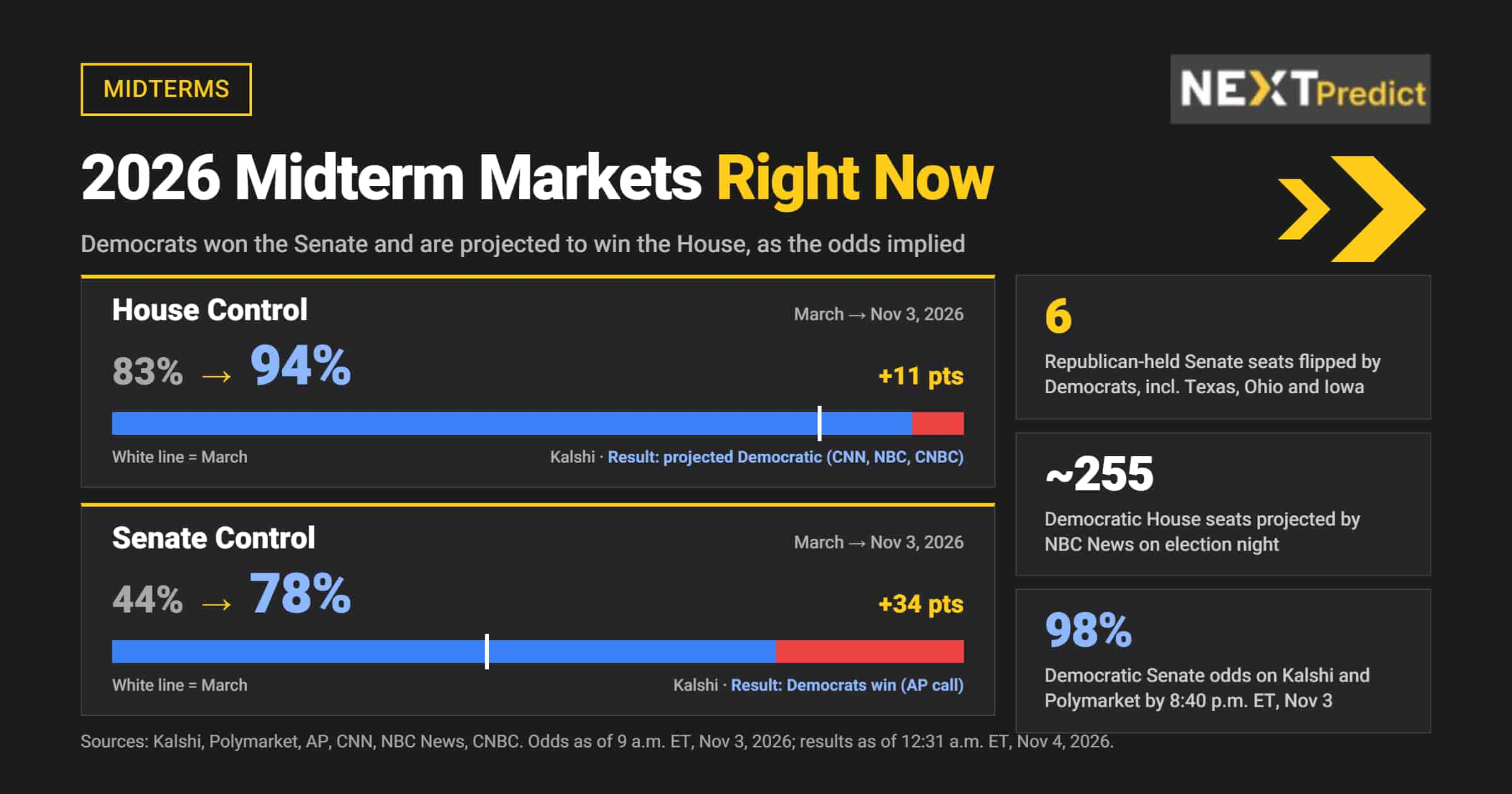
Democrats have won control of the Senate and the House in the 2026 midterms. As of 12:31 a.m. ET on November 4, 2026, the Associated Press had called the Senate for Democrats, while CNN, NBC News and CNBC had projected a Democratic House majority.
CNN’s projection positions Democratic leader Hakeem Jeffries to become the first Black speaker in US history when the new Congress convenes in January, and NBC News estimates Democrats will finish with 259 House seats (to Republican’s 176).
As of 9 a.m. ET on Election Day, traders on Kalshi and Polymarket put Democratic Senate control at 78%, up nearly 4 points in 24 hours. Both platforms gave Democrats a 94% to 95% chance of winning the House, and they priced a Democratic sweep of Congress at 76%.
Kalshi co-founder Luana Lopes Lara highlighted the speed of prediction markets compared with traditional election forecasting in a Tuesday night post on X. Lara said Kalshi had already priced Democrats at 99% to win the House and 98% to take the Senate when the New York Times‘ election-night Needle began forecasting control of both chambers at 8:37 p.m. ET.
This page tracks election market prices, the economic inputs driving them, and the certified midterm election results once polls close. For readers new to the format, see our Learn hub on how prediction markets work before diving into the data below.
2026 Midterm Election Results
Democrats flipped six Republican-held Senate seats after a series of major upsets: Texas (James Talarico over Ken Paxton), Kansas (Adam Hamilton over Sen. Roger Marshall), Iowa (Josh Turke over Ashley Hinson), North Carolina (Roy Cooper over Michael Whatley), South Carolina (Annie Andrews over Sen. Graham), and Ohio (Sherrod Brown over Sen. Jon Husted). Jon Ossoff held his seat in Georgia.
CNN and The New York Times projected Democrats would take Senate control, and the AP called the chamber for Democrats when Turek’s win in Iowa gave them at least 51 seats. Races in Michigan, Maine, and Alaska had not been called at last check.
Michigan’s Abdul El-Sayed was priced at 98.4% on Kalshi and 98.3% on Polymarket at 12:31 a.m. ET, and Alska’s Mary Peltola at 93.7% and 93%. Nebraska’s Pete Ricketts (R) was priced at 98% on Kalshi and 98.8% on Polymarket to hold his seat.
The House
In the House, CNN, NBC News and CNBC projected a Democratic majority on election night, with Jefferies expected to become speaker. NBC News counted 218 confirmed Democratic seats and 20 Democratic flips, and estimated Democrats will finish with about 255 seats. CNBC’s desk projected at least 235.
Texas delivered historic Democratic victories. CNN projected Talarico and Gina Hinojosa as the winners of the state’s Senate and governor’s races, despite heavy Republican campaign spending. Talarico is the first Democrat elected to the Senate from Texas since 1988, and Hinojosa, who defeated Gov. Greg Abbott, ends more than three decades of Republican control of the governship.
Eleswhere in the governor races, Democrats won Georgia (Keisha Lance Bottoms over Rick Jackson) and Ohio, where CNN projected Amy Acton over Vivek Ramaswamy, making her the first woman elected to governor of Ohio and the first Democrat to win the office since 2006. Rob Sand was projected the winner in Iowa. The Nevada and Kansas governor’s races had not been caled at last check.
How Prediction Markets Fared
Prediction markets called the direction of the night and saw dramatic reversals in individual races, according to our Election Day live updates blog. Kalshi’s Democratic House odds were at 97.2% by 6:42 p.m. ET, and both Kalshi and Polymarket had Democratic Senate control at 98% by 8:40 p.m. ET, up from about 72% to 74% hours before the first polls closed.
Hinjosa surged from 37% on Kalshi around 8:20 p.m. ET to 96.8% by 10:20 p.m. ET. In the Kansas governor’s race, Democrat Cindy Holscher climbed from 37% earlier on Tuesday, though her odds eased to 85% on Kalshi and 83.7% on Polymarket by 12:20 a.m. ET. Acton’s odds rose from 83% on Kalshi Tuesday morning to 99% before the race was called. The biggest misses were South Carolina, where Kalshi had Sen. Graham at 71% on the morning of November 3, and the Texas governor’s race, where Abbott was priced at about 61% on November 2.
What the Prediction Markets Showed Before the Polls Closed
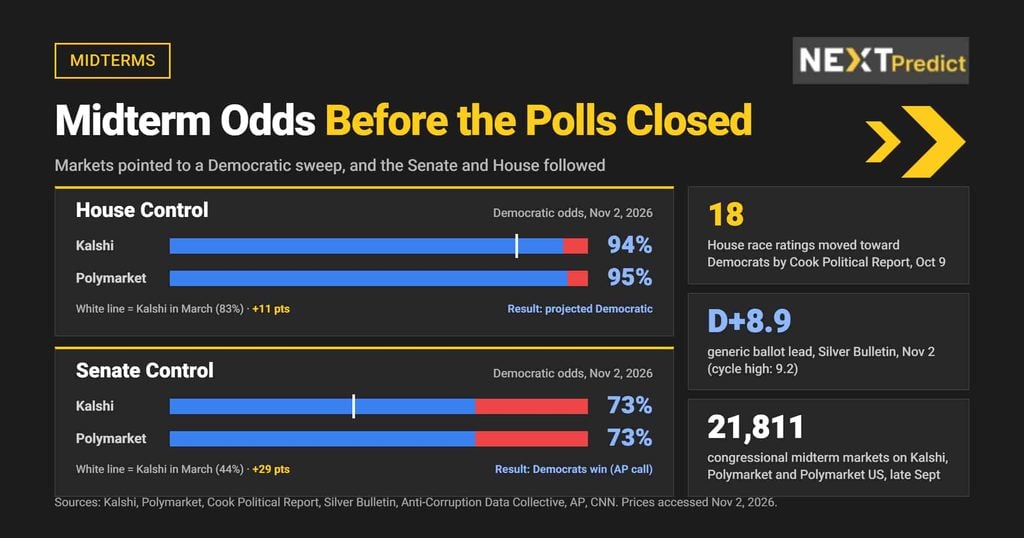
As of November 2, 2026, Kalshi and Polymarket favored Democrats to win the House by 88 to 90 percentage points and favored Democrats to win the Senate by about 46 percentage points. Democrats took the Senate and are projected to take the House, as the pre-election odds implied.
Since March, Kalshi’s implied odds of a Democratic House have risen from 83% to 94%, while its Senate contract has risen from 44% to 73%. On October 9, the Cook Political Report moved 18 House race ratings toward Democrats. Democrats also led the generic congressional ballot by 8.9 points in the Silver Bulletin average on November 2, 2026, just below the cycle high of 9.2.
Kalshi and Polymarket together list thousands of midterm election markets as of October 2026. An Anti-Corruption Data Collective count found 21,811 congressional midterm markets across Kalshi, Polymarket and Polymarket US in late September. Prices update continually.
The table below reflects data available as of the access date listed in the caption only.
Polymarket and Kalshi Midterm Odds
|
Race | Kalshi Price (11/2/26) | Polymarket Price (11/2/26) |
Implied Probability |
|
Republican House Control | $0.06 | $0.05 | Kalshi 6% | Polymarket 5% |
|
Democratic House Control | $0.94 | $0.95 | Kalshi 94% | Polymarket 95% |
|
Republican Senate Control | $0.27 | $0.27 | Kalshi 27% | Polymarket 27% |
|
Democratic Senate Control | $0.73 | $0.73 | Kalshi 73% | Polymarket 73% |
Midterm election results odds across Kalshi and Polymarket, accessed November 2, 2026.
See our page, Prediction Markets vs Polls to discover how each performs.
Chuck Todd: We Are Witnessing Trump’s Undoing
In this episode of the In this episode of the NEXTPredict Podcast, Chuck Todd, former NBC political director, longtime moderator of Meet the Press, and host of The Chuck ToddCast, joins Pierre Lindh to talk about the 2026 midterms, prediction market blind spots & the future of political forecasting.

Chuck is one of the few guests who can speak to both the political reality and the prediction market picture with genuine authority. In the conversation, recorded September 18, he says where he thinks the markets are right, where he thinks they are missing something, and what the final weeks of the campaign will tell us. Todd said he agrees with the markets on the Texas Senate race and would be more surprised by a Talarico loss than a win.
Todd hosted the NEXTPredict summit in New York on October 22 and 23, where he moderates a session on whether polls, models or the markets call the midterms best.
House Control 2026: Prediction Market Odds
House control is the most lopsided of the major midterm election results contracts. Democratic House control contracts traded at $0.94 on Kalshi and $0.95 on Polymarket as of November 2, 2026, while a Republican House majority was priced at $0.06 on Kalshi and $0.05 on Polymarket. Polymarket’s House control market has drawn about $19 million in volume.
History gives traders a base rate to weigh against the current price. The American Presidency Project found that the president’s party lost an average of 27 House seats and three Senate seats in the midterms from 1934 to 2022.
Republicans hold 218 House seats as of October 20, 2026, alongside one independent who caucuses with them, against 214 Democrats and two vacancies. Democrats need 218 seats for a majority. The Cook Political Report rates 213 seats as at least lean Democratic and 201 as at least lean Republican, with 21 toss-ups, in its October 9 ratings.
Of those 21 toss-ups, 15 are Republican-held and six are Democratic-held. Democrats need to win five toss-ups if every seat rated in their favor holds. Cook’s October 9 update projects Democratic gains of nine to 19 seats, which would give the party between 224 and 234 seats. On Kalshi, the most likely Democratic seat count as of October 29 is the “above 249” range at 24%, up eight points in a week, ahead of 238 to 241 at 13% and 234 to 237 at 12%.
NBC News’s election-night estimate of about 255 Democratic seats is above both Cook’s range and that Kalshi threshold.
2026 Senate Election Results and Market Odds
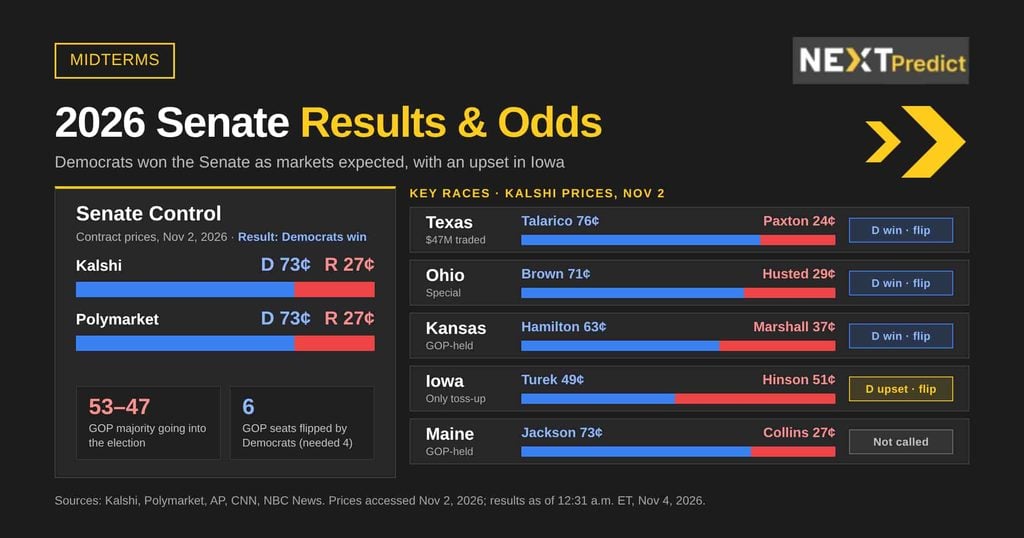
Kalshi priced Democratic Senate control at $0.73 and Republican control at $0.27 as of November 2, 2026. Polymarket priced the same outcomes at $0.73 for Democrats and $0.27 for Republicans over the same period. Kalshi’s Senate control market had drawn more than $63 million in volume as of October 15.
Texas carried the most volume of any individual Senate race on Kalshi, with about $47 million traded as of October 27, and the market reversed from June. Democrat James Talarico traded at $0.76 against Republican Ken Paxton at $0.24 on Kalshi as of November 2, 2026, and won the race. As of October 20, Polymarket priced Talarico at $0.63, with about $4 million traded on its Texas Senate market. A CBS News/YouGov poll released October 18 showed Talarico ahead 51% to 49%.
Iowa was Kalshi’s only Senate toss-up as of November 2, 2026, with Republican Ashley Hinson at $0.51 against Democrat Josh Turek at $0.49, while Kansas had swung to the Democrat at $0.63. Turek and Kansas’s Adam Hamilton both won. Maine had moved toward Democrat Troy Jackson at $0.73 against Republican Sen. Susan Collins at $0.27. Ohio’s special election priced Democrat Sherrod Brown at $0.71 against Republican Sen. Jon Husted at $0.29, and Brown won. Polymarket’s tightest Senate contract was also Iowa, where Hinson traded at $0.57 on October 19.
Republicans held the Senate 53 to 47 going into the election. Democrats need a net gain of four seats to reach 51, because Vice President JD Vance casts tie-breaking votes. The Cook Political Report named Alaska, Iowa, Kansas, Maine, Michigan, Ohio and Texas as toss-ups as of October 6, and six of the seven are Republican-held.
| Senate Race | Democratic Contract | Republican Contract | Cook Rating (10/6/26) | Result (12:31 a.m. ET, 11/4/26) |
| Texas | Talarico $0.76 | Paxton $0.24 | Toss Up | Talarico (D) wins, flip |
| Maine | Jackson $0.73 | Collins $0.27 | Toss Up | Not called; Jackson led the count |
| Ohio (special) | Brown $0.71 | Husted $0.29 | Toss Up | Brown (D) wins, flip |
| Michigan | El-Sayed $0.78 | Rogers $0.22 | Toss Up | Not called; El-Sayed priced at 98.4% on Kalshi |
| Alaska | Peltola $0.72 | Sullivan $0.28 | Toss Up | Results pending; Peltola priced at 93.7% on Kalshi |
| Iowa | Turek $0.49 | Hinson $0.51 | Toss Up | Turek (D) wins, flip |
| Kansas | Hamilton $0.63 | Marshall $0.37 | Toss Up | Hamilton (D) wins, flip |
Kalshi Senate race prices accessed November 2, 2026. Cook Political Report ratings as of October 6, 2026. Results per AP, CNN, and NBC News projections.
Governor Races: Prediction Market Odds 2026
Thirty-six states held gubernatorial elections in the 2026 midterm cycle, and a handful of races accounted for most of the trading volume. Kalshi traders favored Democrats in 22 of those races and Republicans in 14 as of October 20, 2026, with Georgia and Nevada priced as toss-ups. By November 2, Georgia and Nevada had moved to Democratic leans, and Texas had become Kalshi’s closest governor race, with Republican Greg Abbott at 61%. Hinojosa won it, surging from 37% on Kalshi around 8.20 p.m. ET on election night to 96.8% by 10:20 p.m. ET.
California’s governor race has drawn more than $66 million in volume on Kalshi alone, the largest on any governor race in 2026. Democrat Xavier Becerra priced at about $0.96 on Kalshi and Polymarket in mid-October 2026, against Republican Steve Hilton at about $0.04. No Republican has been elected California governor since 2006, which kept the contract priced heavily toward a Democratic outcome despite its size.
Ohio’s governor race had shifted toward the Democrat from June. Amy Acton traded at $0.83 on Kalshi as of November 2, 2026, against Republican Vivek Ramaswamy, a former 2024 presidential candidate, at $0.17. Her odds rose to 99% before CNN called the race, and she became the first woman elected governor of Ohio and the first Democrat to win the office since 2006. Acton led a CNN/SSRS poll 50% to 42% on October 8 and a New York Times/Siena poll 49% to 45% on October 4. President Trump rallied with Ramaswamy in Youngstown on October 12.
Georgia was the closest governor race on the board through late October. Kalshi priced Democrat Keisha Lance Bottoms and Repbulican Rick Jackson at 50% each as of October 20, 2026, while Polymarket had Bottoms at 53%. By November 2, Kalshi had Bottoms at 70% and Jackson at 30%, and Polymarket US had Bottoms at 71%. Bottoms, the former Atlanta mayor, won, becoming the first Black woman elected governor in US history if Georgia’s contract resolves in her favor.
The Economic Angle: What Is Moving Midterm Market Odds
Several economic and trade policy inputs are measurably moving how traders price contracts for midterms in 2026.
Tariff policy and midterm odds
The Supreme Court struck down the bulk of the tariffs the Trump administration applied to trade partners between 2025 and 2026. The administration replaced them with a 10% across-the-board tariff in February 2026 under Section 122, and that tariff expired on July 24, 2026. New Section 301 tariffs of 10% or 12.5% on about 60 economies took effect the same day. Allianz Research estimates the average US import tariff returns to about 12.4% by the fourth quarter of 2026.
Consumer confidence remains near record lows. The University of Michigan survey hit a record low of 44.8 in May 2026, when high prices and Strait of Hormuz supply disruptions weighed on households. The final October reading was 48.0, revised up from a preliminary 46.3, and just below September’s 48.1, and the lowest level in five months. A drop in consumer confidence has historically coincided with House seat losses for the incumbent party, in this case Republicans.
Presidential approval and midterm contract pricing
Historically, presidential approval below 50% has tracked with incumbent-party House seat losses at the midterm. Statistician Nate Silver’s Silver Bulletin average put President Trump’s net approval rating at 38.4% on November 2, 2026, with about 59% disapproving. The average recently hit an all-time low of 36.3% approval in late October, the lowest of either Trump term. Kalshi and Polymarket contracts for Democratic House control have risen alongside the decline in approval.
Economic data releases and midterm odds movement
Midterm contracts, including House and Senate control, can move on the same days key economic indicators publish. The Bureau of Labor Statistics reported on October 2, 2026 that employers added 29,000 jobs in September, well below the roughly 90,000 economists expected. The unemployment rate rose to 4.2%, and the report was the last jobs release before election day. Kalshi’s House contract stayed between 91% and 92% in the days that followed, and the October jobs report is scheduled for November 6, three days from now.
Kalshi and Polymarket: Midterm Election Contract Coverage
Polymarket Midterms Coverage
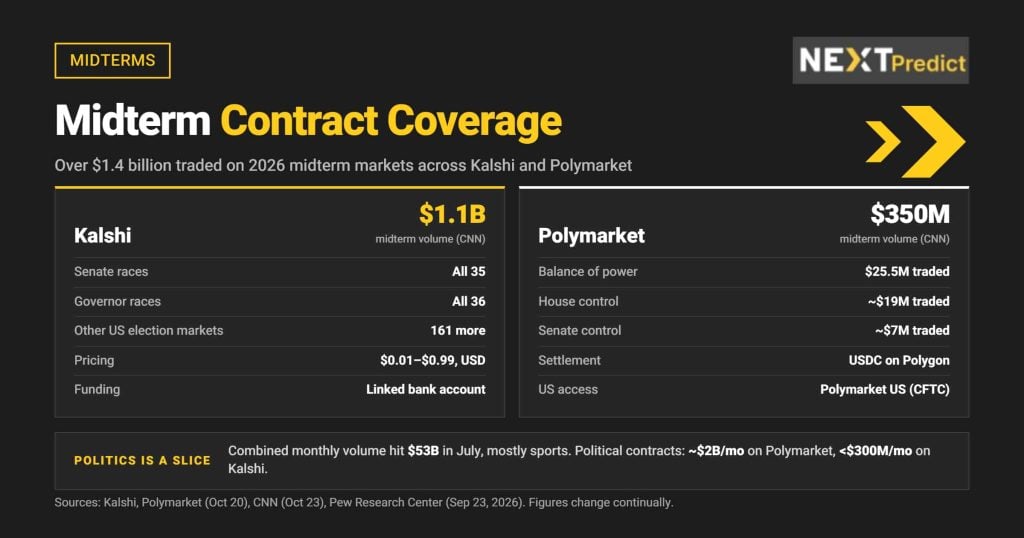
The Polymarket midterms hub lists contracts on House control, Senate control, balance of power, individual Senate, House and governor races, and conditional markets tied to oil prices and a Strait of Hormuz agreement. Its balance of power market has traded $25.5 million as of October 20, 2026, with its House control market near $19 million and its Senate control market near $7 million. Polymarket runs on the Polygon blockchain and settles in USDC. US traders access the platform through Polymarket US, which operates as a CFTC-regulated exchange.
Kalshi midterm elections coverage
This prediction market platform lists a market on every one of the 35 Senate races, all 36 governor races, House control, a balance of power contract and 161 more US election markets, though Kalshi does not publish an exact midterm contract count. Kalshi prices contracts in US dollars between $0.01 and $0.99. Its House control contract settles on a consensus of media calls, or on the party of the Speaker of the House on February 1, 2027 if no early call is made. Deposits and withdrawals run through a linked bank account.
Volume comparison
Politics remains a small share of total volume on both platforms. A Pew Research Center analysis published September 23, 2026 found combined monthly volume on Kalshi and Polymarket rose from $26 billion in May to $53 billion in July, predominantly on sports. Political contracts averaged about $2 billion a month on Polymarket in 2026 and under $300 million on Kalshi. A CNN analysis published October 23 put trading on 2026 midterm markets above $1.4 billion, with Kalshi reporting nearly $1.1 billion and Polymarket $350 million, and Bloomberg estimated on October 30, using Dune data, that cumulitive midterm volume on the two platforms was about $1.5 billion. A Washington Post analysis put election-related contracts traded on Kalshi and Polymarket at nearly $1.9 billion as of November 2.
Traders can review live contract counts and volume at Polymarket’s midterm election hub and Kalshi’s 2026 midterms section directly.
Polymarket and Kalshi Midterm Elections Odds
Kalshi is regulated by the CFTC, and Polymarket serves US traders through its CFTC-regulated Polymarket US exchange, so both list a host of CFTC event contracts specifically for midterm election results. As of November 2, 2026, Polymarket’s midterm markets indicated a Democratic sweep as the most likely outcome, with Democrats at 73% to win the Senate and 95% to win the House. These two main midterm odds markets attracted the highest volume, along with the ‘Balance of Power’ market, which priced a Democratic sweep at 77.5%, a Republican Senate with a Democratic House at 17.5% and a Republican sweep at 4.5%.
The story was similar at Kalshi, where Democrats were favored 94% to win the House and 73% to control the Senate as of November 2, 2026. Kalshi’s midterm elections odds differed slightly from Polymarket, and its Congress balance of power market priced a Democratic sweep at 75% on November 2, with a Democratic House and Republican Senate at 20%. Kalshi reports $216 million traded across its 2026 Senate, House, and governor markets.
Alongside the three most popular midterm prediction markets outlined above, both Kalshi and Polymarket have hundreds more on individual state elections on the Senate, House, Governor and Balance of Power. Digest NEXTPredict’s election betting odds hub for the latest movements, while sticking to this page for all the latest election results on midterms and more.
How Election Prediction Markets Work
An election prediction market contract is a binary event contract that resolves against a certified election outcome. The contract settles at $1.00 if the outcome occurs and $0.00 if it does not.
Operators verify outcomes against a published resolution source, typically an official state election certification, an Associated Press race call, or Federal Election Commission records. Each contract states its resolution source in advance.
A contract’s life cycle starts when a trader identifies an outcome, such as the winner of a Senate race or a yes-or-no ballot result. The trader reviews the contract price, which functions as implied odds: a contract priced at $0.75 implies roughly 75% probability. The trader buys the contract, holds or trades the position before resolution, and receives settlement once the outcome is certified.
Conclusion
Kalshi and Polymarket’s contract prices gave traders a continuously updated read on where the House, Senate, and key governor races stood, and the pre-election direction held: Democrats won the Senate and are projected to win the House. Markets underpriced Democrats in some races, including South Carolina and the Texas governor’s race, where prices reversed sharply as results came in, while tariff policy, presidential approval, and economic data releases moved prices into November 3, 2026. Some Senate and governor races remain uncalled, and certified results are still to come.
This page updates as new contract prices, economic data, and structural inputs publish, and it carries the certified midterm election results once they are final. For coverage of the broader category, visit the trending prediction markets hub.
Frequently Asked Questions
What do prediction markets say about the 2026 midterms?
Kalshi and Polymarket priced Democratic House control at 94% and 95%, respectively, and both priced Democratic Senate control at 73%, as of November 2, 2026. Those midterm elections odds left Democrats with roughly an 88-to-90-point advantage in the House contract and a 46-point advantage in the Senate contract. Both Democratic outcomes were reached on election night.
How do election prediction markets work?
An election prediction market contract is a binary yes-or-no derivative that resolves against a certified election outcome. Contracts trade between $0.01 and $0.99, and the price represents the market-implied probability of that outcome. Traders buy or sell their position before resolution, and once an outcome is certified, the contract settles at $1.00 or $0.00.
What is the prediction market for House control in 2026?
Kalshi priced House control at 94% Democrat and 6% Republican as of November 2, 2026. Polymarket priced the same contract at 95% Democrat and 5% Republican over the same period. Democrats were projected to win the House on election night.
What are the 2026 Senate election results?
Democrats won control of the Senate, according to the AP, CNN, and The New York Times, flipping Republican-held seats in Texas, Kansas, Iowa, North Carolina, South Carolina and Ohio, and holding Georgia. Thirty-five seats are on the ballot, including special elections in Ohio and Florida, and Republicans held a 53 to 47 majority before the election. Races in Michigan, Maine, and Alaska had not been called as of 12:31 a.m. ET on November 4. The Senate section above details current contract prices and implied odds for Senate control and individual races as of November 2, 2026.
Are midterm election prediction markets legal in the US?
Yes, when traded on a CFTC-regulated venue. Kalshi is a CFTC-designated contract market, and Polymarket serves US traders through its CFTC-regulated Polymarket US exchange. The CFTC withdrew a 2024 proposal that would have classed election contracts as gaming in February, and on June 10, 2026 it proposed a framework under which elections would not count as gaming. Some states have challenged event contracts in court, and on October 28, 2026 Utah’s attorney general filed criminal charges against Kalshi and its co-founders, which the CFTC is separately seeking to block in federal court. See our guides to whether Polymarket is legal in the US and the Kalshi legal states before trading on CFTC prediction markets.
How are tariffs affecting midterm prediction market odds?
Tariff-driven consumer price pressure coincided with a decline in President Trump’s approval rating, which the Silver Bulletin average put at 38.4% on November 2, 2026. Lower approval ratings track with incumbent-party House losses in past midterm cycles. Traders priced this relationship into House control contracts, which sat at $0.94 for Democrats and $0.06 for Republicans on Kalshi as of November 2, 2026.
Does Polymarket have midterm election markets?
Yes. Polymarket lists midterm contracts covering House control, Senate control, balance of power, and individual House, Senate, and governor races. Its balance of power market has traded $25.5 million and its House control market about $19 million as of October 20, 2026.
How accurate were election prediction markets in past cycles?
Prediction market accuracy has run competitive with traditional polling models in recent US election cycles. A University of Cincinnati analysis published December 6, 2024, found Polymarket’s implied odds outperformed traditional polls and pundits in the 2024 cycle. Kalshi reports that prices across more than 2.2 million resolved markets from 2021 to mid-2026 were well calibrated. Thin markets remain a caution, because research shared with CNBC found a $3,500 trade can move 97% of midterm-related markets by five cents or more.
Resources: Kalshi | Polymarket | NGA | Reuters | SCA | Pew Research (September 2026) | Cook Political Report | BLS | Silver Bulletin | Decrypt