
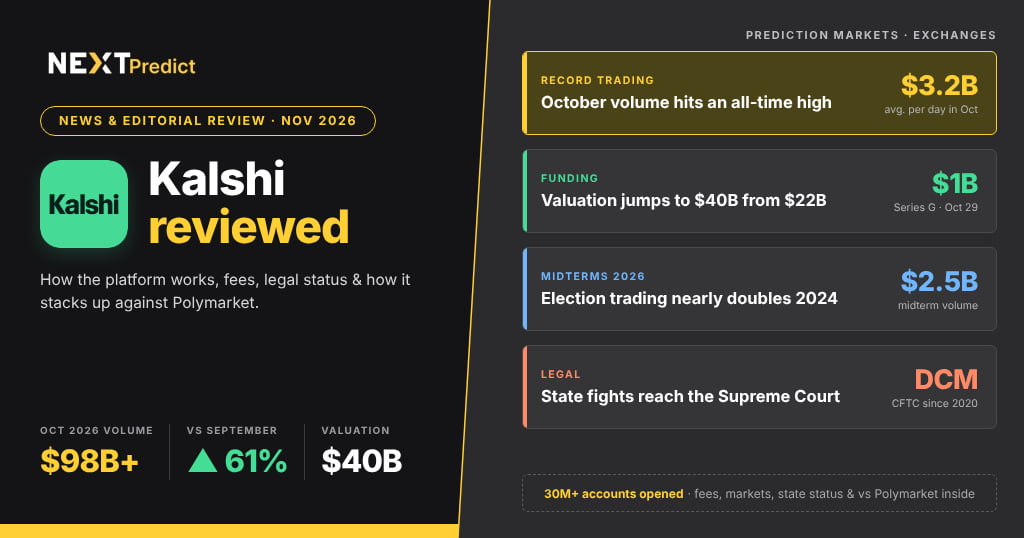
Kalshi is a U.S. prediction market exchange, regulated by the CFTC as a Designated Contract Market, where users buy and sell yes-or-no event contracts on sports, politics, economics and culture. Prices run from $0.01 to $0.99 and reflect implied probability. What people call Kalshi betting is technically trading against other users, not a sportsbook, with contracts settled in U.S. dollars.
Kalshi trading volume topped $98 billion in October 2026, a new record for the platform with trading on the 2026 Midterm elections helping to drive growth. Those types of numbers have kept many serious and more casual traders focused on Kalshi news over the last couple years along with information on the prediction market’s main competitor, Polymarket.
Monthly volume ran around $40bn in July and August before climbing to $60.85bn in September and $98.15bn in October. These numbers ballooned with NFL and college football and the run-up to the November 3 midterms helping to drive growth. The 2026 FIFA World Cup in the summer also introduced new users to the platform.
According to the company itself, the exchange now boasts more than 30 million open accounts as of October 2026. As of October 29, 2026, Kalshi was valued at $40 billion after a $1 billion Series G co-led by Wellington Management and Sequoia Capital, up from $22bn in May.
This page covers the latest Kalshi news alongside an editorial review of how the platform works. Readers will find recent developments, what Kalshi is, how it works, fees, legal status, and how it compares to Polymarket.
Recent Kalshi News and Developments
With a constantly changing menu of markets available for traders, Kalshi news has become more sought-after as users look to keep on the major headlines affecting the platform. Here is a quick look at some of the headlines the company made as of November 2026.
CFTC Weighs Charges
On November 10 and November 11, 2026, Kalshi was warned it may be charged over how it self-certified dozens of contracts. Kalshi calls it a procedural error, and no charges have been filed at the time of writing.
Record Midterm Trading
Over $2.5bn was traded on the 2026 midterms, nearly double the $1.3bn in 2024. The biggest market was House control, at $400.6m.
New State Actions
Utah filed criminal charges on October 28, 2026, Arkansas sued on November 4 and a federal court barred sports contracts on two California tribes’ lands on the same day.
World Cup Brings Record Trading
Kalshi began offering sports event contracts in 2025 and has steadily seen those numbers rise. As the FIFA World Cup played out in June and July, the platform saw record numbers including an average daily volume over $1 billion after the tournament got underway on June 11.
State-Level Legal Actions Continue
Over the last two years, Kalshi has been involved in several lawsuits against state gaming regulators, who allege the company has circumvented gaming laws. However, companies like Kalshi and Polymarket have argued they are regulated solely by the Commodity Futures Trading Commission (CFTC).
Meta Acquisition Considered
Reports also surfaced in July 2026 that Meta considered buying Kalshi before developing its own prediction market platform. CEO Mark Zuckerberg even met with CEO of Kalshi, Tarek Mansour in 2025 about a potential acquisition but talks ultimately fell through.
Additionally, CNBC reported in June 2026 a potential Kalshi IPO (initial public offering) could take place in 2026 or 2027. Until then, Kalshi stock is held privately. Kalshi continues making news on a daily basis in regard to trading volume, platform growth, Kalshi markets available, and more.
What Is Kalshi?
A CFTC-regulated prediction market platform, Kalshi offers event contracts settled in U.S. dollars. Traders engage in various markets with each other ranging from economics and elections to sports and culture.
The platform was founded in 2018 in New York City by Tarek Mansour and Luana Lopes Lara, both of whom graduated from the Massachusetts Institute of Technology. Mansour serves as chief executive officer and Lara is the company chief operating officer.
Prediction market operators like Kalshi must be a DCM under CFTC regulations to operate legally. The operator received licensing in 2020, five years before Polymarket’s November 2025 designation.
Kalshi markets and trading volume
As of November 2026, Kalshi users are able to choose from hundreds of active markets, with over 500 NFL-related contracts alone. Some of the platform’s most popular categories included sports, politics, and economics. Sports have proven particularly popular for the exchange, with event contracts in the category accounting for 78-81% of total Kalshi trading volume.
As an example of trading volume, the U.S. was set to play Belgium in the FIFA World Cup Round of 16 on July 6. Trading volume reached $17.5 million a few hours before the match with 53% of funds flowing in on the U.S.
As with other event contracts on the platform, highly liquid markets offer a percentage on the likelihood of the event actually occurring. In this instance, traders were giving the U.S. a 53% chance to win.
Beyond sports, prediction markets like Kalshi offer insight on other critical scenarios, such as elections, economics, and geopolitics. Kalshi and Polymarket first gained some notoriety as the 2024 U.S. presidential election played out. Kalshi trading gave Donald Trump the advantage in the days before ballots were counted and this projection proved to be accurate.
Since then, even news gathering operations like CNN and Fox News have partnered with the company as prediction markets have become a focus of election coverage beyond traditional polling.
How Does Kalshi Work?
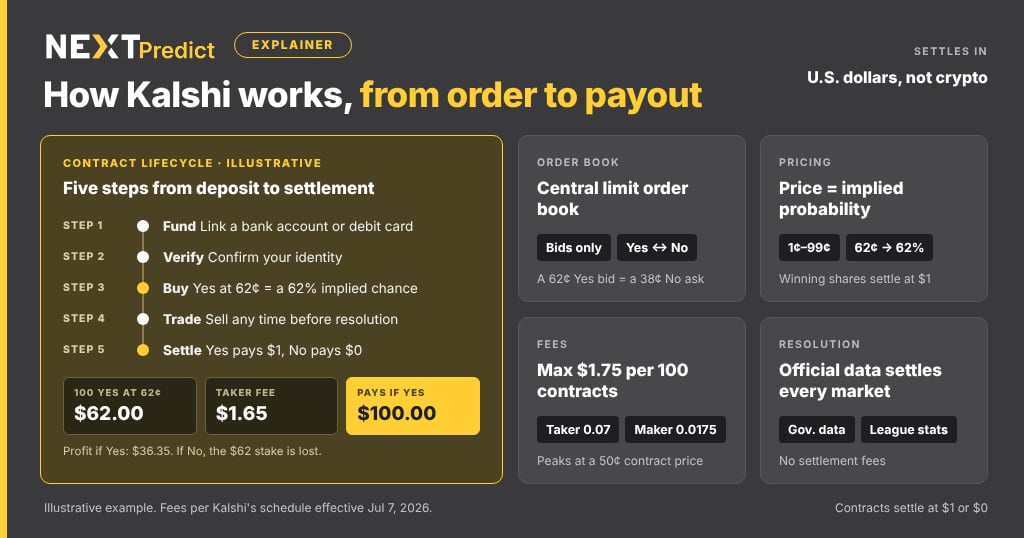
Kalshi is a prediction market exchange where users can take positions on varying issues and events and whether they occur in the future. Unlike a sportsbook, you can enter and exit a market at any time with prices at $0.01 to $0.99 before an event reaches a resolution.
These prices can fluctuate based on trading and growing liquidity. Kalshi is a U.S. dollar-based platform, not based on blockchain architecture like Polymarket. Here’s a look at some of the key features of the Kalshi platform.
Order book structure
Kalshi makes use of a central limit order book (CLOB) structure as a binary prediction market. This allows the exchange to match buyers and sellers on markets across the platform. The order book is unique and only returns bids, not asks from traders.
This structure depends on the mutual relationship between “yes” and “no” positions. Unlike Polymarket, Kalshi event contracts are settled in U.S. dollars rather than via crypto on a blockchain.
Contract lifecycle
Funding an account on the Kalshi app or via a desktop computer is a simple and straightforward process. Users must link a U.S. bank account or debit card to begin the funding process. Kalshi also accepts deposits using Venmo, Apple Pay, Google Pay, and PayPal.
New traders will have to verify their identity. Once complete, you scan various regular and trending markets and place orders for shares as desired.
Resolution process
Seeing a market reach a result is known as “resolution” in the world of prediction markets, and Kalshi and other regulated prediction market operators use verifiable information to resolve contracts. These designated data sources include “authoritative government agencies, official league statistics, and certified financial authorities,” according to the company’s customer help documentation.
Kalshi pricing and implied probability
Prediction market shares are priced at $0.01 to $0.99 until settlement, when winning shares are then priced at $1 each and losing shares are priced at $0 each. Until resolution, trading continues and the price at any one time reflects the probability of the event occurring.
For example, a price of $0.62 for the Fed to raise interest rates would imply a 62% chance of a rate hike in the real world.
Liquidity note
Kalshi offers a wide range of market categories, and sports has been the largest since the platform began offering markets on March Madness (the U.S. NCAA basketball tournament) in 2025. Sports markets now reportedly account for more than 78% of trading volume on the exchange.
Other popular markets include politics, culture, and major economic events. These usually carry lighter spreads and easier execution than thinly traded markets.
Kalshi Fees
Kalshi fees are paid at the time of a trade. Fees vary based on the order type and the contract’s probability, typically ranging from $0.07 to $1.75 per 100 contracts at a 50¢ price.
Pricing is divided into fees paid by “takers” and those for “makers.” A “taker” is a trader who instantly matches with an existing, resting order in the order book. This is similar to a market order on other financial markets. These users aren’t setting their own price and immediately remove liquidity from the market, so they typically pay higher fees than “makers.”
A maker puts in a resting limit order on the platform to purchase or sell event contracts at a specified price. This gives liquidity to the order book and incurs smaller fees.
According to Kalshi’s fee schedule, trading fees are charged as a variable percentage fee of the expected earnings on an individual contract. This is worked out by multiplying the contract’s maximum potential earnings by the implied probability of making such earnings, or the price of the contract divided by $1.
Here’s a look at how the platform calculates fees for takers:
- fees = round up (0.07 x C x P x (1-P))
- C = the amount of contracts being traded
- P = price of a contract in U.S. dollars (50 cents is 0.5)
- round up = rounds to the next cent
For makers, substitute the lower 0.0175 for 0.07 in the equation above.
Kalshi fee schedule
| Kalshi fee | Amount (schedule effective July 7, 2026) |
| Taker trading fee | Round up (0.07 x C x P x (1-P)), from $0.07 to $1.75 per 100 contracts |
| Maker trading fee | Round up (0.0175 x C x P x (1-P)), charged only when a resting order fills and only on series where the multiplier applies |
| Settlement fee | None |
| ACH deposit/withdrawal | Free |
| Wire | Free deposits, withdrawals only from $500,000 |
| Debit card, Apple Pay, Google Pay, PayPal, Venmo | Up to 2% |
It’s important to note that Kalshi doesn’t charge any settlement fees. There are also no fees for bank or wire transfers, although wire withdrawals aren’t supported under $500,000, to fund an account or to move profits out of an account. However, funding via debit cards, Venmo, Apple Pay, Google Pay, and PayPal come with up to a 2% processing fee.
Kalshi fees vs. Polymarket Fees
Polymarket generally charges a 0.1% taker fee in the U.S. but also with varying amounts between $1.74 and $2.38 by category. This can range from 0% for geopolitical events, 0.75% for sports, and up to 1.8% for crypto on their global platform.
Kalshi fees are based on the equations above and generally max out at about $1.75 per 100 contracts. Polymarket accounts make use of USDC, a U.S. dollar-pegged stablecoin, and the pUSD on the Polygon blockchain, which is a collateral token used for all trading on the platform, whereas Kalshi uses U.S. dollars.
Kalshi App Review
Using prediction market apps makes trading in event contracts an easy process. The Kalshi app is available on both iOS and Android. As of November 2026, the current version for Android devices was 9.10.28 with the latest Apple iOS devices supporting version 9.10.35.
At the Google Play Store, the Kalshi app earned 4.7 stars with more than 162,000 reviews, as of July 2026. Apple users gave the app a 4.8 after more than 688,000 reviews.
With the app, you can easily browse markets and categories, track your positions, place orders, keep up with your portfolios, and create and fund an account. Those interested in gauging the likelihood of certain events and outcomes can easily check those markets and look at the probability of various results, whether they own a position in a certain market or not.
Kalshi traders also have the option of using a desktop computer to access the exchange and will find minimal differences between the two formats. Some users find the desktop version less compact and cluttered while others prefer the ease of access and use on a mobile phone or tablet.
Is Kalshi Legal in the U.S?
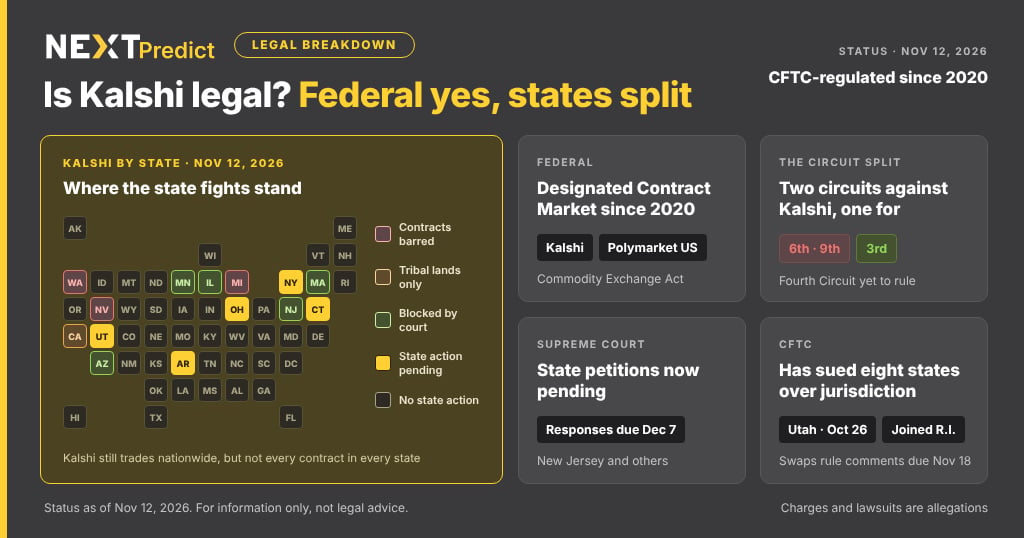
Yes, Kalshi (and Polymarket) are legal and licensed by the CFTC as a DCM license. This distinction allows the prediction market to legally offer event contracts, swaps, and perpetual contracts to American traders.
Kalshi received the DCM approval in November 2020, about five years before Polymarket. Because of the earlier approval, Kalshi has operated under federal oversight for materially longer than Polymarket.
These platforms are regulated at the federal level, but this assertion faces challenges by several states throughout 2025 and 2026. State gaming regulators argue the platforms violate state gaming laws. However, companies like Kalshi and Polymarket have argued they only fall under the purview of the CFTC.
This has led to several court cases involving Kalshi and others in the industry in both federal and state courts, with varying rulings. The CFTC itself also stepped in and sued states like New York, Arizona, Connecticut, Illinois, Wisconsin, Utah and Minnesota in an attempt from those states attempting to regulate prediction markets at the level. The commission also sued the state of New Mexico in June 2026 and has joined a Rhode Island case.
In September 2026, Kalshi Klear, Kalshi’s affiliated clearinghouse, asked the CFTC to approve margin trading for selected financial event contracts.
Separately, the CLARITY Act, a crypto market-structure bill, passed the House in July 2025 but failed a Senate cloture vote 49-50 on September 15, 2026.
Kalshi legal status
| Kalshi legal status | Detail (as of November 12, 2026) |
| Federal | CFTC DCM since November 2020 |
| Supreme Court | Petitions from New Jersey and others pending, responses due December 7, 2026 |
| 3rd Circuit (NJ) | Rule for Kalshi, 6 April, 2026 |
| 9th Circuit (NV) | Ruled against Kalshi, August 28, 2026. Rehearing denied November 4 |
| 6th Circuit (OH, TN) | Ruled against Kalshi, September 25, 2026. Rehearing pending |
| 4th Circuit (MD) | Argued May 7, 2026. No decision yet |
| CFTC rulemaking | Proposed rule (October 9) to define sports and political contracts as swaps, comments due November 18 |
State-by-state legal status
| State | Kalshi status (November 12, 2026) |
| Nevada | Sports, election and entertainment contracts bared (state injunction, May 2026) |
| Washington | Most non-financial categories barred (state injunction, July 2026) |
| Michigan | Sports contracts barred (stat injunction, September 1, 2026) |
| California | Available, except sports contracts on two tribes’ lands (November 4, 2026) |
| Arizona, Illinois, New Jersey, Minnesota, | Available, state enforcement blocked by federal court |
| Massachusetts | Available, state injunction stayed pending appeal |
| Utah, New York, Ohio, Connecticut, Arkansas | Available, state action pending |
| Other states | Available national, though not every contract in every state |
Kalshi vs Polymarket
Kalshi and Polymarket are currently the largest CFTC-regulated prediction market firms available to American traders. While these platforms have some similarities, there are some key differences between them. Here’s a look at how the platforms compare to each other.
| Kalshi | Polymarket | |
| CFTC regulatory status | Designated Contract Market (DCM) | Designated Contract Market (DCM) |
| Settlement asset | U.S. dollars | USDC stablecoin |
| Deposit methods | U.S. bank account transfers, wire transfers, debit cards, Venmo, Apple Pay, Google Pay, PayPal | Crypto transactions |
| Fee structure | Typically ranging from $0.07-1.75 per 100 contracts. Pricing is divided into fees paid by ‘takers’ and ‘makers’ | $1.74-2.38 (Polymarket US), 0-1.75 (Polymarket global) |
| Market count | Thousands of markets | Thousands of markets |
| Participant profile | Casual traders, financial speculators, market makers, interested parties in the probability of certain scenarios playing out | Crypto-savvy digital traders, institutional users like hedge funds and arbitrage traders, and casual news consumers |
Notable Kalshi Markets
Traders following Kalshi news will have an interest in some of the more popular Kalshi markets. The FIFA World Cup still holds the single-event record, with Kalshi reporting more than $22.4bn in tournament volume by July 14, days before Spain beat Argentina in the final. Since then, NFL and college football have taken over.
Over the weekend of November 7-8, Kalshi trading topped $10.6bn, about 74.5% of all tracked prediction market volume. NFL event contracts on Green Bay vs. New England drew more than $47 million on Kalshi, with Cincinnati vs. Atlanta close behind at $41m.
Politics has been the other big driver. Kalshi says more than $2.5bn was traded on the 2026 midterm elections, almost double the $1.3bn traded during the 2024 cycle. Market favorites won 479 of the 487 races resolved by the morning after election day, and the House control market passed 99% for Democrats at 8:10 p.m. ET on election night.
Economic markets remain a staple. Kalshi’s market on the Federal Reserve’s December 9 decision had traded about $10.5m by mid-November. After the Fed held rates at 3.75%-4.00% in October, traders were pricing a 25-basis-point hike at roughly 86%.
| Kalshi market category | Recent market |
| Sports | About 78-81% of volume. 2026 FIFA World Cup $22.4bn, per Kalshi |
| Politics | $2.5bn midterm volume, House control $400.6m |
| Economics | Fed rate decisions, CPI |
| Perpetual futures | $83bn traded since launch |
| Culture, crypto, climate, mentions | Smaller, thinner markets |
Conclusion
Kalshi news has moved quickly in 2026, with record trading during the World Cup, in October and around the midterms. Investors now value the platform at $40 billion, and it still operates under CFTC oversight. Its legal fight with several states remains unresolved.
This page has covered how Kalshi works, what it costs to trade and where it stands under federal and state law. It has also compared Kalshi with Polymarket, its main regulated rival. The FAQs below give quick answers to the most common questions.
Frequently Asked Questions
What is Kalshi?
Kalshi is a CFTC-designated prediction market platform allowing users to trade event contracts settled in U.S. dollars. Traders buy and sell binary yes-or-no contracts based on the outcomes of real events and scenarios. The platform features categories like politics, economics, and sports.
How does Kalshi work?
Traders first fund an account via a linked bank account, debit card, or other deposit option. Users then buy or sell event contracts through Kalshi’s central limit order book. Contract prices serve as the implied probability of the result occurring.
Traders can enter or exit a market at any time until settlement, selling shares at a profit or cutting losses when they exit. Contracts trade between $0.01 and $0.99 until settlement, when winning shares pay $1 and losing shares pay $0.
Is Kalshi legal in the US?
Yes, Kalshi received Designated Contract Market (DCM) status from the CFTC in November 2020. This status allows the company to offer event contracts to traders across the country under federal regulation.
What are Kalshi’s fees?
Kalshi charges trading fees when someone makes a trade. Fees typically range from $0.07 to $1.75 per 100 contracts. Kalshi splits pricing between “takers” and “makers,” with makers generally paying lower fees.
What is Kalshi stock?
Kalshi is a private company, so its stock doesn’t currently trade on any public stock exchange. As of November 2026, investors valued the company at $40 billion following its latest funding round, which raised $1 billion.
Is Kalshi planning an IPO?
Some reports note the company is gearing up for an IPO either in late 2026 or 2027, but Kalshi hasn’t announced an official date as of November 2026.
How does Kalshi compare to Polymarket?
Both platforms hold CFTC DCM status and operate under federal regulation. However, they differ in how users fund accounts and how each platform pays out winning contracts.
Kalshi uses U.S. dollars through standard banking options, while Polymarket settles in the USDC stablecoin and pUSD on the Polygon blockchain. Kalshi’s markets center on sports, politics, and economics, while Polymarket has become popular with traders interested in crypto.
Does Kalshi have an app?
Yes. Kalshi’s app is available on iOS and Android and offers the same core market-browsing, position tracking, and order-placement functionality as one would experience on the desktop version. As of November 2026, the current version for Android devices was 9.10.28 with version 9.10.35 the latest on Apple iOS devices. The app earns 4.8 stars in the App Store (688,000+ reviews) and 4.7 stars in the Google Play Store (162,000+ reviews).
Who owns Kalshi?
Founders Tarek Mansour and Luana Lopes Lara, plus investors including Sequoia, Wellington, a16z and Coatue.
Resources: CNBC | The New York Times | New York Times Dealbook | NPR | Kalshi | CFTC | Sports Business Journal | Axios | Reuters | DeFi Rate | Covers