
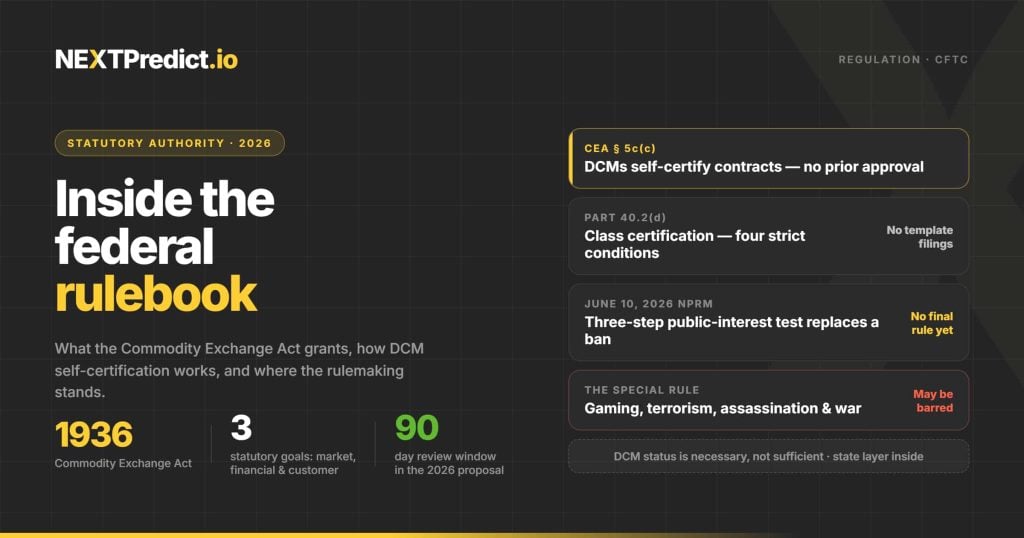
CFTC event contracts operate under a specific grant of federal authority, not a general assumption of oversight. The Commodity Futures Trading Commission draws its jurisdiction over event contracts, often called CFTC prediction markets in industry and media coverage, from the Commodity Exchange Act (CEA), the 1936 statute governing derivatives trading in the United States. Congress built the CEA around three goals: market integrity, financial integrity, and customer protection.
An exchange earns Designated Contract Market (DCM) status only after the CFTC determines it can meet those goals. DCM status lets prediction market platforms list and settle event contracts, subject to ongoing federal oversight. It does not, on its own, settle every question a contract category raises.
This page explains what that statutory grant covers, how DCM status and Part 40 self-certification work in practice, and where CFTC rulemaking on event contracts, including sports-related contracts, currently stands. It is one part of a larger, still-developing regulatory picture. For the framework overview across prediction markets, see the Regulation hub. If your question is whether a state gaming regulator can reach a specific contract category, or if your question is whether a named operator is legal in your state, see the Legal hub.
What Are Event Contracts
An event contract is a type of derivative contract. Its payout depends on the occurrence, or the extent of an occurrence, of a specific future event. The contract is listed and settled on a CFTC-regulated exchange. Event contract is the CFTC’s formal regulatory term for this instrument.
Prediction market is the broader, informal term for the same underlying instrument. It appears across trade press, consumer platforms, and everyday conversation. NEXTPredict uses event contract when referring to the regulated product itself, and prediction market when referring to the industry built around it.
The CFTC has addressed event contracts across a wide range of categories, including economic and financial indicators, elections, weather, and, most contentiously, sports outcomes. Which categories the CFTC currently restricts, and under what conditions, is a separate and fast-moving question, covered in the CFTC Rulemaking section below. This section defines the instrument. It does not assert a current rule status for any category.
An exchange must hold Designated Contract Market (DCM) status to list event contracts for trading in the United States under CFTC oversight. The next section explains what that status requires.
CFTC’s Statutory Authority: The Commodity Exchange Act
The CFTC’s jurisdiction over event contracts comes from the Commodity Exchange Act (CEA), codified at 7 U.S.C. Chapter 1. The CEA gives the CFTC authority over commodity futures, options, and other derivatives, a category the Commission and the courts have interpreted to include event contracts structured around an excluded commodity, defined in CEA Section 1a(19)(iv) as an occurrence, extent of an occurrence, or contingency.
Three goals anchor the CEA’s regulatory design:
- Market integrity – contracts free from price manipulation and other distortions
- Financial integrity – sound pricing and protected transaction funds
- Customer protection – safeguards against fraudulent or abusive sales practices and misuse of customer assets.
State gaming law pursues a related but separate set of goals, built around licensing and consumer protection at the state level. This page does not resolve which framework controls a given contract category. That question is addressed in the What DCM Status Does Not Resolve section below.
The Special Rule
CEA Section 5c(c) gives a Designated Contract Market a self-certification pathway. A DCM lists a new contract, including an event contract, by certifying to the CFTC that the contract complies with the CEA and CFTC regulations, without seeking the Commission’s prior approval. The CFTC retains authority to review a self-certified contract after listing. Under Section 5c(c)(5)(C), often called the Special Rule, the Commission can also determine that a contract involving specific enumerated activities, including gaming, terrorism, assassination, or war, is contrary to the public interest and therefore prohibited from listing. Part 40 of the CFTC’s regulations govern the mechanics of that self-certification and review process, covered in the next section.
The CFTC’s application of this authority to sports-related event contracts specifically has been an active and litigated question through 2026. Verify the current posture directly against CFTC.gov, the Federal Register, or eCFR before citing a specific status. Do not rely on this paragraph, a previous draft of this page, or general background knowledge for that determination.
Designated Contract Market Status and Self-Certification
Designated Contract Market (DCM) status is the CFTC’s authorization for an exchange to list and settle commodity contracts, including event contracts, under a defined set of core principles. Those principles cover market surveillance, the financial integrity of transactions, and the protection of market participants. A DCM offers access to all types of traders, including retail participants, the same structure traditional futures exchanges use for commodities such as corn or crude oil.
Part 40 of the CFTC’s regulations sets out how a DCM lists a new event contract. Under Section 40.2(a), a DCM self-certifies an individual contract by submitting its terms along with a certification that the contract complies with the CEA and CFTC regulations, without waiting for prior Commission approval. The CFTC retains authority to review a self-certified contract after listing and can stay or require withdrawal of a certification it finds inadequate.
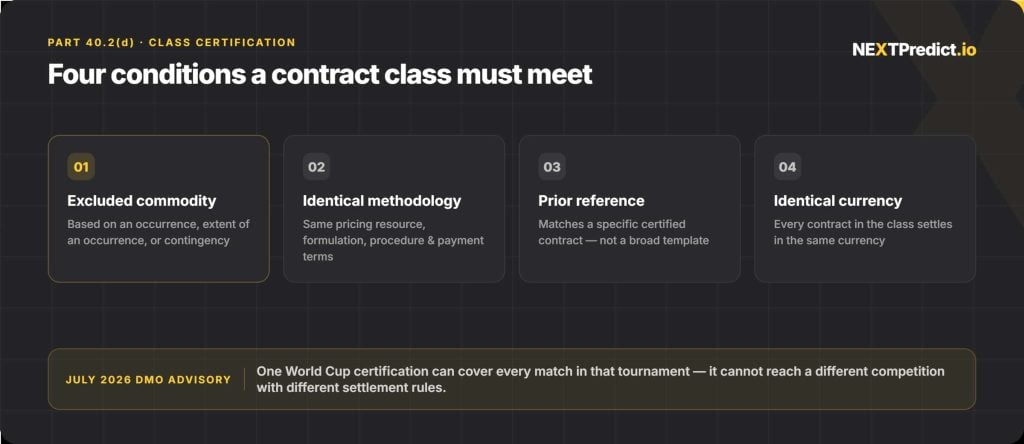
A DCM also has the option to certify a class of related event contracts together, under Section 40.2(d), rather than filing each one individually. That class certification is available only where every contract in the class meets four conditions:
|
Requirement |
What it means |
|
Excluded commodity |
Each contract is based on an occurrence, extent of an occurrence, or contingency, the CEA’s definition of an excluded commodity. |
|
Identical methodology |
Each contract shares an identical pricing resource, formulation, procedure, and methodology for determining reference prices and payment requirements. |
|
Prior reference |
That methodology matches a specific, previously certified or approved contract, not a broad template. |
|
Identical currency |
Each contract in the class involves the same currency or currencies. |
This structure has a real limit. In a July 2026 advisory, the CFTC’s Division of Market Oversight reminded DCMs that broad, template-style certifications covering many possible contract variations under one filing do not satisfy Section 40.2’s requirements, because they leave staff unable to evaluate the settlement methodology and manipulation risk of each individual contract.
The advisory illustrated the distinction with an example: a DCM can self-certify a series covering every match in a single tournament, such as the 2026 FIFA World Cup, by referencing one prior, specific contract certified for that tournament under the same methodology. It cannot use that same reference to certify contracts for a different tournament, such as the 2026 MLS Leagues Cup, because the two competitions apply different settlement rules.
Kalshi is one example of a real, CFTC-designated exchange operating under this framework. The CFTC issued Kalshi its DCM designation in November 2020, and Kalshi lists event contracts across categories including politics, weather, sports, and economic indicators. Naming this exchange illustrates how the self-certification mechanism operates. It does not address the exchange’s legal status in any specific state.
Retail Access
Retail access to event contracts also extends beyond the DCMs themselves. Robinhood Derivatives, LLC, a CFTC-registered futures commission merchant, offers customers access to event contracts listed on DCMs, including KalshiEX. The DCM listing the contract, not the intermediary offering access to it, carries the DCM designation.
DCM status authorizes federal listing and oversight of a contract. It does not, by itself, foreclose a separate argument that a state gaming regulator can raise about the same contract category.
CFTC Rulemaking on Event Contracts: History and Current Status
CFTC rulemaking on event contracts has moved through several distinct postures since 2024, and sports-related contracts have drawn the most activity. In 2024, the prior Commission proposed a rule that would have categorically treated political and sports-related event contracts as contrary to the public interest. The Commission never finalized that proposal. In February 2026, the current Commission formally withdrew it, citing state regulatory actions and litigation over the CFTC’s exclusive jurisdiction over event contracts.
On June 10, 2026, the CFTC published a new Notice of Proposed Rulemaking (NPRM) amending Regulation 40.11 and adding Appendix F to Part 40. Rather than a categorical prohibition, the 2026 proposal sets out a contract-by-contract framework: a three-step test asking whether a contract involves an excluded commodity, whether it involves an enumerated activity under the CEA’s Special Rule (unlawful activity, terrorism, assassination, war, or gaming), and, if so, whether listing it is contrary to the public interest. The proposal would also define gaming for the first time and set procedural protections, including a 90-day review window and a right for the exchange to respond to Commission concerns before a final determination.
The public comment period on the 2026 NPRM closed on July 27, 2026.
No Final Ruling
As of this page’s last verification date, the Commission has not published a final rule. Confirm the docket’s current stage directly against the Federal Register or CFTC.gov before citing a specific status, since a rulemaking of this kind can move from proposed to finalized, or be withdrawn, within weeks. For the Commission’s own rulemaking calendar and docket search tools, see CFTC.gov’s Final Rules, Guidance, Exemptive Orders and Other Actions page and the Federal Register’s docket search.
The pace of change reflects a structural reality. CFTC rulemaking priorities shift with a change in agency leadership, and litigation testing the CFTC’s authority, including KalshiEX LLC v. CFTC, continues alongside the rulemaking docket.
What DCM Status Does Not Resolve
Designated Contract Market status and the state gaming law question sit under different statutes entirely. A federal DCM designation does not, on its own, determine whether a state gaming regulator can separately assert jurisdiction over the same contract category.
Several state regulators argue that event contracts tied to sports and election outcomes function the same way a state-licensed wager does, regardless of the federal designation. Arizona’s attorney general brought the first criminal case testing that argument against a DCM, in March 2026. Operators and the CFTC counter that a federally designated contract is governed by federal law, which pre-empts conflicting state statutes in their view, a position that has prevailed in several federal courts to date.
Compliance, Market Integrity, and Customer Protection Standards
DCM status carries ongoing operational obligations, not a one-time approval. The CFTC’s core principles require a DCM to maintain diligent market surveillance capable of detecting and responding to contract manipulation, to preserve the financial integrity of every transaction and its clearing, and to protect customer funds. DCMs also publicly disclose contract terms and provide trading data to the Commission.
For event contracts specifically, this means each contract settles against a defined, publicly verifiable outcome source, and a DCM must be able to explain, and defend, the reliability of that source if the Commission asks. Where applicable, the CFTC also has authority to impose position limits or additional reporting requirements on a specific contract or category.
DCM Core Principle 3 addresses the prevention of manipulation and price distortion specifically, a standard the Commission applies directly to event contract settlement sources, given the incentive a binary payout creates to influence the underlying data. A DCM is expected to evaluate the commercial acceptability, public availability, and timeliness of any price series it uses for cash settlement before listing a contract that relies on it.
For counsel, these are the standards a client’s DCM status is measured against in a Commission review or enforcement matter. But for an investor, these are the operational safeguards that distinguish a CFTC-regulated exchange from an unregulated one, though they are not, by themselves, a guarantee that a given contract is lawful in every state. That question is addressed in the previous section.
What This Means for Institutional Readers, Counsel, and Policy Teams
CFTC event contracts sit inside a regulatory picture that changes quickly. What is accurate today is not guaranteed to hold next quarter. A methodical monitoring approach serves every reader on this page better than a single reading.
- Track the CFTC’s rulemaking dockets tied specifically to event contracts, including the Regulation 40.11 and Appendix F proposal covered above
- Follow CFTC enforcement or stay actions against a DCM’s self-certified contracts
- Keep up with state legislative sessions and litigation in parallel, since either can move first
- Treat DCM status as necessary, not sufficient, for a complete regulatory risk picture
For counsel, CFTC.gov’s rulemaking and enforcement pages, the Federal Register, and eCFR Parts 38 and 40 are the primary sources this page synthesizes. Verify a specific client matter against those sources directly, not against this page alone.
Closing
CFTC oversight of event contracts rests on a specific statutory grant, a defined DCM designation process, and an active rulemaking docket, not a settled legal picture.
This page provides general regulatory information. It is not legal or investment advice.
Frequently Asked Questions
What is a Designated Contract Market (DCM)?
A Designated Contract Market is an exchange authorized by the CFTC to list and settle commodity contracts, including event contracts, under core principles covering market surveillance, financial integrity, and customer protection. DCM status is granted and maintained under the Commodity Exchange Act. It authorizes federal oversight of the listed contract, but it does not, by itself, resolve a separate state gaming law question about a specific contract category.
What are event contracts, and how do they differ from “prediction markets” as a general term?
Event contracts are the CFTC’s formal regulatory term for a derivative contract whose payout depends on the outcome of a specific future event. Prediction market is the broader, informal term used across the industry and in media coverage for the same underlying instrument. NEXTPredict uses event contract when referring to the regulated product and prediction market when referring to the industry as a whole.
What law gives the CFTC authority over event contracts?
The Commodity Exchange Act (CEA) gives the CFTC jurisdiction over commodity futures, options, and other derivatives, a category interpreted to include event contracts. The CEA sets out the market integrity, financial integrity, and customer protection standards the CFTC applies when it reviews or authorizes these products. Federal courts and the CFTC continue to interpret the scope of that authority as applied to specific contract categories.
How does an exchange list a new event contract with the CFTC?
A Designated Contract Market lists a new event contract through self-certification under CFTC Part 40, submitting the contract’s terms along with a certification that it complies with the CEA and CFTC regulations, rather than seeking prior CFTC approval. The CFTC retains authority to review a self-certified contract after listing and can act if it identifies a compliance concern. This process is distinct from a formal CFTC rule approving or restricting an entire category of contracts.
Is the CFTC currently restricting or banning any category of event contracts?
The CFTC’s rulemaking posture toward event contracts, including sports contracts, remains active. A June 2026 proposal would set a contract-by-contract framework for determining whether a contract is contrary to the public interest, and its public comment period closed July 27, 2026, with no final rule published as of this page’s last verification date. Confirm the current docket status directly on CFTC.gov or the Federal Register before citing a specific stage.
Does CFTC Designated Contract Market status mean an operator is legal in every state?
No. DCM status is a federal designation under the Commodity Exchange Act. It does not, by itself, resolve a separate question some state gaming regulators raise about whether a specific contract category, notably sports-related contracts, also falls under state gaming jurisdiction.
Where can I find the current legal status of a specific operator in a specific state?
This question is different from the federal regulatory mechanism covered on this page. Our Legal page keeps up with current, jurisdiction-specific legal status for individual operators and is the right destination for that question. This page covers the CFTC’s statutory authority, DCM status, and rulemaking record, not operator-by-operator, state-by-state status.
Resources: CFTC | Cornell | Ropes Gray | Business Wire | Robinhood | Greenberg Traurig | Stinson LLP