
Kalshi has added 36 single-stock perpetual futures, including contracts on Taiwan Semiconductor Manufacturing Co. (TSMC) and SK Hynix, according to an email the company sent to users on Wednesday.
The listings arrive as a trade group backed by Cboe Global Markets and Citadel Securities asks a federal court to overturn the Commodity Futures Trading Commission (CFTC)’s approval of the products. The new contracts add to 58 stock perps the CFTC approved on Nov. 2, more than 50 of which Kalshi launched on Nov. 5. The approvals came roughly two months after the company announced plans for about 60 stock and ETF perps following its Securities and Exchange Commission (SEC) registration.
When Kalshi launched its initial single-stock perps lineup on Nov. 5, users traded more than $300m that morning, co-founder and COO Luana Lopes Lara said on X, calling the products “one of the most consequential products we’ve launched.”
On Nov. 3, US District Judge Valerie Caproni found the Capital Markets Alliance Association “likely to succeed on the merits of its claim that the CFTC lacks statutory authority” to allow single-stock perps to be offered to retail investors on CFTC-regulated platforms. She let trading continue only because the alliance had not shown its members were likely to suffer irreparable harm, calling its evidence “conjectural.”
US District Judge Lorna Schofield is now weighing a preliminary injunction in Capital Markets Alliance Association v. CFTC. If she grants it, stock perps at Kalshi, Coinbase Derivatives and Bitnomial could be suspended. Each new listing adds to the positions exposed to that outcome.
NEXTPredict has contacted Kalshi for comment.
Kalshi pitches after-hours trading and 7% yield
Kalshi self-certified the 36 contracts with the CFTC on Nov. 17 and began listing them on Nov. 18, according to CFTC filings. Unlike the original contracts, which went through CFTC review, self-certified contracts can list without the agency’s prior approval.
The filing says the new contracts are identical to the approved ones except for the underlying stock. Thirty-three reference common or ordinary shares, including Goldman Sachs, Morgan Stanley, BlackRock, ASML, CrowdStrike and Shopify. The other three reference American depositary receipts for TSMC, SK Hynix and Arm.
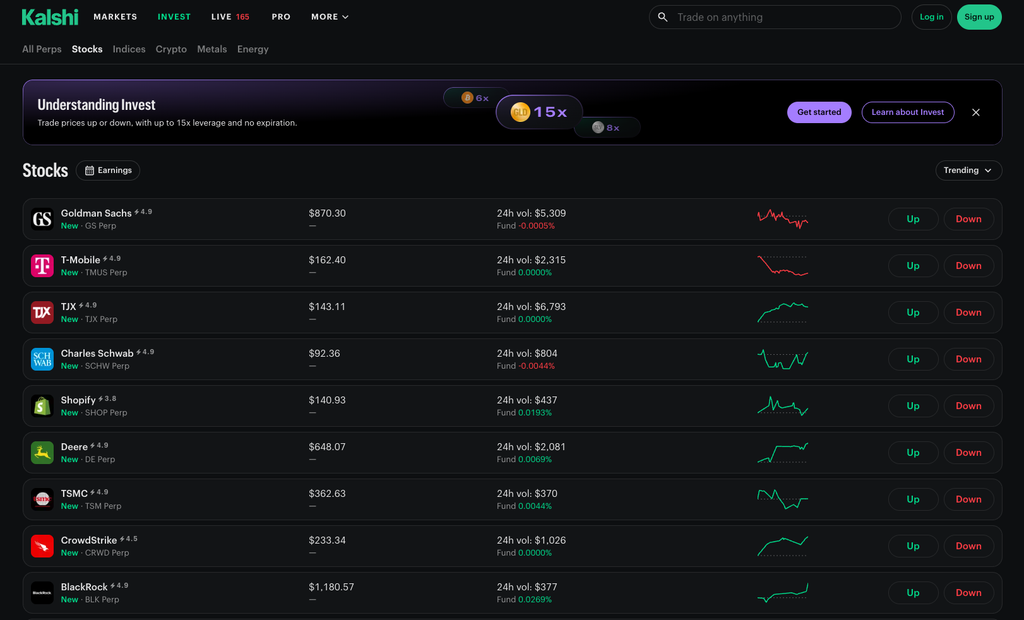
The email invites users to trade on whether the new names “rise or fall” and to react “live to earnings and breaking news, even after hours.” Kalshi’s perps explainer says non-crypto perps trade 24/5, from 6 p.m. ET Sunday to 5 p.m. ET Friday.
The email also offers a 7% APY to users holding a qualifying position. Under Kalshi’s terms, the 7% rate applies to funds backing open perps positions, against a standard 3.5%. It requires an average monthly perps balance of at least $250, and the program ends once total payouts reach $7m.
Kalshi offers up to 4.6x leverage on Nvidia and 3.5x on Micron and SpaceX, Bloomberg reported. Kalshi’s explainer says a roughly 20% adverse move liquidates a 5x position.
The contracts launched into a volatile market. Nov. 5 was also the day tech stocks had their worst selloff since 2020, according to Bloomberg. Nvidia perps topped $100m in 24 hours amid CEO Jensen Huang’s exit, and Micron also passed $100m on Nov. 9, according to the same report.
What the judge found
The CFTC deemed the contracts approved as security futures after its 45-day review lapsed on Nov. 2. But in her order (ECF No. 11), Caproni wrote that because perps never provide for “a sale for future delivery of a single security,” they “cannot be a security future over which the CFTC has statutory and regulatory authority.”
Instead, they “appear to satisfy the definition of a swap,” which falls under the Securities and Exchange Commission (SEC).
She also found that the balance of equities and the public interest favored the alliance, writing that the CFTC’s actions “seem to represent a major disruption to the equities market.”
She denied the restraining order only because harm must be “actual and imminent,” and the alliance’s declarations described harmful events that “could occur.” The preliminary injunction turns on the same four tests, now with the products live and trading at scale.
Cboe, the SEC and what comes next
The alliance’s members are Cboe, Citadel Securities and the Healthy Markets Association. Cboe CEO Craig Donohue said the CFTC’s actions “threaten to erode the regulatory framework that has protected investors,” according to Cboe’s announcement. Cboe says the fight is about investor protection, not competition, noting it could list the same products on its own CFTC-regulated exchanges.
Still, the perps compete with listed single-stock options, a core Cboe business. Traditional exchanges are also in the market themselves. CME Group lists single-stock futures with more than 6x leverage, according to Bloomberg, and separately sued the CFTC in June over its approval of Kalshi’s Bitcoin perpetual contract and Coinbase’s crypto perps.
The CFTC has pushed back. A spokesperson called the lawsuit “troubling” interference with CFTC-regulated markets, saying “our markets should be governed by law, not litigation campaigns intended to block innovation,” Reuters reported.
The SEC has sided with the CFTC, filing a brief last week that urged the court not to block the products, Finance Magnates reported. Kalshi, Coinbase, Kraken parent Payward, DRW, Jump Trading and Paradigm filed a proposed amicus brief backing the CFTC as well. The CFTC’s answer to the complaint is due Nov. 25, and no hearing date on the injunction has been set.
The case is one of several pressures on Kalshi. The CFTC has separately warned the exchange it could face charges over how it self-certified dozens of contracts, Politico reported on Nov. 10, citing a person with direct knowledge of the probe. Kalshi called it a procedural error.
Meanwhile, Kalshi plans to offer stocks and ETFs within two months, the Wall Street Journal reported. That push toward a multi-asset exchange now depends on a single Manhattan ruling on whether its fastest-growing equity product belongs to the CFTC or the SEC.