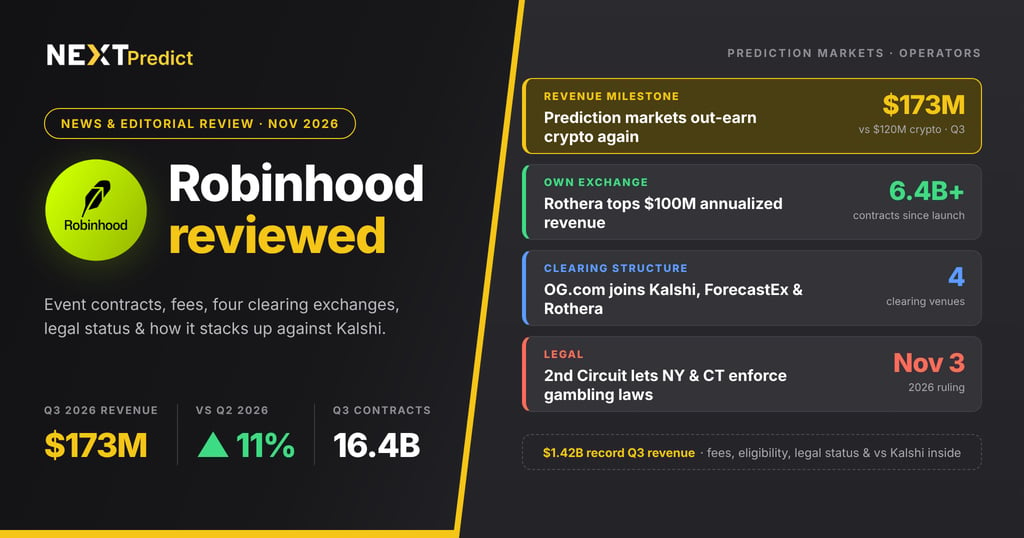
Robinhood prediction markets out-earned the company’s crypto business for a second straight quarter. The platform reported $173 million in prediction market revenue for the third quarter of 2026, up 11% from $156m in the second quarter and more than six times the year-earlier figure, according to the company’s October 27 earnings release. Event contracts traded on the platform reached a record 16.4 billion in the quarter, up from 13.6bn in the second quarter.
The growth arrives alongside a structural shift most competing coverage has missed. Robinhood now clears contracts through four separate exchanges, including one it partly controls. This page covers the current state of Robinhood: recent developments, what the product is, how it works, what it costs, where it stands legally, and how it compares to Kalshi.
Recent Robinhood Prediction Markets News and Developments
Robinhood’s prediction market business moved on three fronts in the past several months. Each is dated and sourced below, since trading volume, clearing structure, and litigation status on this page have each changed more than once over the past year.
Prediction Markets Revenue Climbs Again in Q3
Robinhood’s third-quarter 2026 earnings, released October 27, showed event contracts generating $173m against $120m from cryptocurrency trading. Crypto revenue fell 55% year over year. Total company revenue reached a record $1.42bn, up 12% year over year.
The quarter was the first test of prediction-market demand without the FIFA World Cup, which had lifted Q2 volumes, and revenue still grew 11% quarter over quarter. Robinhood said Rothera reached more than $100m in annualized revenue in its first full quarter of operation.
At its HOOD Summit in September, the company also announced earnings contracts for the Prediction Markets hub. HOOD closed at $94.56 on the day of the release and fell about 5.5% in after-hours trading to around $89, after revenue came in slightly below analyst estimates.
Crypto.com’s OG.com Becomes Fourth Clearing Partner
On September 8, 2026, Robinhood announced minority equity stakes in Crypto.com and its prediction-markets spinoff OG.com, and began routing a portion of its football event contracts to OG.com’s CFTC-regulated exchange and clearinghouse. Kalshi, ForecastEx and Rothera remain clearing partners, with contracts routed among the four venues depending on factors such as availability.
Prediction Markets Revenue Overtakes Crypto in Q2
Robinhood’s second-quarter 2026 earnings, released July 29, showed prediction markets generating $156 million against $100 million from cryptocurrency trading, the first quarter prediction markets outpaced crypto as a Robinhood revenue line. Total company revenue reached $1.31 billion for the quarter. Robinhood’s chief financial officer described the prediction market segment as the company’s fastest-growing product line. HOOD shares traded near $89 the day after the release, following a broader market pullback tied to the Federal Reserve’s decision to hold rates steady.
Rothera Goes Live as a Robinhood-Controlled Exchange
In January 2026, a joint venture between Robinhood and Susquehanna International Group closed its acquisition of MIAXdx, a CFTC-licensed Designated Contract Market and Derivatives Clearing Organization. The venture renamed the exchange Rothera Exchange and Clearing LLC and began routing World Cup and baseball contracts through it on June 4, 2026. Rothera has traded more than 6.4bn contracts since launch, according to Robinhood’s Q3 release.
Robinhood is the controlling partner in the joint venture that owns Rothera, which means Robinhood now has an ownership stake in a CFTC-Designated Contract Market for the first time. Robinhood Derivatives, the entity that actually offers contracts to Robinhood customers, remains a futures commission merchant rather than a DCM in its own right. See the clearing-structure section below for how that distinction works in practice.
State Legal Fights Escalate
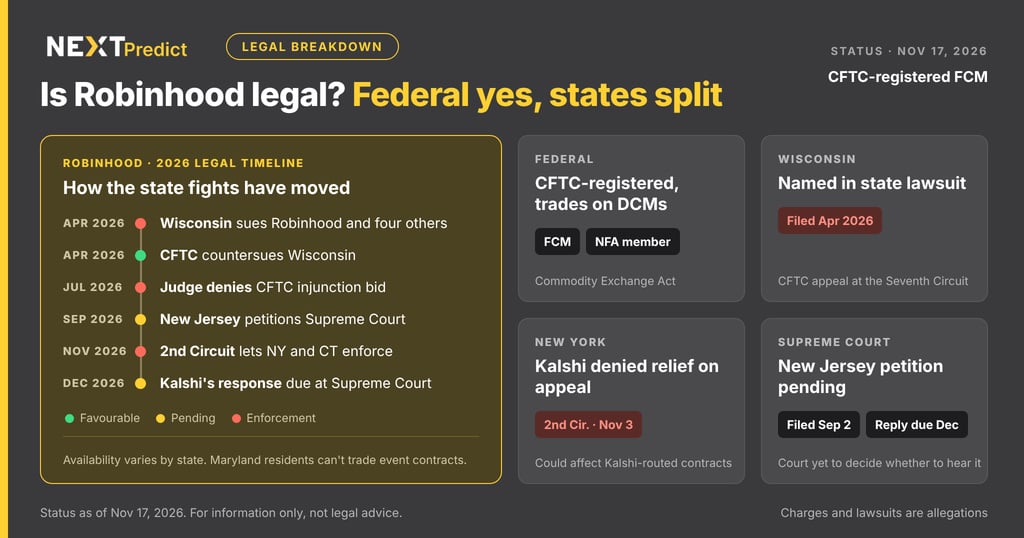
On July 29, 2026, a federal judge in Wisconsin denied the CFTC’s request for an injunction against the state, ruling that federal law does not pre-empt Wisconsin’s gambling statutes. Wisconsin’s Department of Justice had sued Kalshi, Robinhood, Coinbase, Polymarket and Crypto.com in April 2026, arguing their event contracts function as unlicensed sports betting under state law. The CFTC sued Wisconsin days later, asserting exclusive federal jurisdiction over the platforms. The CFTC has appealed the ruling to the Seventh Circuit.
On November 3, 2026, a three-judge Second Circuit panel denied Kalshi’s requests for injunctions pending appeal against New York and Connecticut, along with a similar request from Coinbase in Connecticut, leaving both states free to enforce their gambling laws while the appeals proceed.
Separately, New Jersey filed a petition on September 2, 2026 asking the U.S. Supreme Court to review the Third Circuit’s April ruling in Kalshi’s favour, the first prediction-market case to reach the Court. The Supreme Court has not yet decided whether to hear it, and Kalshi’s response is due in December.
New Blockchain
On July 1, 2026, the company launched the public mainnet of Robinhood Chain, an Ethereum layer-2 network allowing the exchange’s 28.7 million funded customers to trade tokenized shares of stocks. The AI-heavy blockchain technology allows crypto users to trade stocks via tokens. The company believes the emerging financial apps will make use of blockchain technology and Robinhood Chain is a step toward that coming change.
The platform allows the AI to make trades for users, enabling automated, agent-driven trading. The platform saw $77 million in agent volume and 2,100 agents in the first week. By the end of the third quarter, Robinhood said roughly 200,000 Agentic Trading Accounts had been opened, with more than $1.6 billion in notional trading volume.
Bond Sales & Financing
Robinhood began considering offering between $400 million and $500 million of asset-backed securities in July 2026. That would include a bond backed by bills for the operator’s branded consumer credit cards. Robinhood’s Credit Card Funding Trust completed the $500 million deal, its first, on July 23, 2026, according to the company’s Q2 10-Q filing.
This followed an announcement in June 2026 that Robinhood closed an offering of $2.2 billion in convertible senior notes due 2029. Robinhood officials said the transaction enhanced its “strategic flexibility to invest for future growth.” About $290 million would be used to repurchase outstanding Class A common stock.
Stock Falls After Q3 Results
Robinhood went public in 2021 and a Zacks report in July 2026 noted that the company’s stock price had seen significant growth in recent months. The price grew 17.31% over the previous month, outpacing the S&P 500’s gain of 1.61%.
Ahead of Q3 results, analysts expected earnings of about $0.55 to $0.56 per share on revenue of roughly $1.43 billion to $1.44 billion. Robinhood reported diluted EPS of $0.51 (adjusted EPS of $0.60) on record revenue of $1.42 billion. The stock closed at $94.56 on October 27, fell about 5.5% after hours, and was down roughly 22% year to date at that point.
What Is Robinhood Prediction Markets?
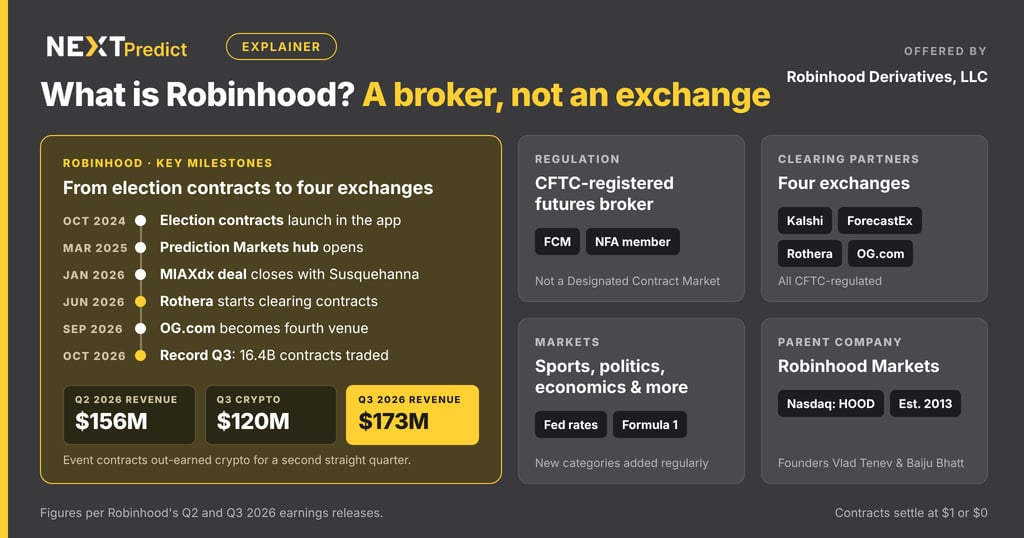
Robinhood Prediction Markets is a feature inside the Robinhood app, operated by Robinhood Markets, Inc. (Nasdaq: HOOD), the publicly traded parent company founded in 2013 by Vlad Tenev and Baiju Bhatt. Event contracts are offered through Robinhood Derivatives, LLC, a CFTC-registered futures commission merchant and National Futures Association member.
Robinhood Derivatives is not a Designated Contract Market. It offers access to event contracts listed and cleared by separate CFTC-regulated exchanges. As of this writing, those clearing partners are KalshiEX LLC, ForecastEx LLC, Rothera Exchange and Clearing LLC (the Robinhood-Susquehanna joint venture described above), and Crypto.com Derivatives North America, operating as OG.com.
Robinhood entered event contracts in October 2024 with election-related markets, expanded into sports through a Kalshi partnership in early 2025, and launched a dedicated Prediction Markets hub in March 2025. The January 2026 acquisition of MIAXdx and the June 2026 Rothera launch mark the platform’s move toward operating its own exchange infrastructure alongside its existing clearing partners. In September 2026, Robinhood added OG.com as a fourth clearing venue and took minority stakes in Crypto.com and OG.com.
Current market categories include politics, sports, economics, crypto, entertainment, weather, and motorsports, with categories such as Formula 1 and Attorney General appointments listed alongside recession and Federal Reserve contracts on Robinhood’s own markets page. Verify the live category list against Robinhood’s site before publication, since new categories are added regularly.
How Does Robinhood Prediction Markets Work?
Eligibility and account setup
Trading event contracts requires an approved Robinhood Derivatives account layered on top of an existing Robinhood brokerage account. Applicants apply from the app’s futures trading section. Robinhood’s own eligibility rules require:
- Age 18 or older
- A valid Social Security number
- A U.S. residential address in one of the 50 states, Puerto Rico, or the U.S. Virgin Islands (Maryland residents are currently excluded from event contracts)
- S. citizenship, permanent residency, or a valid U.S. visa
Once approved, the Derivatives account functions independently of a standard Robinhood brokerage account and requires an initial margin deposit before trading begins. Gains are generally taxable; Robinhood does not issue a 1099 for event contract trades, so confirm reporting requirements with a tax professional.
Contract structure and order types
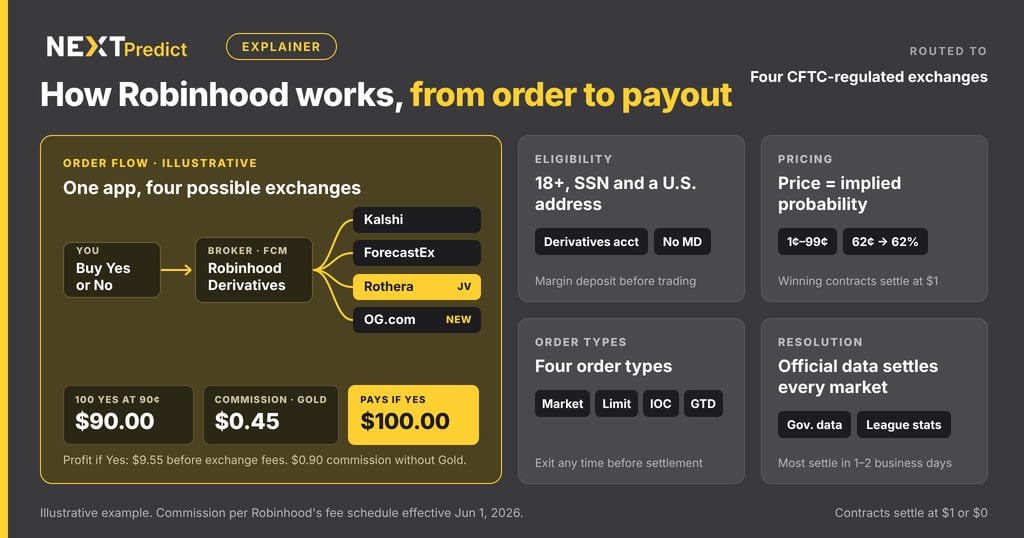
Robinhood’s event contracts are binary. Each offers a Yes or No position, priced between $0.01 and $0.99 while the market stays open. The price reflects the crowd’s implied probability of the outcome.
A Federal Reserve rate-decision contract active on Robinhood as of July 29, 2026 illustrates the mechanic: a Yes contract priced at $0.62 implies a 62% probability the Fed holds rates steady, and traders can buy or sell at any point before the contract settles.
Robinhood supports several order types shared across the prediction market industry:
- Market order – fills at the best currently available price
- Limit order – fills only at a trader-specified price or better
- Immediate-or-cancel order – fills what it can immediately and cancels the rest
- Good-till-date order – a limit order that stays active until a set date, a fill, or a cancellation
The clearing and multi-DCM structure
A contract traded on Robinhood is listed and cleared by one of four separate CFTC-regulated exchanges, and which one handles a given contract can vary by category and by date.
Contracts routed through KalshiEX LLC, ForecastEx LLC or OG.com put Robinhood in the position of an introducing broker in front of an independent exchange. Contracts routed through Rothera put Robinhood, via its controlling stake in the Rothera joint venture, on both sides of the transaction: distributor and, functionally, part-owner of the exchange.
Liquidity, order-book visibility, and specific contract terms still depend on the underlying exchange rather than on Robinhood’s app. Robinhood does not show the full order book (bids and asks) that a trader would see going directly to KalshiEX, ForecastEx, OG.com or Rothera.
Resolution process
Contracts settle against official data sources named in the market description: election results, government statistics, sports league data, or Federal Reserve statements, depending on the category. Winning positions settle at $1 per contract and losing positions settle at $0. The site that most contracts settle within one to two business days, though markets tied to elections or contested outcomes can take longer to certify.
Robinhood Prediction Markets Fees
Robinhood moved from a flat per-contract fee to a probability-weighted commission on June 1, 2026, according to its published fee schedule. The formula is:
Commission = k × p × (1 − p) × c
- k = 10% without a Robinhood Gold subscription, or 5% with Gold (subscription price: $5 per month)
- p = contract price, expressed as a decimal between 0 and 1
- c = number of contracts traded
Robinhood rounds every commission up to the nearest $0.01 and applies the formula on top of separate exchange fees, which run roughly $0.02 per contract per side according to the fee schedule. Commissions run lowest near $0.01 or $0.99 and peak near $0.50, where the probability weighting is highest.
Robinhood’s own worked example: a trader buying 100 Yes contracts at $0.90 each pays a $0.45 commission with Gold, for a total of $91.45, or a $0.90 commission without Gold, for a total of $91.90. Both figures come from Robinhood’s fee schedule and exclude the separate per-contract exchange fee.
Robinhood vs Kalshi vs Polymarket Fees
Kalshi charges its own probability-weighted fee directly, separate from anything Robinhood charges on top when a contract routes through KalshiEX. Kalshi’s taker fee is 7% of price times (1 minus price) times contract count, rounded up to the next cent. Maker fees, charged only on resting limit orders that get filled, run at one quarter of the taker rate.
Polymarket, which settles in a stablecoin rather than U.S. dollars, charges a category-based taker fee between between roughly 1.00% and 1.75% at peak (50¢), with geopolitics markets fee-free as of its most recent fee update, while maker orders trade free and can earn liquidity rebates.
|
Fee driver |
Robinhood |
Kalshi |
Polymarket |
|
Base formula |
k × p × (1−p) × c, plus exchange fee |
0.07 × c × p × (1−p) taker; 0.0175 × same maker | 1%-1.75% taker by category; makers free |
|
Subscription tier |
Gold ($5/mo) lowers k from 10% to 5% |
No subscription tier |
No subscription tier |
|
Settlement currency |
U.S. dollars |
U.S. dollars |
USDC stablecoin |
Robinhood Prediction Markets App Review
Prediction markets are not a standalone app. They live inside the main Robinhood app for iOS and Android, alongside stock, options, and crypto trading. They are accessible from the Investing section once a Derivatives account is approved. Inside the prediction markets app, traders browse markets by category, place orders, and track open positions. All of this happens from a single Prediction Markets hub.
As of November 2026, the Robinhood app carries a 4.3 out of 5 rating on the Apple App Store. That figure comes from more than 4.8 million reviews. On the Google Play Store, it rates roughly 4.4 out of 5 from more than 556,000 reviews. Both figures reflect the Robinhood app as a whole. Neither store publishes a rating specific to the prediction-markets feature. Verify current figures against each store listing before publication.
Is Robinhood Legal for Prediction Markets in the U.S.?
Robinhood Derivatives is CFTC-registered, and the event contracts it distributes trade on CFTC-Designated Contract Markets. That registration is the basis for a position shared by Robinhood and the CFTC. In their view, event contracts are federally regulated derivatives rather than state-regulated gambling products.
Several states dispute that position specifically as it applies to sports-related contracts. Wisconsin’s Department of Justice sued Kalshi, Robinhood, Coinbase, Polymarket, and Crypto.com in April 2026. It argued their event contracts amount to unlicensed sports betting under state law. The CFTC countersued Wisconsin days later. On July 29, 2026, a federal judge denied the CFTC’s request to block the state. The judge ruled federal law does not preempt Wisconsin’s gambling statutes. The CFTC has appealed to the Seventh Circuit.
New York has pursued a parallel track against Kalshi specifically. A federal judge denied Kalshi’s request for a preliminary injunction against the state. On November 3, 2026, a three-judge Second Circuit panel then denied Kalshi’s request for an injunction pending appeal. That allows New York to enforce its gambling laws while the appeal continues.
New Jersey has separately asked the U.S. Supreme Court to decide the federal-versus-state question. Neither Robinhood nor its other clearing partners were named as parties in the New York case as of this writing. However, the outcome could affect Kalshi-routed contracts available on Robinhood.
This is general information, not legal advice. State availability for Robinhood’s prediction markets changes as litigation proceeds. Readers with a specific concern about their own state should check Robinhood’s current state-availability page directly. NEXTPredict’s regulation hub and legal hub track the broader state-by-state picture across the industry.
Robinhood vs Kalshi
Robinhood and Kalshi solve different problems for the same underlying activity. Kalshi is the exchange: a CFTC-Designated Contract Market that lists and clears its own event contracts. Robinhood is the access point: a broker that routes customer orders to Kalshi and three other clearing venues, one of which, Rothera, it now partly owns.
|
Category |
Robinhood |
Kalshi |
|
Regulatory role | Introducing broker and FCM, routed through KalshiEX, ForecastEx, Rothera, and OG.com |
CFTC-Designated Contract Market operating its own exchange |
|
Settlement currency |
U.S. dollars |
U.S. dollars |
|
Fee model |
Probability-weighted commission, Gold-tier discount, plus exchange fees |
Probability-weighted taker and maker fees, no subscription tier |
|
Market catalogue |
Curated subset of partner-exchange markets |
Full native catalogue, thousands of active markets |
|
Order-book visibility |
Not shown in the Robinhood app |
Full bid/ask visibility on Kalshi’s own interface |
Because some Robinhood-listed contracts are the same contracts cleared on Kalshi’s own exchange, choosing between the two platforms is partly a choice about interface and account structure rather than a fundamentally different market. That overlap holds for KalshiEX-routed categories. It does not hold for contracts routed through Rothera, which exist only inside Robinhood’s own infrastructure.
Polymarket remains the third major reference point in this cluster. It operates its own CFTC-adjacent-but-distinct structure, settles in a stablecoin rather than dollars, and is not a Robinhood clearing partner, so no Robinhood-listed contract maps directly onto a Polymarket contract.
Notable Robinhood Prediction Markets
A few markets illustrate current trading activity on the platform. Figures below are dated and should be re-verified against Robinhood’s live markets page before publication, since prices move continuously.
- Fed rate decision, December 2026 meeting: an active contract asking whether the Federal Open Market Committee changes the target rate, cleared through Robinhood’s exchange partners with no explicit per-trade fee shown at the time of listing.
- Recession in 2026: a standing economic contract on Robinhood’s markets page, priced around 2% Yes as of its most recent listing, reflecting low implied probability of a 2026 recession call.
- Aggregate Q2 2026 activity: 13.6 billion event contracts traded across Robinhood in the second quarter, up from 8.8 billion in Q1, against an industry-wide daily volume peak of $4.8 billion during the June 2026 FIFA World Cup, the highest single-day total prediction-market volume on record at the time.
- Aggregate Q3 2026 activity: A record 16.4 billion event contracts traded across Robinhood in the third quarter, up from 13.6 billion in Q2 and more than seven times the year-earlier total. This followed an industry-wide daily volume peak of $4.8bn during the June 2026 FIFA World Cup, the highest single-day total prediction-market volume on record at the time.
Conclusion
Robinhood’s prediction markets now run through four clearing venues. One of them is a Robinhood-controlled exchange rather than an arm’s-length partner. The product itself still works the way it always has with binary Yes/No contracts priced between $0.01 and $0.99. A probability-weighted commission applies, and it drops with a Gold subscription.
Contracts settle inside the same app used for stocks and crypto. Its legal footing at the federal level is stable, but not so in individual states. That dispute is moving through several federal courts at once.
Frequently Asked Questions
What is Robinhood Prediction Markets?
Robinhood Prediction Markets is a hub within the overall Robinhood securities app allowing users trade event contracts, binary yes-or-no positions on the outcome of real-world events. These can include sports, elections, economic data, and other categories. Contracts are offered through Robinhood Derivatives, LLC, a CFTC-registered subsidiary of Robinhood Markets, Inc.
How does Robinhood Prediction Markets work?
Traders with an approved Robinhood Derivatives account buy and sell yes-or-no contracts priced between $0.01 and $0.99. Share price represents the market’s implied probability of the outcome occurring. On Robinhood, contracts are listed and cleared through a separate CFTC-Designated Contract Market partners rather than by Robinhood itself. Traders can enter and exit a position at any time before settlement with winning contracts settling at $1 and losing contracts at $0.
Is Robinhood legal for prediction markets in the U.S.?
Robinhood Derivatives is a CFTC-registered entity and contracts trade on CFTC-Designated Contract Markets, the basis for treating these offerings as federally-regulated derivatives. Several states have challenged the legality of sports-related event contracts under state gaming laws, and Robinhood has been named in some of these legal wranglings. Current state-by-state availability changes and should be verified against Robinhood’s support documentation.
What are Robinhood’s prediction market fees?
Robinhood charges a commission on event contract trades calculated from the contract’s price. A subscription-based rate. Robinhood Gold subscription members are charged a lower commission.
Is Robinhood the same as Kalshi?
No. Kalshi is a CFTC-Designated Contract Market and can legally offer prediction market trading on event contracts. Robinhood is a CFTC-registered broker offering access to event contracts. These are cleared via separate Designated Contract Market partners, including Kalshi, depending on the contract. Some contracts available on Robinhood are the same as those listed on Kalshi. They are simply accessed through a different interface and account structure.
How are Robinhood prediction market gains taxed?
Event contract gains and losses are generally treated as taxable financial activities. Specific tax treatment can depend on the type of contract and IRS regulations. This page provides general information, not tax advice. For more information on taxes, consult a tax professional or Robinhood’s own tax documentation before filing.
How does Robinhood compare to Kalshi and Polymarket?
Robinhood offers fewer markets than Kalshi or Polymarket. However, it integrates prediction markets into an app many users already use for stock, options, and other securities trading. Kalshi settles in U.S. dollars and is a Designated Contract Market. Polymarket settles in the USDC stablecoin on a public blockchain. Robinhood routes trades to one or more partner exchanges rather than operating its own order book. Traders seeking the widest market selection and full order-book visibility typically consider Kalshi or Polymarket directly.
Does Robinhood have a prediction markets app?
Prediction markets are not a separate app but featured as part of the main Robinhood app for iOS and Android. This hub is accessible from the Investing section once a Robinhood Derivatives account is approved. Current app store ratings reflect the Robinhood app as a whole rather than the prediction-markets feature specifically.
Sources: CFTC | CNBC | Robinhood | Bloomberg | Yahoo Finance | Investing.com | CoinMarketCap