
A new prediction market platform is allowing traders to take positions on some of science’s biggest unanswered questions, from the nature of dark matter to a mathematical hypothesis that has remained unsolved for more than 160 years.
Science Markets, which launched Tuesday, brings a new approach to technology and science prediction markets, combining cryptocurrency trading with artificial intelligence to create contracts tied to scientific discoveries. According to its launch announcement, the contracts have no expiration dates and rely on three AI models to evaluate research and ultimately determine when a question has been definitively answered.
“There are people who spend years understanding a scientific question and have good reasons to disagree with the prevailing view. Now, they have an incentive to make that information public,” founder Conner Lambden said in the announcement.
Lambden’s background spans scientific research, AI and financial forecasting. A former computational scientist at Boston-based Brigham and Women’s Hospital, a Harvard-affiliated teaching and research hospital, he currently works as a solutions engineer at Salt AI, a platform for building AI-powered research workflows. His work there includes developing a system that generates potential drug molecules and evaluates their properties, including how effectively they might bind to biological targets and how easily they could be manufactured.
He also founded Helium Trades, a financial research platform offering AI-powered market forecasts and options strategy analysis.
Science Markets is not registered with the CFTC as an exchange, clearinghouse or intermediary. According to its risk disclosures, the platform has not received approval from the CFTC or Securities and Exchange Commission (SEC) and prohibits trading by US residents and users in other restricted jurisdictions.
Markets target dark matter and unsolved mathematical mysteries
Science Markets launched with four markets covering questions in physics, mathematics and computer science.
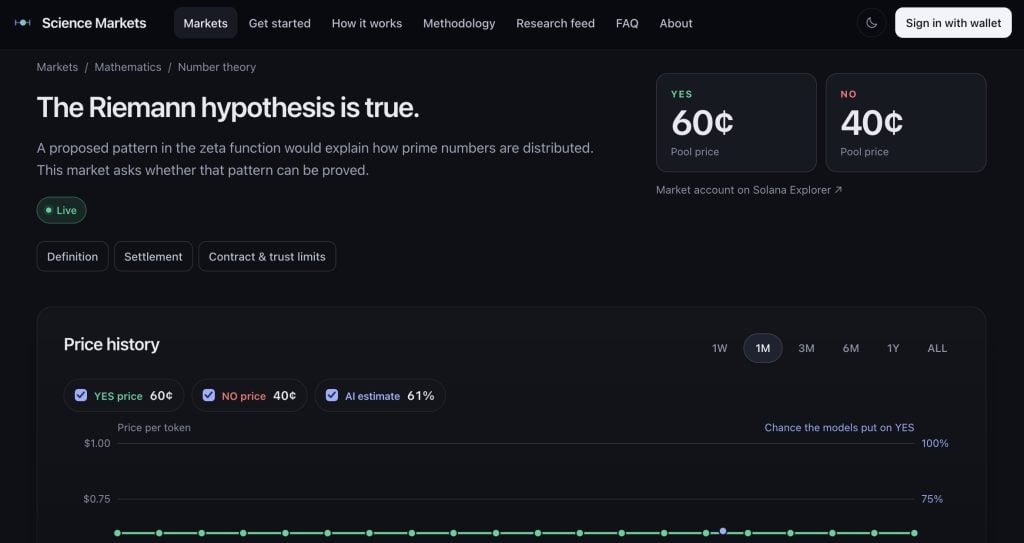
One asks whether the Riemann hypothesis is true. Proposed by German mathematician Bernhard Riemann in 1859, the hypothesis concerns patterns in the distribution of prime numbers and has remained unsolved for more than 160 years. It is one of the Clay Mathematics Institute’s seven Millennium Prize Problems, each carrying a $1m prize for a solution.
The other markets address whether undiscovered particles make up most dark matter, whether neutrinos have a particular type of mass and whether P equals NP, a fundamental computer science question about how efficiently complex problems can be solved.
As of Tuesday, “Yes” tokens were priced at 60 cents for the Riemann hypothesis, 72 cents for dark matter, 34 cents for neutrino mass and 6 cents for P equals NP.
Participants connect a cryptocurrency wallet and use USDC, a stablecoin pegged to the US dollar, to purchase “Yes” or “No” tokens on the Solana blockchain. If a contract eventually settles, each winning token can be redeemed for 1 USDC, minus fees, while losing tokens become worthless.
Unlike conventional prediction markets tied to a specific event or date, these contracts have no expiration dates. They can remain unresolved indefinitely if the underlying scientific questions are never definitively answered.
AI models evaluate evidence and determine settlements
Science Markets uses AI models from OpenAI, Anthropic and xAI to independently assess the scientific evidence behind each contract. Under the platform’s methodology, the models receive the same research materials and resolution criteria during weekly evaluations, producing estimates and explanations that are published alongside market prices.
The Riemann hypothesis market illustrates how differently the models can interpret the evidence. In their Nov. 16 assessments, OpenAI and xAI each assigned the hypothesis a 90% score, while Anthropic assigned it just 2%. The resulting average was 61%, close to the market’s 60-cent “Yes” price.
However, the platform cautions that these AI-generated estimates are not scientifically validated probabilities and do not determine trading prices. All three models classified the Riemann hypothesis as undecided because no definitive proof or counterexample has been established.
To settle a contract, all three models must independently return the same definitive “Yes” or “No” verdict under the market’s predetermined criteria. That decision is then recorded on the Solana blockchain, allowing holders of winning tokens to redeem them for USDC. Once finalized, the result cannot be appealed.
If the models disagree or cannot reach a definitive conclusion, the contract remains open. Science Markets also acknowledges that agreement among AI models does not necessarily establish scientific truth, particularly because the platform’s operator selects the evidence they evaluate.
Research market roots and debate over medical contracts
The idea of using prediction markets to gather information and improve forecasting has roots in academic research. The University of Iowa established the Iowa Electronic Markets in 1988 to study how markets predict election outcomes and economic developments.
Also with an elections focus, PredictIt followed in 2014 as a research-oriented project associated with Victoria University of Wellington in New Zealand. Both received no-action relief from the Commodity Futures Trading Commission (CFTC), allowing them to operate under special conditions tied to their educational and research purposes.
Other research-oriented forecasting platforms include Metaculus, which aggregates predictions on scientific and technological questions without requiring users to trade with real money.
Science Markets has no comparable university affiliation or regulatory relief, and its focus on fundamental scientific questions sets it apart from those earlier initiatives.
Its launch also comes amid growing debate over the role of prediction markets in medical research and public health.
As NEXTPredict.io recently reported, Kalshi’s contracts on clinical trial outcomes and Food and Drug Administration (FDA) decisions have drawn criticism from researchers and lawmakers concerned about insider trading, patient safety and potential interference with clinical studies.
A Nov. 14 report in The Guardian also highlighted concerns surrounding public health prediction markets on Kalshi and Polymarket, including contracts tied to measles outbreaks.
Science Markets takes a different approach. Its listing policy explicitly excludes contracts tied to individual companies’ clinical trials, FDA decisions and identifiable patients’ health outcomes, citing concerns about confidential information, privacy and incentives to influence outcomes.