
Gemini’s prediction market business could still thrive even if legal challenges ultimately prevent it from offering sports contracts, CEO Tyler Winklevoss said during the company’s third-quarter earnings call, arguing that the category is only one part of its broader event-contract strategy.
“The future or success of Gemini predictions will not rise and fall on one category alone,” Winklevoss said.
“It’s just getting started, and so if we don’t offer sports, we still believe we’ll have a very large and exciting offering for our customers.”
The comments came in response to an analyst’s question about recent state court rulings involving sports prediction markets. Winklevoss defended Gemini’s federal regulatory licenses, expressing confidence that the law would ultimately support the company’s ability to offer sports event contracts.
Gemini reported $796,000 in prediction market revenue for the third quarter, up 52% from $524,000 in Q2. Despite that growth, the business still represented less than 2% of the company’s $40.9m in total quarterly revenue.
Prediction market revenue climbs as trader activity grows
Despite its relatively small contribution to overall revenue, Gemini reported signs of growing customer engagement with its prediction market platform.
“Revenue remains modest relative to the broader business, and our focus is on translating the investment in marketplace liquidity and infrastructure into greater participation and fee generation,” interim CFO Danijela Stojanovic said during the Q3 earnings call.
According to Gemini’s third-quarter shareholder presentation, more than 350m event contracts had been traded on the platform by Nov. 1, with more than 35,000 unique traders participating since its December 2025 launch.
Activity accelerated in October, when average daily prediction traders increased approximately 50% compared with the third-quarter average. Monthly trader retention reached its highest level since launch, approximately 1.5 times the first-quarter average.
Gemini also reported that nearly one-third of new prediction traders in October were entirely new to the company, more than double the proportion recorded during Q3.
The figures suggest predictions are increasingly attracting customers beyond Gemini’s existing crypto trading base, although the company has not disclosed how many of those new users have adopted its other products.
Gemini seeks partners for prediction market infrastructure
Gemini is also looking to expand its prediction market business by providing trading and clearing infrastructure to outside brokerages and other financial firms.
“We’re in active discussions with a number of other brokerages, FCMs, and trading platforms that want regulated access to event contracts and derivatives, which we believe we’re well positioned to provide,” co-founder Cameron Winklevoss said during the call.
In August, Gemini announced a nonbinding letter of intent with Apex Fintech Solutions that would make its exchange the exclusive venue for crypto event contracts distributed through Apex’s futures commission merchant (FCM).
Gemini’s regulated clearinghouse, Gemini Olympus, has been clearing the company’s event contracts since August. The company also wants to provide clearing services to other exchanges, potentially allowing it to generate revenue from trading activity beyond its own platform.
Gemini defends federal oversight of sports contracts
Winklevoss pointed to Gemini’s licenses from the Commodity Futures Trading Commission (CFTC) as the basis for his confidence in the company’s ability to continue offering sports markets.
He also highlighted the company’s other prediction market categories, including crypto, politics, economics, culture and weather, as opportunities for growth regardless of the outcome of the sports contract litigation.
His remarks follow a series of legal setbacks for other prediction market operators. On Nov. 4, the Ninth Circuit rejected Kalshi’s request for rehearing in its Nevada case, leaving intact a ruling that the exchange was unlikely to succeed in blocking state gambling enforcement against its sports contracts.
That same day, a federal judge barred Kalshi from offering sports contracts on certain California tribal lands, adding to the legal uncertainty facing federally regulated prediction markets.
Gemini plans social trading and expanded platform access
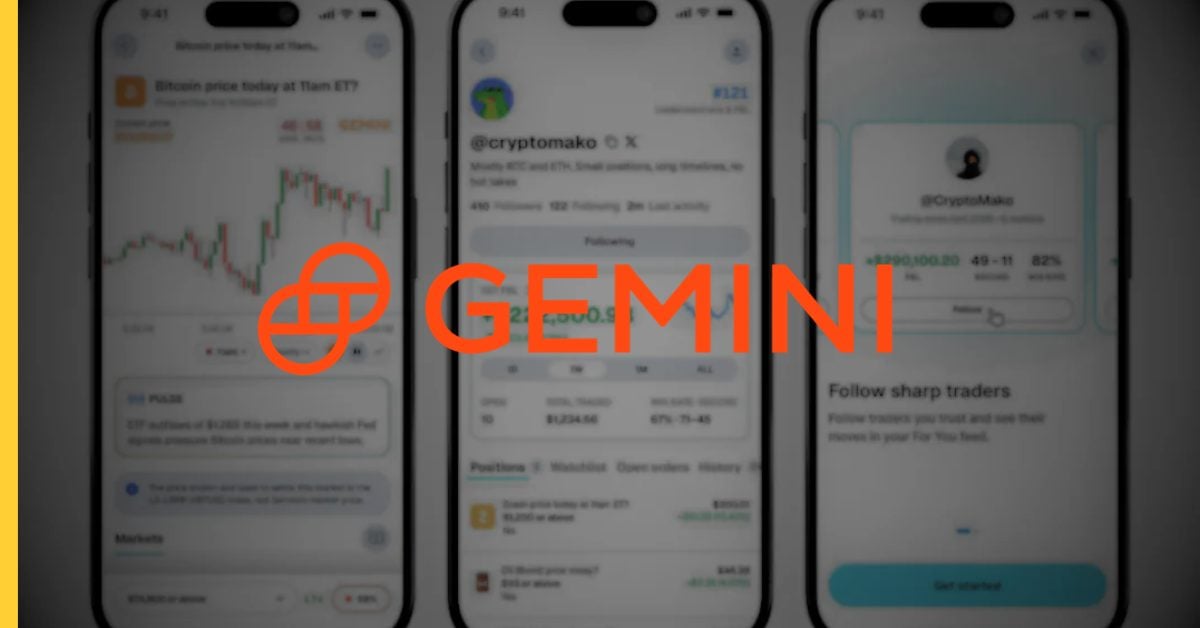
Gemini is expanding its prediction market offerings. The company has launched custom Combos, allowing customers to combine multiple event outcomes, and is developing social trading features, including trader profiles and groups.
It also plans to bring prediction markets to ActiveTrader, its professional trading terminal, alongside cryptocurrency products.
The expansion comes as Gemini faces continued financial pressure. Total company revenue fell 19% year-over-year in Q3, while crypto exchange revenue declined 47% to $13.4m. Its net loss narrowed to $58.6m from $159.5m a year earlier, with operating expenses falling 30% to $119.9m.
During the call, Tyler Winklevoss acknowledged that expanding the company’s offerings would ultimately need to translate into stronger financial performance.
“We know the measure of all this is results, not just launches,” he said. “On our next call, we’ll share our priorities for 2027 and the measures we’ll use to track our progress.”