
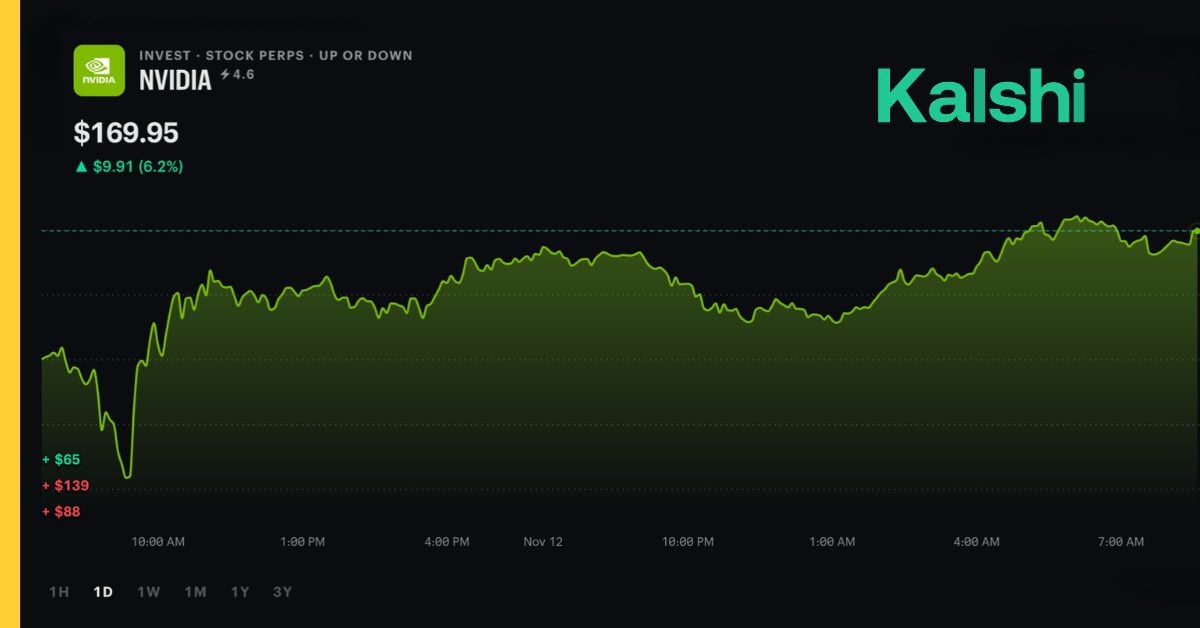
Kalshi is cutting the minimum trading size across its 58 perpetual stock futures contracts, allowing investors to take substantially smaller positions in companies such as Apple, Tesla and Amazon.
Under the amendment, brought forward following Kalshi’s launch of perpetual futures earlier this month, traders could buy or sell as little as 0.0002 shares of the underlying security, equivalent to one five-hundred-thousandth of a standard 100-share contract.
That’s a 100-fold reduction for 54 contracts currently requiring minimum orders equivalent to 0.02 shares. Four earlier contracts, covering Amgen, Costco, McDonald’s and Qualcomm, will see their minimums reduced 50-fold from 0.01 shares.
A stock trading at $1,000 would consequently have a minimum transaction exposure of just 20 cents, compared with $20 under the existing 0.02-share threshold.
Kalshi said the smaller increments would allow traders to match specific dollar amounts more accurately, particularly when dealing with expensive stocks.
The prediction market operator submitted the changes to the Commodity Futures Trading Commission (CFTC) on Nov. 12, with implementation scheduled for Nov. 27.
Kalshi moves closer to fractional stock trading
The amendment affects order quantities only. The existing $0.005 minimum price movement, $0.50 standard-contract tick value, margin requirements and position limits remain unchanged.
Kalshi’s changes bring its perpetual futures closer to the fractional-share trading already available through conventional retail brokerages, but with the added features of derivatives contracts.
Fidelity, for example, allows customers to purchase fractional stocks and ETFs starting at $1. Traditional futures exchanges generally use standardized contract sizes, although smaller Micro contracts offer reduced exposure.
Competition for equity-related trading is also expanding among prediction market operators. Polymarket recorded more than $220m in trading across approximately 31,000 equity-linked markets between October 2025 and early September 2026.
Its contracts allow traders to speculate on stock-price thresholds and other corporate outcomes rather than hold perpetual exposure to shares.
Cboe has also announced binary options tied to performance indicators at 23 publicly traded companies, with Robinhood named its initial retail distribution partner.
CME Group offers conventional single-stock futures alongside financial prediction market contracts covering benchmarks including the S&P 500 and Nasdaq-100.
Unlike those event-based contracts, Kalshi’s perpetual futures track movements in individual stock prices without a fixed expiration date. Reducing the minimum trade size to 0.0002 shares makes smaller positions possible without changing the underlying 100-share contract structure.