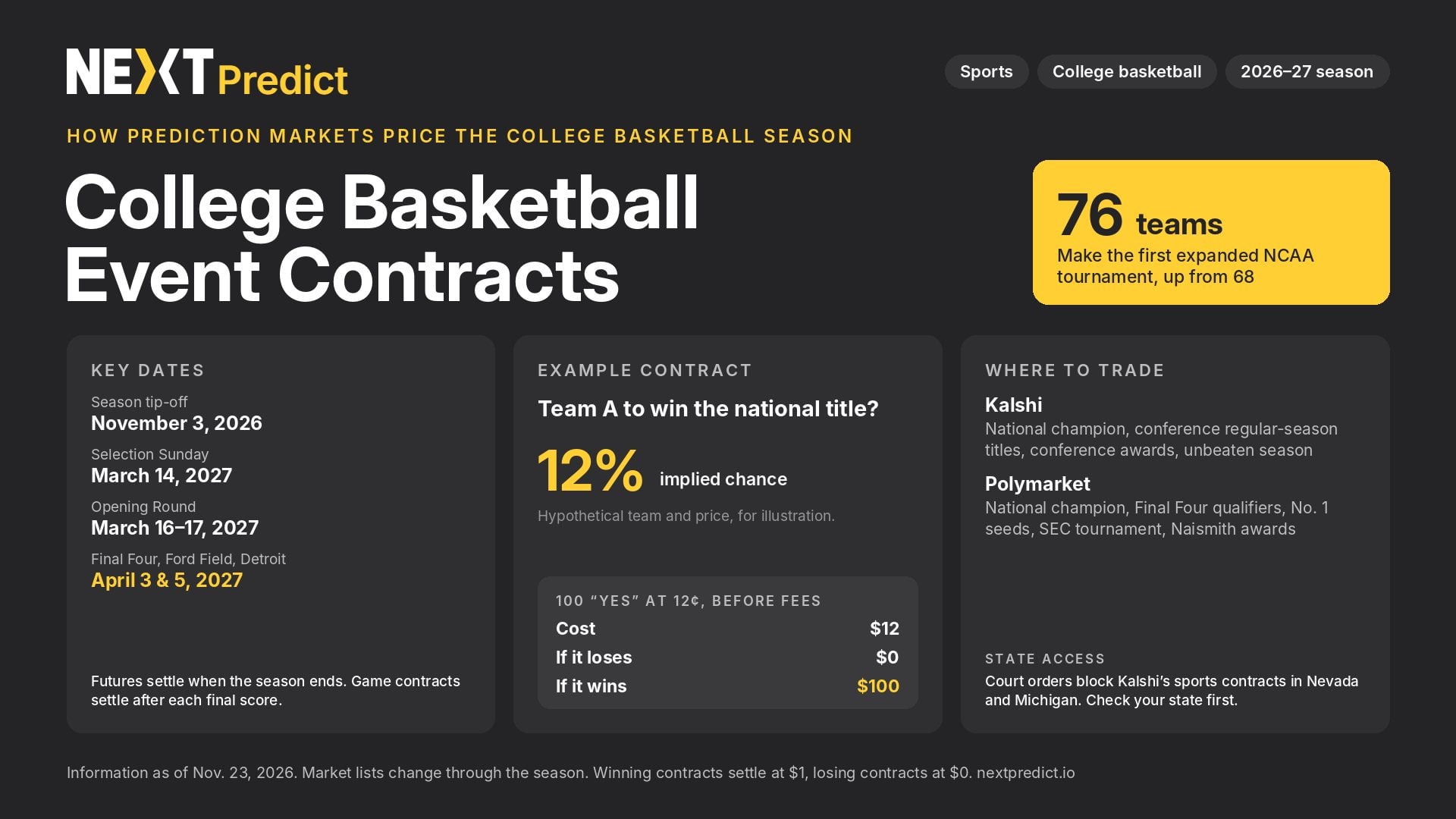
College basketball odds are available on individual games, Conference standings, and title wins. They tell traders how likely the outcome is, with prices varying between $0.01 to $0.99. Use this page to learn about college basketball prediction markets on Kalshi and Polymarket, and where state challenges restrict access.
What Are College Basketball Event Contracts?
College basketball odds tell traders two things: who is the favorite and by how much. Event contracts pay out $1 if the stated outcome occurs, but $0 if it doesn’t. Traders buy and sell Yes and No binary positions on an order book, with prices displayed as implied probability based on supply and demand.
For example, a price of 25¢ suggests the outcome is 25% likely to happen. Use our “what is a prediction market” guide if this is new to you.
Every contract settles on an official result, whether it’s a final score, the conference standings, or an award announcement. Each platform’s contract rules name the data source and the settlement date. Read those rules before you trade, because they decide edge cases such as postponed or canceled games
The Commodity Futures Trading Commission (CFTC) oversees both US exchanges covered on this page, as outlined below:
- Kalshi: has held CFTC designated contract market status since 2020.
- Polymarket: US trades through QCX LLC, a designated contract market that Polymarket acquired in 2025. A CFTC filing lists QCX LLC as doing business as Polymarket US.
- Polymarket international: Polymarket.com is a separate product and is not regulated by the CFTC.
Season-Long Markets: Championship, Final Four and Conference Futures
College basketball futures typically resolve at the end of the season, rather than at the end of an individual game. This is where the majority of the season-long pricing happens, with the table below outlining the market types available on Kalshi and Polymarket as of November 23, 2026.
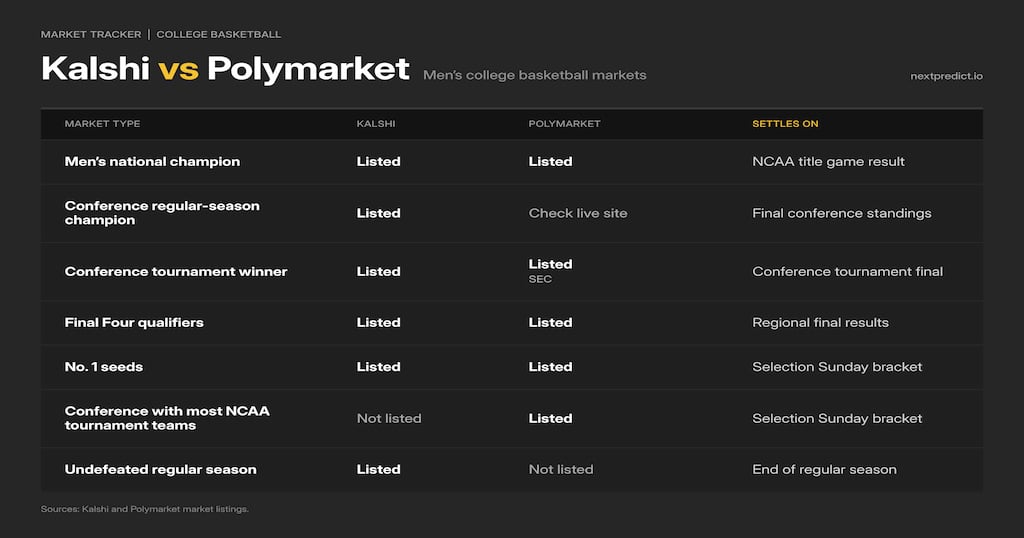
Kalshi also lists women’s college basketball games and a women’s undefeated-season market. However, availability changes throughout the season, so confirm each market on the platform before you trade.
Futures prices fluctuate based on results. Let’s look at an example using a hypothetical team in a national champion market.
- Team A opens the season at $0.08, an 8% implied chance.
- Team A beats two ranked opponents in November, and traders push the price to $0.12.
- Its leading scorer suffers an injury in January. Sellers drop the price to $0.06.
- The contract settles at $1 if Team A wins the title and $0 if it does not.
In a single-winner market, Yes prices across every team should add up to roughly $1. A total above $1 reflects the spread between buyers and sellers.
Game contracts work the same way. NCAAB odds on sportsbook sites show a spread or moneyline. On prediction market platforms, spread or total contract shows a price, as is the case with other sports event contracts.
Awards and Player of the Year Markets
Multiple college basketball awards are covered on prediction market platforms. Award markets price individual honors instead of team results.
- Polymarket: Lists a 2026-27 Naismith College Player of the Year market and a Naismith Coach of the Year market.
- Kalshi: Lists conference awards, such as a Big 12 Defensive Player of the Year market.
Each award market holds one contract per candidate. A candidate’s contract settles at $1 when the award body names that player, and every other candidate’s contract settles at $0. Award markets often trade thinly, so expect wider gaps between the buy and sell price.
Event Contract Prices vs. Sportsbook Odds
An event contract price converts directly into an implied probability. This contrasts sportsbooks, where the same idea is displayed as odds. The difference between the two is outlined in the following table:
| Contract price | Implied probability | American odds equivalent |
| $0.10 | 10% | +900 |
| $0.25 | 25% | +300 |
| $0.50 | 50% | +100 |
| $0.75 | 75% | -300 |
Exchange vs. Sportsbook Structure
The two models also differ in terms of who sets the price and how operators make money.
| Feature | Event contract exchange | Sportsbook |
| Who sets the price | Traders | The operator |
| How the operator earns | Trading fees | A built-in margin |
| Counterparty | Another trader | The operator |
| Exit before the result | Sell your position | Cash out features |
| Regulator | The CFTC | State gaming regulators |
Both Kalshi and Polymarket charge fees that scale with price and peak near $0.50. Kalshi’s published fee schedule sets its general trading fee at 0.07 × contracts × price × (1 − price), rounded up to the next cent. Polymarket publishes its own price-based schedule, with rates that vary by category.
The CFTC also cares how exchanges present prices. In August 2026, CFTC staff warned exchanges showing prices in American sportsbook-style odds could mislead users. Whether these contracts count as gambling remains contested, as outlined in our “are prediction markets gambling?” guide.
Liquidity: Top Programs vs. Mid-Majors
The highest trading volume typically surrounds well-known programs, rather than smaller schools. More traders follow leading programs, with more orders on both sides of the book. The gap shows up in the bid-ask spread, as outlined below.
| Contract | Best bid | Best ask | Spread | What it means |
| Major conference favorite | $0.11 | $0.12 | $0.01 | Traders can enter and exit close to the quoted price |
| Mid-major contender | $0.01 | $0.04 | $0.03 | The ask is four times the bid, so the price tells traders less |
In thin markets, a large order can move the price several cents, a situation known as slippage.
Where College Basketball Event Contracts Are Available
Access to sports contracts varies between states and platforms. Several states argue that sports event contracts are unlicensed gambling. The exchanges argue federal law gives the CFTC exclusive authority. Check Kalshi’s legal states before you sign up, because the list changes often.
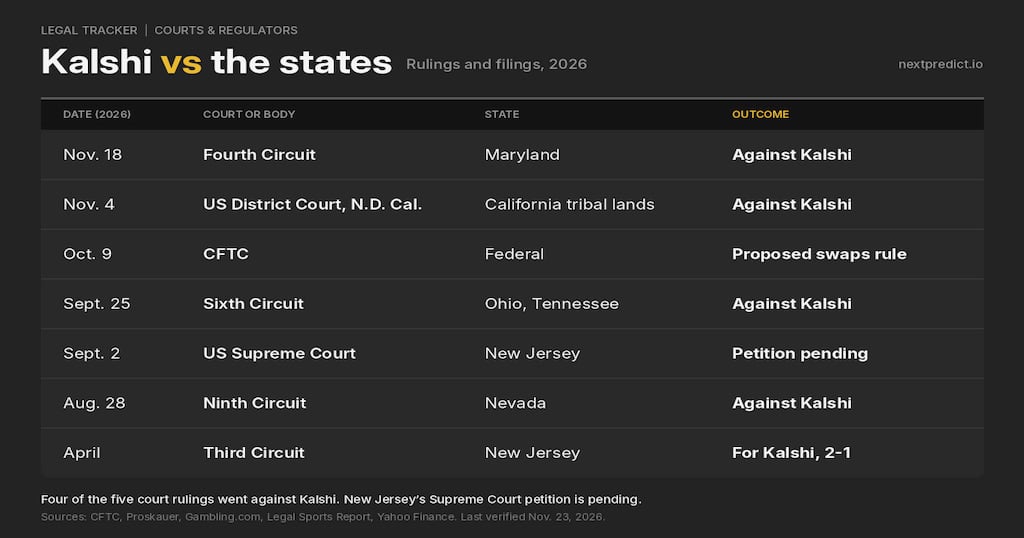
College games add a specific layer. For example, New Jersey’s constitution prohibits gambling on college games held in the state or involving its teams, and the state’s regulator raised that point in its Supreme Court petition.
Missouri shows how fast this moves. In September, its attorney general ordered six platforms to halt sports contracts. On November 10, the state agreed in a joint court filing to pause enforcement against Kalshi while the federal case runs. That pause does not cover the other operators.
The NCAA’s Position
The NCAA wants limits on college sports contracts. On January 14, 2026, NCAA President Charlie Baker asked the CFTC to pause all college sport offerings until stronger safeguards exist. One day later, federal prosecutors unsealed an indictment alleging a scheme to fix college basketball games. Prosecutors said the scheme ran through sportsbooks.
Congress is also involved. A Senate amendment to the Protect College Sports Act would let conferences restrict athletes who trade sports event contracts. However, the bill remains a proposal.
March Madness and the NCAA Tournament
The NCAA tournament is the peak of the college basketball calendar. Selection Sunday sets the bracket, and with it the field for tournament contracts. Bracket-level markets also add round-by-round contracts that the regular season does not offer. This page covers the full season. For tournament pricing, bracket markets and NCAA tournament odds, visit our dedicated March Madness odds page.
Conclusion
College basketball odds and event contract prices answer the same question in different formats. A contract price reads directly as a probability, and traders set it through an order book. Season-long futures, conference markets and award markets let you track that probability from November to April.
Start by confirming the market exists. Then, read the spread to judge how much the price tells you, before confirming your state allows access. For other leagues, start at the Sports Event Contracts Hub.
Frequently Asked Questions
What are college basketball event contracts?
College basketball event contracts are Yes or No contracts on a defined outcome, such as a national champion or a conference title. They trade between $0.01 and $0.99 and settle at $1 or $0. Kalshi and Polymarket US offer them in the United States, and the CFTC oversees both exchanges.
How are event contract prices different from sportsbook odds?
A contract price reads directly as an implied probability. A $0.30 price means about a 30% chance. A sportsbook expresses the same idea as odds, with its margin built in. Traders set exchange prices, while the operator sets sportsbook odds. See prediction market odds explained for the conversions.
Which college basketball markets are available on Kalshi and Polymarket?
On November 23, 2026, both platforms listed a men’s national champion market. Kalshi also listed conference regular-season champions, an undefeated-season market and conference awards. Polymarket also listed Final Four qualifiers, No. 1 seeds, an SEC tournament market and Naismith award markets. Listings change, so confirm on each platform
How do you read the price on a college basketball championship market?
Treat the Yes price as the market’s probability for that team. A team at $0.12 carries a 12% implied chance of winning the title. If it wins, each contract pays $1, and if it loses, each pays $0. The live market shows current prices. Tournament pricing sits on our March Madness hub.
Why are markets on smaller programs harder to trade?
Fewer traders follow smaller programs, so fewer orders rest on the book. That leaves wider bid-ask spreads and more slippage on larger orders. A wide spread also makes the quoted price a weaker probability signal.
Are college basketball event contracts available in every state?
No. Court orders block Kalshi’s sports contracts in some states, including Nevada. Other states have open lawsuits or enforcement actions against several operators. The rules change often, so check Polymarket’s legal states and Kalshi’s status before you trade.
Resources: CFTC | Kalshi | Polymarket | NCAA | Legiscan | ESPN