
The Short Answer
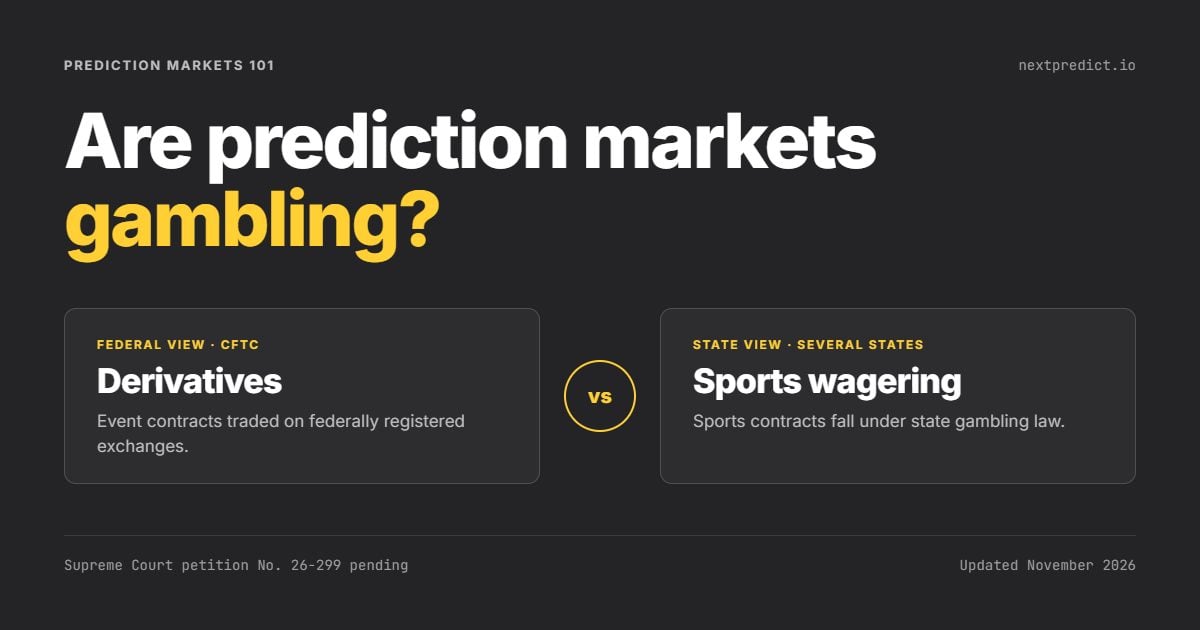
Are prediction markets gambling? The answer depends on who is asked and the specific contract category. The Commodity Futures Trading Commission (CFTC) refers to event contracts as derivatives trading on federally regulated exchanges. However, multiple state regulators and two deferral appeals courts believe sports event contracts are a form of sports betting.
As of November 19, 2026, no court has resolved the question for the entire nation. Disputes over prediction markets vs gambling now sit in the U.S. Supreme Court. New Jersey asked the court to hear Flaherty vs KalshiEX, and following two extensions, Kalshi’s response is now due on December 7, 2026.
The majority of state actions featured on this page surround sports contracts, rather than politics, weather,or economics contracts. On this page, we outline arguments from both sides, as well as what the courts have held to date. It doesn’t reach a verdict of its own, and you can check out our “what is a prediction market?” page if you are new to this.
How a Prediction Market Differs From a Sportsbook
A prediction market exchange allows traders to buy and sell contracts, whereas a sportsbook sets its own prices and takes the other side of your position. This key structural difference is the core of the operator’s argument.
The CFTC describes event contracts as yes-or-no contracts with a fixed payout, usually $1, and a set expiry. If you buy “yes” at 70 cents and the event occurs, you receive $1 at settlement. If it doesn’t happen, you lose your 70 cents. According to the CFTC’s own explainer, the price reflects traders’ perceived probability of the outcome.
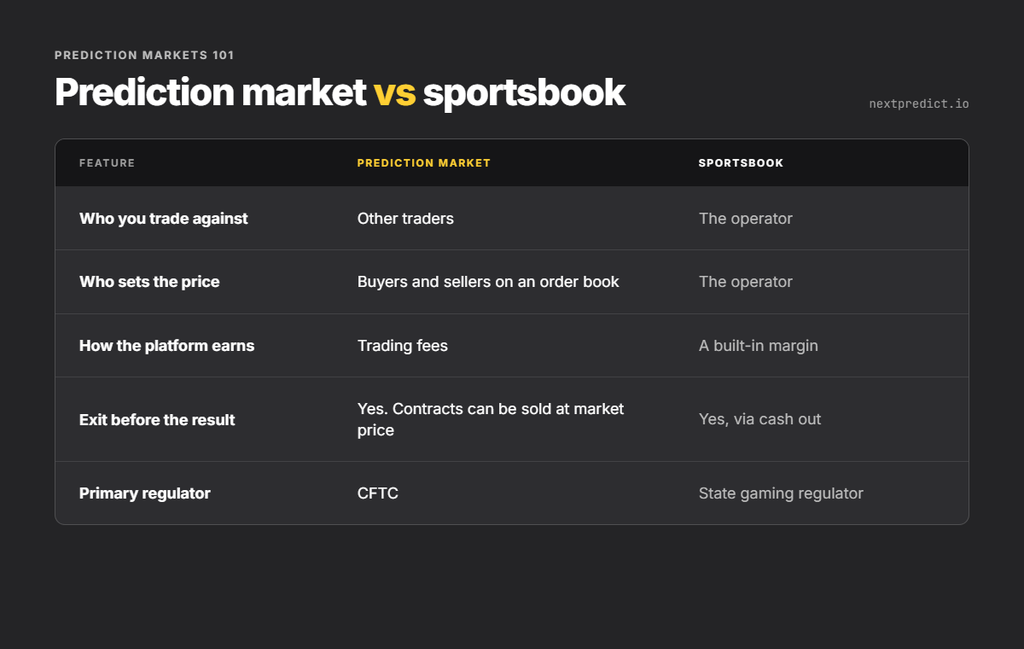
The CFTC believes that regulated exchanges “do not take a side of the trade”. Traders can sell positions before settlement to lock in a profit or cut losses. Learn more about how prices map to probability in our “How event contracts are priced” guide.
Several U.S. states believe a contract on who wins a game is still a stake on a sporting result. Find out more on our prediction markets vs sports betting page.
Who Regulates Prediction Markets
The CFTC regulates prediction markets operating as federally registered exchanges. Its authority comes from the Commodity Exchange Act (CEA), the federal law governing futures, options and swaps. An exchange the CFTC approves is called a designated contract market, or DCM.
The CFTC has overseen event contracts on DCMs since 2004. The 2010 Dodd-Frank Act gave it power to prohibit event contracts it finds contrary to the public interest. The agency now argues that its jurisdiction over swaps on DCMs is exclusive. That claim is the reason state gambling law and federal derivatives law collide.
| Date | Action |
| October 19, 2026 | An interim final rule took effect that excludes casino-style products, including sportsbook wagers, from the definition of swap. |
| October 9, 2026 | The CFTC proposed a rule to define swaps as including sports, political, cultural and weather event contracts. Comments closed November 18, 2026 |
| June 10, 2026 | The CFTC proposed criteria for deciding which event contracts are contrary to the public interest. |
| March 12, 2026 | The CFTC asked for public comment on whether new prediction market rules are needed |
CFTC Chairman Michael Selig called event contracts “commodity derivatives squarely within the CFTC’s regulatory remit.” The CFTC has also sued states that moved against registered exchanges. The states’ Supreme Court brief counts CFTC litigation against at least nine states.
The states push back on the rulemaking itself. Forty-four states opposed the CFTC’s June proposal in July 2026. They also argue that Congress never meant the 2010 Dodd-Frank Act to hand sports gambling to federal regulators.
Where States Disagree
Federal courts disagree on whether states are able to enforce gambling law against sports contracts on CFTC-registered exchanges. The Third Circuit sided with Kalshi, but the Ninth and Sixth Circuits sided with the states.
| Date | Court | Case | What the court heard |
| November 4, 2026 | Ninth Circuit | KalshiEX vs Assad (Nevada) | Denied Kalshi’s request for rehearing. No judge asked for a full-court vote |
| November 3, 2026 | Second Circuit | Kalshi and Coinbase appeals (New York, Connecticut) | Denied injunctions pending appeal. Both states may keep enforcing |
| October 2, 2026 | N.D. Illinois | Coinbase vs Raoul | Partly granted injunctions for Kalshi, Coinbase and the CFTC. Found title-game contracts are likely swaps. |
| September 25, 2026 | Sixth Circuit | Kalshi vs Schuler (Ohio, Tennessee) | Held sports contracts are not swaps. Held federal law would not preempt state law even if they were |
| September 1, 2026 | Ingham County Circuit Court | Michigan Attorney General vs Kalshi | Preliminary injunction barring Kalshi’s sports contracts in Michigan. Requires geofencing, with a $500,000 daily penalty |
| August 28, 2026 | Ninth Circuit | KalshiEX vs Assad (Nevada) | Held sports contracts are likely not swaps. Nevada may enforce its gaming laws |
| April 6, 2026 | Third Circuit | KalshiEX vs Flaherty | Ruled 2-1 that federal law likely preempts New Jersey’s restrictions |
The Sixth Circuit ruling binds federal courts in Ohio, Tennessee, Michigan and Kentucky. The Ninth Circuit found the contracts’ substance “is sports gambling, regardless of whether Kalshi calls them swaps.”
The state position
- Ohio, 38 other states and Washington, D.C. filed a Supreme Court brief on October 7, 2026, backing New Jersey.
- The states argue operators “cannot strip the States of their core sovereign power through relabeling and window-dressing.”
- They say federal preemption would undo state licensing, age limits, exclusion lists, and spending limits.
The operator position
- Kalshi argues its sports contracts are swaps on a DCM, under the CFTC’s exclusive jurisdiction.
- The CFTC backs that reading in court and in its October 2026 proposal.
- In the Illinois case, Judge Martha Pacold wrote, “Whatever the potential for gambling, a swap is a swap.”
Is Kalshi Gambling?
Not according to Kalshi. However, several states say yes. Federal appeals courts have split on the question. So, the answer you get depends on the state you are in and the contract you trade.
Kalshi’s Position
Kalshi is a CFTC-designated contract market and it argues its sports contracts are swaps under the CEA. On that reading, the CFTC alone regulates them and state gambling law does not apply. After the Sixth Circuit ruling, Kalshi spokesperson Dani Lever said, “The ruling shows exactly why a state-by-state patchwork doesn’t work.”
The States’ Position
Michigan Attorney General Dana Nessel sued Kalshi in March 2026 under the state’s Lawful Sports Betting Act. Her office alleges Kalshi offers sports betting to Michigan residents under the guise of event contracts. New York, Nevada, Ohio, Connecticut and other states make similar claims.
What Courts Have Pointed To
- Age: Michigan requires sports bettors to be 21. Kalshi accepts customers from 18. The Ingham County judge cited that gap as a source of harm.
- Licensing: Michigan alleges Kalshi operates without approval from the Michigan Gaming Control Board.
- Geofencing: The Sixth Circuit found Kalshi can comply with both federal and state law by blocking users by location.
Kalshi’s appellate record stands at one win (Third Circuit) and two losses (Ninth and Sixth Circuits). It also lost a bid for interim relief at the Second Circuit. It won a partial injunction in Illinois federal court.
Is Polymarket Gambling?
Polymarket US operates as a CFTC-registered exchange, but states are now testing its sports contracts. The US venue runs through QCX LLC, which the CFTC designated as a contract market on July 9, 2025. A November 24, 2025 amended order of designation let brokers offer it to US customers.
New York sued Polymarket on September 24, 2026, alleging an unlicensed gambling business. The state also objects that Polymarket US accepts traders aged 18 to 20. Polymarket removed the case to federal court and sued New York, arguing the CEA preempts state law. In June 2026, a Michigan federal judge denied Polymarket US a preliminary injunction against state enforcement.
What the Difference Means in Practice
Legality decides who can trade in which states, and on what terms. It changes what traders experience on the app even before any final ruling. This page is general information, not legal advice. Some key points are outlined below:
- Age rules: Kalshi and Polymarket US accept traders from 18. Michigan and New York set 21 as the minimum age for sports wagering. Novig became the first CFTC-regulated prediction market to require users to be 21. The NFL has asked for a 21 minimum across the sector.
- Geofencing: Court orders can force an exchange to block your location. Michigan’s injunction requires Kalshi to use a state-licensed geolocation provider.
- State availability: Sports contracts may be offered in one state and blocked in the next. Check the state legal pages before you trade, because orders change quickly.
- Protections: Platforms are adding tools that state sportsbooks already offer. Polymarket US added deposit limits and self-exclusion by October 2026.
- Tax: The label may affect how your gains are reported. Read the NEXTPredict tax guide and speak to a tax professional.
Most state actions so far target sports contracts. Nevada’s case also covers Kalshi’s election contracts, which the Ninth Circuit sent back to the district court.
Conclusion
As of November 19, 2026, whether prediction markets are gambling remains contested. The CFTC says event contracts are federally regulated derivatives. Many states, backed by the Ninth and Sixth Circuits, say sports contracts are sports wagering. The Third Circuit and an Illinois federal court have sided with the operators.
The Supreme Court may resolve the split. Kalshi’s response in Flaherty v. KalshiEX is due December 7, 2026. The CFTC’s proposed swap definition may also shape the outcome.
Frequently Asked Questions
Are prediction markets gambling?
The answer depends on the contract and the jurisdiction. The CFTC regulates event contracts as derivatives on federally registered exchanges. Several states, and the Ninth and Sixth Circuits, treat sports contracts as sports wagering under state law. The Supreme Court has been asked to resolve the split.
Is Kalshi gambling?
Kalshi says it is a CFTC-regulated exchange, not a gambling operator. Michigan, New York, Nevada, Ohio and other states argue its sports contracts are unlicensed sports wagering. A Michigan court has barred Kalshi’s sports contracts in that state since June 2026, now under a September 1 injunction. The Third Circuit sided with Kalshi in New Jersey.
Is Polymarket gambling?
Polymarket US operates as a CFTC-designated contract market. New York sued it in September 2026, alleging an unlicensed gambling business. Polymarket has countersued, arguing federal law preempts state law.
What is the difference between a prediction market and a sportsbook?
On a prediction market, you trade contracts with other users on an exchange that charges fees. A sportsbook sets the price and takes the other side of your position. States argue the economic substance of a sports contract is the same either way.
Do prediction markets have age limits?
Yes. Kalshi and Polymarket US accept traders from 18. Novig requires users to be 21. Michigan and New York require sports bettors to be 21, and both states cite that gap in their cases.
Resources: CFTC | Congress | Michigan Attorney General | DeFi Rate