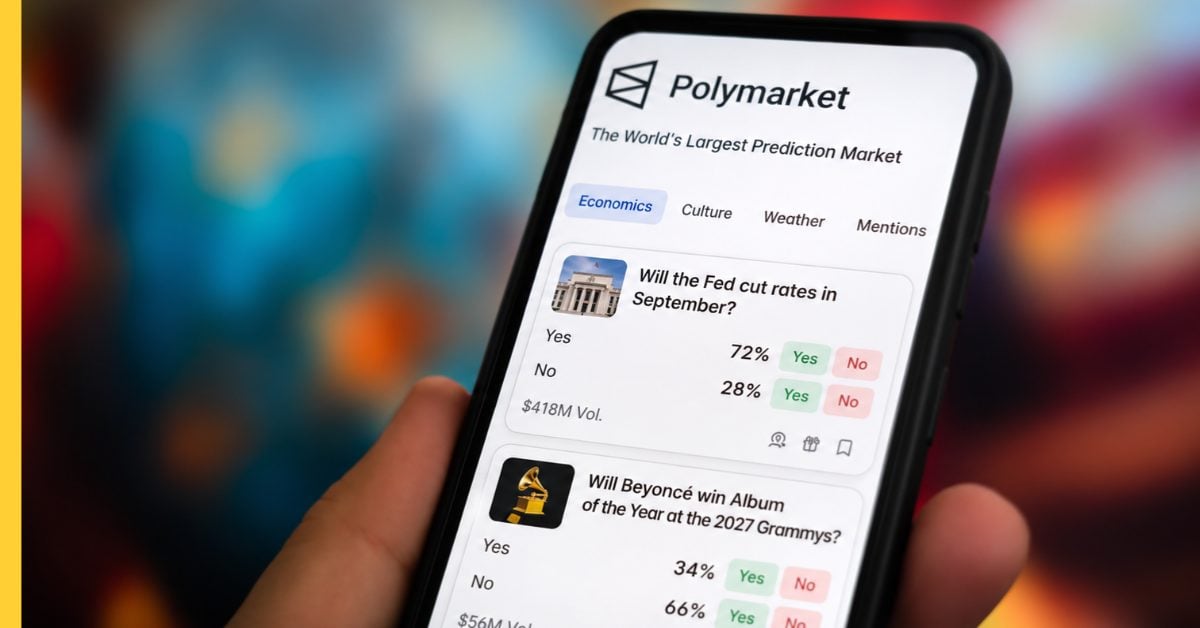
Polymarket will cut taker fees on its international platform by 29% to 86% across six market categories, effective Friday, Nov. 20 at 23:59 UTC, according to the company’s fee change documentation. Most of those categories drop to a 0.01 fee coefficient from 0.04 to 0.07, while 5- and 15-minute bitcoin up/down markets ease to 0.05 from 0.07.
The cut covers economics, culture, weather, mentions, politics excluding elections, and all crypto markets, including the short-term bitcoin contracts.
Not every category gets cheaper. Sports, combos and general markets stay at 0.05, while finance, tech and election markets are going up.
The change applies only to Polymarket International (Polymarket.com). It does not touch Polymarket US, the Commodity Futures Trading Commission (CFTC)-regulated exchange, which moved to a volume-tiered schedule on Nov. 14 with coefficients from 0.0695 to 0.095. Those rates are higher than all of the international platform’s new rates, and also higher than Kalshi’s 0.07 fee rate for anyone trading less than $250,000 a month.
The fee cuts apply to takers, traders whose orders fill instantly against existing orders on the book. Makers continue to pay no platform trading fee, but their rebates come out of taker fees, so a smaller fee pool means smaller payouts.
Who wins, who loses
Polymarket’s fee formula stays the same: shares × coefficient × price × (1 − price). Only the coefficients change.
The coefficient is the multiplier in that formula. At 0.01, a taker buying at 50 cents pays 0.5% of the trade, down from 2.5% at 0.05.
The biggest cut goes to non-short-term crypto markets, which fall from 0.07 to 0.01. Economics, culture and weather drop from 0.05, and mentions and non-election politics from 0.04. Five- and 15-minute BTC up/down markets from 0.07 to 0.05.
Finance, tech and elections move the other way, rising from 0.04 to 0.05. That means the “politics” in Polymarket’s announcement doesn’t include election markets, which will cost more to trade.
Sports contracts stay at 0.05. Combos keep their own 0.05 rate regardless of the individual legs’ categories, and geopolitics stays fee-free.
What it costs at the middle and the edges
In dollars, fees are highest at 50 cents and lower toward both extremes. As a percentage of what you spend, though, longshots pay the most. Under the new 0.01 rate, a contract bought at 5 cents carries a fee of about 1% of the trade, compared with 0.5% at 50 cents and 0.05% at 95 cents.
For 100 shares in an economics, culture or weather market:
| Price | Trade value | Old fee (0.05) | New fee (0.01) | Kalshi* (0.07) |
|---|---|---|---|---|
| 5¢ | $5 | $0.24 (4.75%) | $0.05 (0.95%) | $0.34 |
| 50¢ | $50 | $1.25 (2.5%) | $0.25 (0.5%) | $1.75 |
| 95¢ | $95 | $0.24 (0.25%) | $0.05 (0.05%) | $0.34 |
*Kalshi figures use its standard taker formula, 0.07 × contracts × price × (1 − price), rounded up, per its fee schedule effective July 7.
At a coin-flip price, a $1,000 taker buy in an economics, culture or weather market costs $25 today and $5 after the cut, compared with $35 on Kalshi.
The full fee schedule
Taker fee coefficients on Polymarket International, per Polymarket’s current and Nov. 20 documentation:
| Category | Current | From Nov. 20 | Change |
|---|---|---|---|
| Crypto: all other markets | 0.07 | 0.01 | −86% |
| Crypto: BTC 5- and 15-minute up/down | 0.07 | 0.05 | −29% |
| Economics | 0.05 | 0.01 | −80% |
| Culture | 0.05 | 0.01 | −80% |
| Weather | 0.05 | 0.01 | −80% |
| Mentions | 0.04 | 0.01 | −75% |
| Politics: excluding elections and geopolitics | 0.04 | 0.01 | −75% |
| Politics: elections | 0.04 | 0.05 | +25% |
| Finance | 0.04 | 0.05 | +25% |
| Tech | 0.04 | 0.05 | +25% |
| Sports, including NFL and college football | 0.05 | 0.05 | No change |
| Combos | 0.05 | 0.05 | No change |
| Other / General | 0.05 | 0.05 | No change |
| Geopolitics | 0 | 0 | Fee-free |
Rebates get tighter
Polymarket also rebuilt both rebate programs. On the taker side, Bronze and Silver are gone, so accounts below $200,000 in 30-day weighted volume no longer get a rebate. Polymarket counts weighted volume as shares × price × (1 − price), which is less than the dollar value traded.
Gold through Obsidian keep their thresholds, and a new Onyx tier returns 60% of taker fees to accounts with more than $75 million in 30-day weighted volume. One-time level-up bonuses end.
Makers move from daily rebate pools to volume-based tiers. Those with at least $200,000 in 30-day weighted volume earn 3% to 15% of the taker fees their fills generate, and those below that threshold earn nothing.
Combos still earn no maker rebates. Under the current program, makers in economics, culture and weather markets collect 25% of taker fees. On 100 shares filled at 50 cents, that drops from about $0.31 today to $0.04 at the new top tier, a decline of nearly 90%. Liquidity rewards, which are paid separately, don’t change.
In the categories getting cut, small takers come out ahead even without a rebate. A small taker who mostly trades sports, finance, tech or elections loses the rebate and gets no fee cut to make up for it. For makers in the reduced-fee categories, however, the economics look very different.
Two Polymarkets, two price lists
Kalshi opened its exchange to non-US traders in October 2025, so the two now compete directly for traders outside the US. In the US, most Polymarket US takers pay more than they would on Kalshi.
Polymarket’s cut to mention markets lands as Kalshi pulls back from the same category. Kalshi halted contracts on what President Trump will say on specific dates after the CFTC ordered a pause Friday over manipulation concerns, the Wall Street Journal reported Tuesday, the same day Polymarket announced its fee changes. A Kalshi spokesperson told CBS News the company is “complying with the order.”
Mention markets draw relatively little trading but outsize public interest, the WSJ notes. Polymarket International, which is closed to US traders, isn’t subject to the order, giving it room to keep building out a category where Kalshi is retreating. The CFTC has, however, opened a wide-ranging investigation into Polymarket, the WSJ reported, showing the platform is not completely out of the regulator’s reach.
In its fee update announcement, Polymarket emphasized it was “doubling down” on its “unmatched breadth of markets.”
NEXTPredict.io has reached out to Polymarket for comment on the US schedule and the election, finance and tech increases.
Polymarket’s fee cuts could put pressure on Kalshi, at least outside the US. In economics, weather and culture, Kalshi’s 0.07 rate will cost non-US traders seven times what Polymarket International charges. Kalshi can cut to match, or bet that market makers earning less on Polymarket will shift their quotes to Kalshi, leaving Polymarket’s books thinner and traders willing to pay higher fees for depth.
For now, the main price war is limited to non-US traders in economics, weather and culture.