
Warsaw-based startup Elastics has confirmed a $2m pre-seed raise, which will go towards building artificial intelligence agents for prediction markets.
French venture capital fund Frst led the round. Other notable backers included several angel investors, among them ElevenLabs founders Mati Staniszewski and Piotr Dabkowski, along with Bartek Pucek of Andreessen Horowitz.
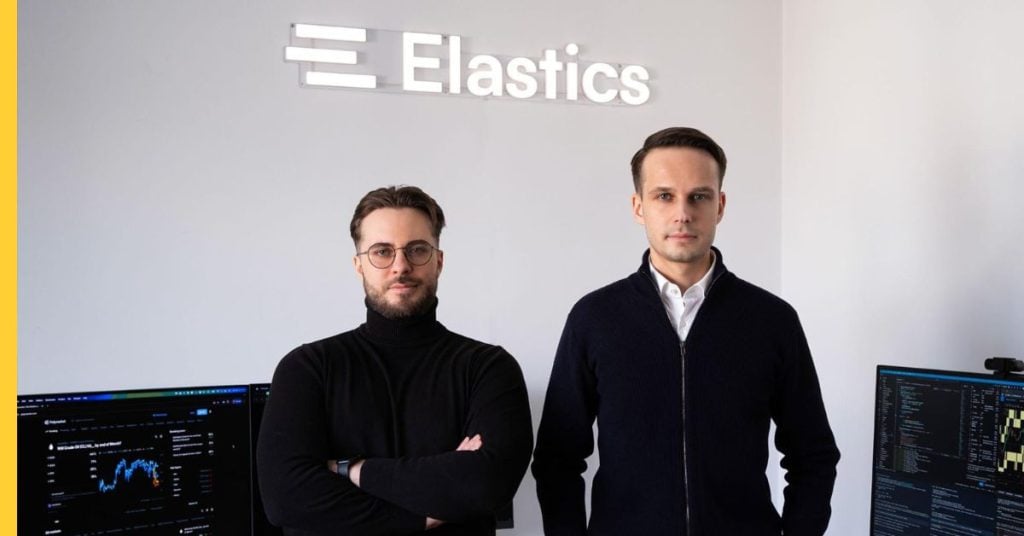
Elastics was founded in April 2025 by Szymon Pawica (pictured right) and Mateusz Brodowicz (pictured left). The company calls itself an AI-native operating system for prediction markets. Its platform uses auditable AI agents that let traders create and automate workflows through plain-language instructions, covering everything from signal generation to live execution.
Pawica, an NYU Stern graduate and former Goldman Sachs employee, said the concept came from a gap he had seen up close.
“The quant edge at hedge funds comes down to people and infrastructure. We think AI can now replicate most of that and make it available to anyone,” he said.
Brodowicz, a mathematician from the University of Houston, previously developed quantitative models for a prediction markets fund.
The new funding will be used to recruit AI and quantitative specialists in Poland.
The funding comes at a time of rapid expansion in the sector. Kalshi, the biggest prediction market in the US, is now valued at $22bn after a $1bn funding round led by Coatue Management. Intercontinental Exchange, the owner of the New York Stock Exchange, has committed almost $2bn to rival platform Polymarket.
Still, retail users on both platforms largely lack advanced trading tools. That is the space Elastics wants to occupy.
XO Market funding also expands prediction market capabilities
In a separate deal, XO Market recently raised $6m in a seed round led by 20VC, Picus Capital, Coinbase Ventures and Venture Together. Angel investors also joined, including Australian cricket captain Pat Cummins. The company is pitching itself as the “YouTube of prediction markets.”
XO’s structure differs sharply from its competitors. Established platforms usually depend on in-house teams to create and approve prediction markets. XO lets individuals and companies launch their own markets, choose the terms and fees and open them up for trading.
Since its mainnet beta went live in mid-November, XO has reportedly handled more than $150m in trading volume. It has also drawn over 30,000 users and recorded more than 600 markets created by users.
XO is also developing XO Vaults. The product will let users combine capital into strategies that supply liquidity across prediction markets, an area currently controlled mainly by professional firms. XO Vaults is aiming for annual yields of about 8% to 10%.
Other user-generated market platforms, including Nine Lives and Warm Protocol, failed to turn the idea into serious liquidity. The result was quiet markets with very little trading activity.
The wider industry has expanded quickly. Total prediction market trading volume passed $50bn in 2025. By early 2026, platforms were processing more than $20bn each month less than a year after Kalshi reported having passed the $1bn mark.
On Polymarket alone, monthly trading climbed from $54m at the beginning of 2024 to more than $2.6bn by the following November.
Regulatory pressure remains a major issue. Some US states claim Kalshi and similar platforms are running unlicensed gambling operations. Kalshi, in particular, is facing more than 20 lawsuits over its legality.
Polymarket is also dealing with lawsuits. Separately, it is under scrutiny over alleged insider trading on its platform linked to geopolitical events.