
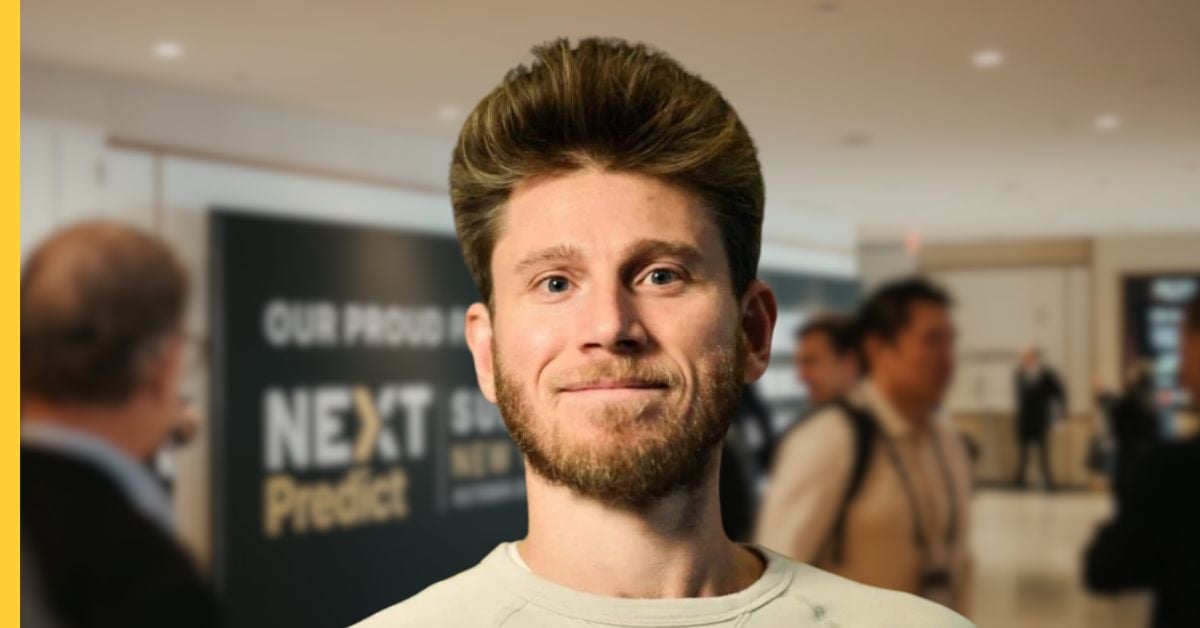
Innovation is what determines the prediction market hierarchy, according to Underdog founder and CEO Jeremy Levine, and he believes it will also shape the next phase of growth, giving challengers a way to close the gap.
While Kalshi is the undoubted market leader, Levine sees a future where his company and other competitors continue to gain ground. In an interview with NEXTPredict.io, he said:
“Kalshi’s market share is the highest it will ever be. It’ll keep going down.”
Levine put Kalshi’s share for the NFL season at around 80%, down from 99% last season, and he expects it to fall substantially in the next year. “Next NFL season it will be 50%.”
NEXTPredict’s October volume report shows Kalshi accounted for $98.15bn of the $126.64bn in notional volume across the eight US exchanges tracked, for around 78% share, based on TickerTracker data.
Measured from the start of the NFL season on Sept 9 to time of publication (Nov 26), the 78% market share is stable for Kalshi, with Underdog taking approximately 2%.
The shape of the trend that Levine is predicting can even be parsed from within that data set – measured exclusively the November statistics, Kalshi’s share falls to 77%, with Underdog’s rising marginally.
Underdog, founded by Levine as a fantasy sports operator, closed its sportsbook in late 2025 and has rebuilt itself around prediction markets, launching its own CFTC-registered exchange. It has since moved into newer verticals, including digital card rips.
Old guard versus new guard
Reflecting on the range of attendees at NEXTPredict Summit New York, Levine noted a key competitive dynamic in the space: “It’s the old guard versus the new guard.”
This applies to the gathering of representatives from historic financial firms and those from the first wave of regulated prediction market start-ups.
“Look at the top for prediction markets, by any metric you want right now,” Levine added. “None of them are the old companies that were in the space. They’re all new innovative companies.”
But within that old versus new dynamic, there is another divide, between Kalshi and other young companies like Underdog and PrizePicks, which made their names by moving first in sports betting-adjacent verticals.
These outfits have forged a share for themselves in predictions now, but they clearly were beaten to the punch initially.
Speed is part of Underdog’s pitch, but Levine admits first movers like Kalshi, Crypto.com and Polymarket had a significant edge. They found a way to launch under the regulatory framework of the time, and everyone else was playing catch-up.
“We move fast, but it was a year and a half behind,” Levine said. “That’s a huge advantage.”
The next product race in prediction markets
For a long time, the prediction market products and their regulatory positioning were the innovation, and it’s that which propelled the first movers and helped Kalshi build its seemingly unassailable lead.
But another theme of the NEXTPredict Summit New York conference was the sense that the base prediction market product has leveled out across the different exchanges to a certain extent, creating the foundations for the next big move in the space.
Underdog’s digital card rips were given a revamp on Nov 24, leaning into the vertical while toughening up consumer protection measures at the same time.
It first launched the vertical in September but version two makes the experience a little more interactive and adds ‘GuardDog,’ a mechanism designed to help customers set play limits and cool-off periods.
Kalshi has not been sitting still either, but has been innovating in a different direction – its perpetual futures reportedly surpassed the trading volume of its event contracts on both Nov 19 and 20, according to CNBC.
If this trend becomes routine, then we could be seeing the market leader transforming into a different beast altogether, and perhaps with different priorities.
While Underdog and Levine are laser-focused on appealing to those sports-focused customers, Kalshi is doing everything to ensure it has a strong business model beyond sports.
“I always believe in product innovation, and I think there’s always more to be built,” Levine told NEXTPredict.io. “Now, customers have all these things in all the states, and now the question is: Can you build something like that that’s really going to resonate?”
Winner takes all?
NEXTPredict.io put it to Levine that in the long-term, this could be a winner takes all market, though the founder disagreed.
He thinks there will be more fluidity in the pack, and on the 50% market share he sees Kalshi having next NFL season, he said: “It’s still great. That’s better than any one else is going to have. But I don’t think it’s a winner takes all market.”
He also doesn’t think a new name will emerge as a disruptor at this point: “I don’t think you’re going to see someone come in a couple years and change it.”
If Underdog was to make headway in that direction, to the extent that it was challenging Kalshi, that would of course be the realization of a great ambition for the operator. But to do so, Levine believes a company must concentrate its efforts where they’re most effective.
“Ultimately, it’s what are you going to focus on, right? For us, it’s just about focusing on the sports fan, getting the best experience for them, being the best place for them and building innovative experiences for them.”