
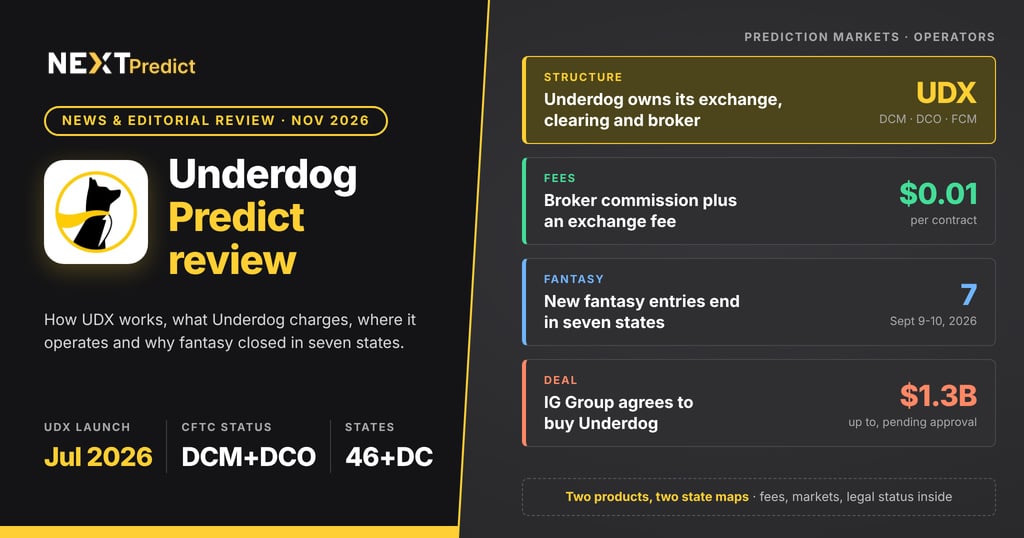
Underdog prediction markets trade on UDX, a CFTC-registered exchange the daily fantasy sports operator launched on July 18, 2026. They bought the exchange, then named Aristotle Exchange, in March 2026 and also holds a futures commission merchant registration. Underdog predictions also route to Kalshi and Crypto.com, depending on the market, alongside the sports event contracts listed on UDX.
This page sets out how the Underdog Predict exchange works, from contract listing and clearing to the app customers use. The sections below also explain UDX trading fees, state availability, and the routing between UDX and outside exchanges.
What Is Underdog and What Is UDX?
Underdog is a fantasy sports operator founded in 2020, with Pick’em contests and Best Ball drafts as its core products. UDX is a separate business, a designated contract market (DCM) Underdog acquired in March 2026.
Underdog launched UDX as its own exchange on July 18, 2026, under CFTC oversight. Underdog prediction markets reach customers through the Underdog app, which also carries fantasy contests in states where those remain licensed.
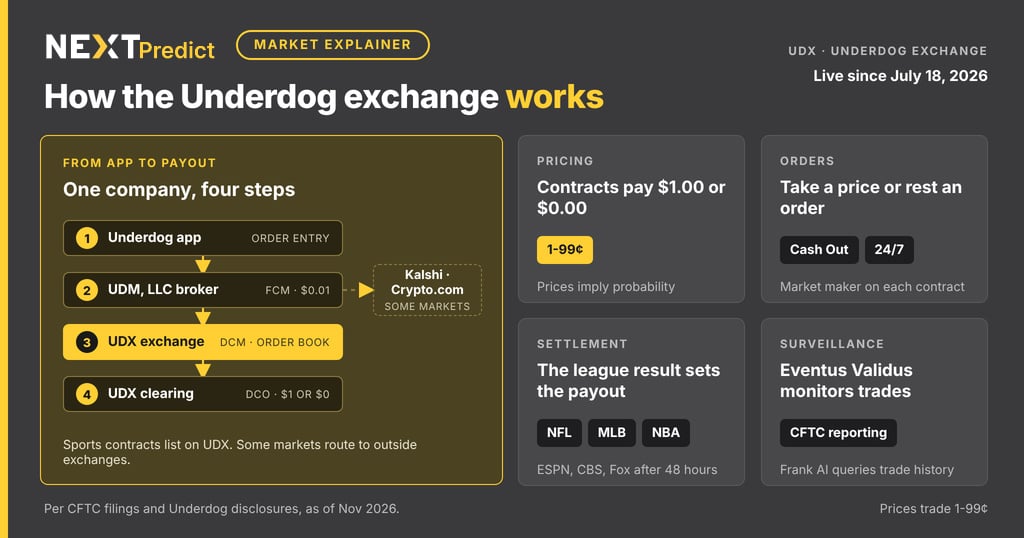
The CFTC designated the exchange, then named Aristotle Exchange DCM, on September 5, 2025. Its clearinghouse, Aristotle Exchange DCO, registered with the CFTC on the same date. The DCM license lets UDX list and trade event contracts, and the DCO license lets it clear and settle them. A separate subsidiary, UDM, LLC, holds futures commission merchant registration and handles customer accounts under the Underdog Predict brand.
Underdog’s help center lists sports contracts only, covering the NFL, NBA, WNBA, NHL, MLB, college football and college basketball, and soccer. MMA, esports, tennis and season-long futures complete the list. Underdog’s launch announcement referenced culture markets, and some non-sports Underdog predictions route to outside exchanges rather than UDX.
IG Group agreed to acquire Underdog for up to $1.3 billion in a deal subject to regulatory approval. The deal covers the full license stack of brokerage, exchange, and clearing.
How UDX Works: Markets, Order Types and Settlement
The Underdog exchange lists binary event contracts priced between $0.01 and $0.99, in increments of $0.01. Each contract pays $1.00 if the stated outcome occurs and $0.00 otherwise. The price reflects an implied probability, as our guide to how event contracts are priced explains.
Listed contracts cover game winners, spreads, totals and player props across major leagues. The market list includes NFL event contracts and NBA event contracts, along with baseball, hockey (NHL), golf and international soccer including Premier League event contracts. UDX also lists combination contracts linking several outcomes in a single position.
Traders take an existing price or post a resting order, which waits in the order book for a match. Prediction Cash Out sells an open position at the current market price, provided a buyer exists. Trading runs around the clock outside scheduled maintenance windows, and at least one market maker supplies liquidity on each contract.
Each contract names a primary source agency, usually the league itself, such as the NFL or MLB. If the league publishes no result within 48 hours, UDX consults ESPN, CBS Sports and Fox Sports in sequence. Revisions published after expiration do not change the settlement value. Some NFL and MLB contracts use Kalshi’s published market price as a second settlement source for a win-probability condition.
UDX monitors trading through Validus, a trade surveillance platform from Texas-based Eventus Systems. Underdog says it reports required findings to the CFTC under its DCM obligations. The exchange also uses Frank, an Eventus AI tool, to query historical trading data.
Underdog Fees
Underdog prediction markets carry two layers of fees, one from the broker and one from the exchange. UDM, LLC charges $0.01 per contract on every buy and every sell, and UDX adds an exchange fee. Contracts routed to Kalshi carry Kalshi’s own exchange fees instead of UDX fees.
| Fee | Product | Rate | Date |
| Broker commission | Underdog Predict (UDM, LLC) | $0.01 per contract, per buy or sell | Nov 2026 |
| UDX taker fee | Orders filling against a resting order | 0.07 x contracts x price x (1 – price), up to $1.75 per 100 contracts at 50¢ | Effective Oct 31, 2026 |
| UDX maker fee | Resting orders, charged on fill | 0.035 x contracts x price x (1 – price), up to $0.88 per 100 contracts at 50¢ | Effective Oct 31, 2026 |
| Kalshi-routed trades | Markets listed on Kalshi | Kalshi fee schedule | Nov 2026 |
| Fantasy contests | Pick’em and Drafts | Entry fee per contest, no per-contract fee | Nov 2026 |
| Deposits and withdrawals | Underdog wallet | Free, with a $4 monthly inactivity fee after 18 months | Nov 2026 |
A $100 position at 50¢ buys 200 contracts, which carries $2.00 in commission and $3.50 in UDX taker fees. Selling before settlement triggers both charges again.
Where Underdog’s Prediction Markets Are Available
According to its eligible-states list, Underdog prediction markets operate in 46 states and Washington DC, as of November 2026. The product remains unavailable in Arizona, Michigan, Nevada and New York, along with US territories. Availability follows the trader’s physical location at the time of each trade, with 18 the minimum age in most states. Higher limits apply in some states, including Massachusetts and Virginia at 21.
The footprint stood at 31 states plus DC in April 2026. Underdog added Massachusetts on September 4, 2026, shortly before ending fantasy contests there. Fantasy availability follows a separate state list, covered in the next section.
Several states listed as open have challenged Underdog’s sports contracts, including Connecticut, Missouri and Tennessee. Connecticut sent a cease-and-desist letter before Underdog sued on September 15, 2026, and Tennessee ordered a halt on October 9.
Missouri’s attorney general demanded Underdog stop or obtain a state license on September 17, 2026. Underdog also filed suits against Massachusetts, Ohio, Wisconsin, New Mexico and Washington officials on September 8, 2026.
Our state legal pages set out the legal position in each state, and other venues publish separate lists. Readers comparing footprints will find Polymarket’s position in our guide to whether Polymarket is legal in the US.
The DFS Business and Why It Shut Down in Some States
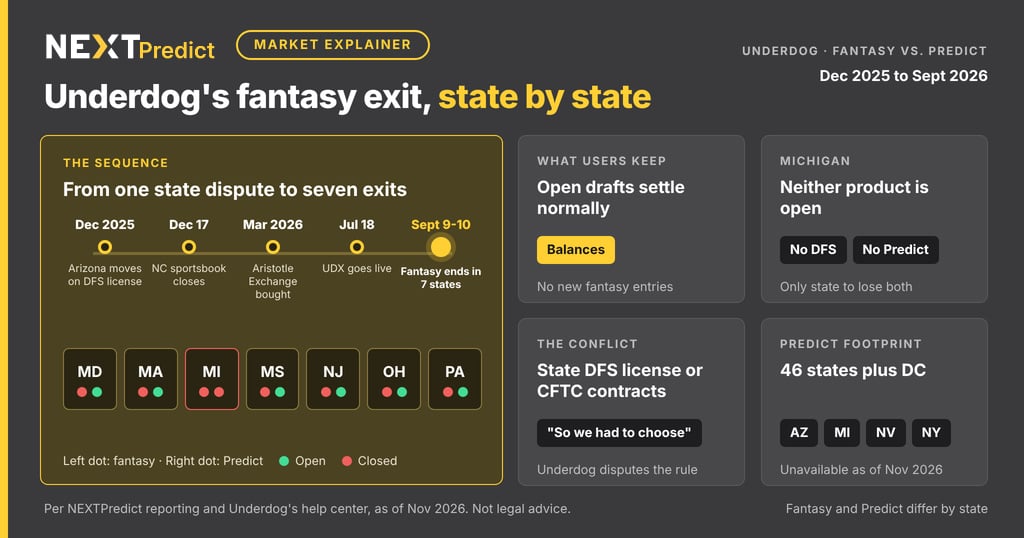
Underdog’s move into prediction markets brought its fantasy licenses into conflict with state regulators, starting in Arizona. Arizona regulators moved to revoke Underdog’s fantasy license in December 2025 over its prediction market partnership with Crypto.com. Underdog’s prediction markets were not offered in Arizona at the time.
In North Carolina, Underdog closed its licensed sportsbook on December 17, 2025, keeping its fantasy and prediction market products there. Unresolved futures paid out at the maximum amount, and unused sportsbook funds moved into fantasy balances.
Underdog ended new fantasy entries in seven states on September 9 and 10, 2026. The states are Maryland, Massachusetts, Michigan, Mississippi, New Jersey, Ohio, and Pennsylvania. Regulators in those states bar a fantasy licensee from offering CFTC-regulated contracts, a position Underdog disputes. Chief executive Jeremy Levine wrote, “So we had to choose.”
Users in the seven states keep drafts entered before the cutoff, which run to completion and settle normally. They keep access to withdrawable balances, though new fantasy entries are closed. Prediction Picks remain open in six of the seven states, with Michigan the exception, where neither product accepts new activity. Both products share one app and wallet, with fantasy balances under state rules and Predict accounts under CFTC rules.
Our guide to fantasy sports vs prediction markets sets out the regulatory split between the two products. At PrizePicks, owner Allwyn reported no sign of cannibalization between fantasy and prediction markets in June 2026.
Underdog vs. Kalshi, Polymarket and the Sportsbook Exchanges
Underdog competes with general prediction market platforms and with sports-first exchanges launched in 2026. The table compares each venue on fees, sports coverage, non-sports coverage and state availability, with the date behind each figure.
| Venue | Fees | Sports coverage | Non-sports coverage | Availability |
| Underdog (UDX) | $0.01 commission plus UDX taker fee up to $1.75 per 100 contracts | NFL, NBA, MLB, NHL, college, soccer, MMA, tennis | None listed in help center | 46 states + DC, not AZ, MI, NV, NY |
| Kalshi | Taker fee 0.07 x price x (1 – price), up to $1.75 per 100 contracts | Major US and international leagues | Politics, economics, weather, culture, crypto | Not available in MI or NV |
| Polymarket US | Taker fee 9.5% x price x (1 − price) under $10,000 monthly volume | Major US and international leagues | Politics, crypto, culture and more | Not available in NV |
| Novig | No fee on pre-game straight trades | Sports only, major leagues | None | 47 states, not AZ, MI, NV |
| ProphetX | Fee charged on net gains per market | Sports-led, major leagues | Election contracts added | 49 states + DC, not NV |
Underdog and Novig limit their catalogs to sports, while Kalshi and Polymarket US carry broad non-sports coverage. ProphetX sits between the two groups after adding election contracts in autumn 2026.
Underdog’s fee puts a broker commission on the exchange fee, while Kalshi, Polymarket US and ProphetX charge exchange fees directly. Fee comparisons depend on contract price, since formula-based fees peak at 50¢ and shrink toward 1¢ or 99¢.
Underdog distributes its prediction markets through an app with an existing fantasy customer base, unlike the standalone exchanges. Our guide to which sportsbooks offer prediction markets covers operators running both product types.
Conclusion
UDX is Underdog’s own CFTC-regulated exchange, listing and clearing sports event contracts since July 18, 2026. Customers reach it through Underdog Predict, the brokerage inside the Underdog app, which routes some markets to Kalshi and Crypto.com. Fees combine a $0.01 broker commission with a UDX exchange fee, and the product operates in 46 states plus Washington DC.
Fantasy contests follow a separate state map after Underdog ended new entries in seven states in September 2026. Our fantasy sports hub explains how the two products differ under state and federal rules.
Readers comparing venues will find the full field on our platforms hub, with detailed profiles of Kalshi, Polymarket and many more.
Frequently Asked Questions
What is UDX?
UDX is Underdog’s own exchange, registered with the CFTC as a DCM and derivatives clearing organization. Underdog acquired it as Aristotle Exchange in March 2026 and launched trading on July 18, 2026. UDX lists and clears sports event contracts offered through the Underdog app.
Is Underdog a prediction market or a fantasy app?
Underdog runs both as separate products with separate state footprints. Its fantasy contests operate under state licenses, while Underdog Predict offers CFTC-regulated event contracts through the same app. In September 2026, Underdog ended new fantasy entries in seven states and kept prediction markets open in six of them.
What states are Underdog’s prediction markets available in?
As of November 2026, Underdog prediction markets operate in 46 states and Washington DC. They remain unavailable in Arizona, Michigan, Nevada and New York. Access follows the trader’s location during each trade, and our state legal pages set out the legal position.
Why did Underdog shut down daily fantasy in some states?
Regulators in seven states barred fantasy licensees from also offering CFTC-regulated contracts, a position Underdog disputes. Underdog ended new fantasy entries in Mississippi on September 9, 2026, and in the other six states on September 10. Arizona had moved to revoke its fantasy license in December 2025.
What does Underdog charge to trade?
Underdog Predict charges a $0.01 commission per contract on each buy and sell, as of November 2026. UDX adds a taker fee of up to $1.75 per 100 contracts under a schedule effective October 31, 2026. Fantasy contests carry separate entry fees.
How does Underdog compare to Kalshi?
Both venues charge taker fees of up to $1.75 per 100 contracts, and Underdog adds a $0.01 broker commission. Kalshi lists politics, economics, weather and culture contracts, while Underdog’s help center lists sports only. Kalshi is unavailable in Michigan and Nevada, and Underdog in Arizona, Michigan, Nevada and New York, as of November 2026.
Resources: Business Wire | Underdog | CFTC | Missouri AG | Court Listener | iGB