
Polymarket on Wednesday expanded its international offering of prediction markets tied to the cost of AI computing power, unveiling a forward pricing tool for three Nvidia chip models extending through the end of 2028.
The launch builds on Polymarket’s efforts to establish a role for prediction markets in AI infrastructure financing. The platform facilitated its first institutional block trade tied to graphics processing unit (GPU) rental prices in June, four months after it began listing GPU rental price contracts.
In an announcement on X, Polymarket founder and CEO Shayne Coplan laid out a broader vision for developing a financial market around one of the AI industry’s most significant expenses.
“We think compute could become one of the largest financial markets in the world,” Coplan wrote. “This launch is Polymarket’s first step toward building it.”
The expansion comes as several US-regulated exchanges, including Kalshi, CME Group and Polymarket’s own domestic platform, pursue compute derivatives amid regulatory uncertainty over the emerging asset class.
Pricing the future of AI compute
Polymarket‘s new compute dashboard displays market-implied forecasts for the hourly rental cost of Nvidia’s H100, B200 and B300 GPUs, with additional chips and contract periods to follow.
GPUs provide much of the computing power needed to train and run AI models. Companies can rent access to the hardware rather than purchase it outright, with prices fluctuating according to factors such as demand, available capacity and the introduction of newer chip models.
Polymarket’s new markets allow traders to buy and sell binary event contracts on whether average rental prices for a particular GPU will exceed specified thresholds in a given month.
For example, one set of contracts asks whether the average hourly rental price for an H100 will exceed various thresholds ranging from $0.25 to $13 in December 2028. The contracts reference the rental price index published by compute data provider Ornn.
By combining the implied probabilities of contracts across multiple price thresholds and expiration dates, Polymarket generates a forward curve showing where traders expect rental prices to go. The platform calls the metric the Polymarket-implied Rental Price (PIRP).
“Think of it as a yield curve for the cost of compute: the forecasted $/hour price of each chip at every expiry, and whether it’s trending up or down,” Coplan wrote.
As of Wednesday afternoon, Ornn’s H100 index put the chip’s hourly rental price at $3.25, up 10.9% over the past week. Polymarket’s forward curve implied a decline to $3.03 in December 2026, $2.67 in December 2027 and $2.16 in December 2028, a 33% reduction from current levels.
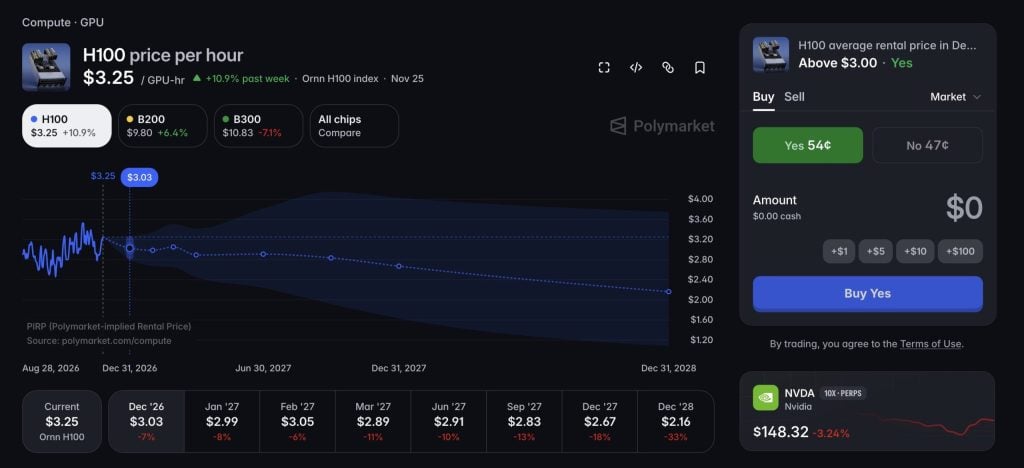
The dashboard also provides a range of potential rental prices for each expiration date and allows traders to request quotes for large transactions or combinations of contracts spanning multiple price thresholds and months.
Coplan sees opportunity in AI financing
While the markets give traders another way to gain exposure to the economics of the AI industry, Coplan emphasized their potential applications for the companies buying, supplying and financing computing capacity.
“Hundreds of billions of dollars are being committed to compute years in advance,” Coplan wrote. “Many of those deals are essentially a levered bet on what GPUs will rent for in the future (what could go wrong lol)”
For infrastructure providers investing billions in hardware and data centers, falling GPU rental prices could undermine the profitability of those investments. Conversely, companies purchasing computing capacity face the risk of rising costs if demand outpaces supply.
An infrastructure provider could use event contracts that pay out if rental prices fall below certain levels to offset some of its potential revenue losses. An AI developer could take the opposite position to help protect against rising costs.
Beyond hedging, a publicly accessible forward pricing curve could help companies negotiate long-term computing capacity agreements and lenders assess the future earning potential of the hardware they are financing.
“This will change how compute gets bought and financed,” Coplan said. “Every contract negotiation and every GPU loan will have a market price to check against.”
The June block trade provided an early example of that commercial application. The six-figure transaction, involving digital asset prime brokerage FalconX and AI risk infrastructure company AneraLabs, was tied to H100 rental prices and helped hedge costs associated with an agreement for future computing capacity.
The depth and liquidity of Polymarket’s expanded markets will be important in determining how effectively they can accommodate larger commercial hedges.
US compute derivatives face regulatory hurdles
The development of compute derivatives has attracted interest from both prediction market operators and some of the world’s largest financial exchanges.
In March, Kalshi began listing event contracts tied to GPU rental prices, before introducing its own compute forward curves in July.
In September, however, the US Department of Commerce reportedly pressed Kalshi to remove its forward pricing tool over national security concerns and separately urged federal commodities regulators to pause new compute contract approvals for 60 days.
The Commerce Department denied the report, which originated with Semafor. While Kalshi reportedly removed the pricing tool, NEXTPredict.io found that the forward curves were visible again by Sept. 16.
The Commodity Futures Trading Commission (CFTC) issued a request for public comment in August on the listing of compute derivatives, examining issues including the reliability of pricing benchmarks, liquidity and susceptibility to market manipulation.
Interest in the sector has persisted. Earlier this month, reports emerged that Kalshi was seeking another funding round at a $65bn valuation, with a source telling Reuters that the proposed financing would help fund the development of a compute futures trading platform.
Bloomberg reported last week that Kalshi was working with Compute Desk, a provider of GPU rental price benchmarks that is also working with other derivatives exchanges, on its planned futures contracts.
Intercontinental Exchange (ICE), the parent company of the New York Stock Exchange, announced a partnership with Ornn in May to introduce GPU compute futures but had yet to establish a listing date in its September update.
CME Group’s planned October launch of compute futures based on rental price indices from Silicon Data was also postponed.
In a Nov. 4 letter to the CFTC, CME subsidiary New York Mercantile Exchange agreed to extend the agency’s review period through Jan. 8, 2027, on the condition that competing registered exchanges do not certify, obtain approval for or list comparable contracts in the interim.
Polymarket US awaiting its compute debut
Polymarket’s federally regulated US exchange has also laid the groundwork for entering the compute derivatives market.
In an Aug. 20 filing with the CFTC, Polymarket US self-certified a class of compute index value contracts, indicating that it intended to begin listing them no earlier than Aug. 24.
The proposed offering extends beyond GPU rental prices to include contracts tied to the cost of processing AI tokens — the units of information processed by AI models — from developers including OpenAI, Anthropic, Google and DeepSeek.
However, compute markets were not available on Polymarket’s US platform as of Wednesday.
For now, Coplan is looking to expand the international platform’s offering, directly soliciting feedback from businesses involved in purchasing, supplying and financing computing power.
“As AI financing sobers up, the labs buying compute, the providers selling it, and the lenders financing it will all need to hedge that risk,” Coplan wrote.