

The US Department of Commerce pressed Kalshi to unpublish an AI compute pricing tool and separately urged the Commodity Futures Trading Commission to pause new compute-contract approvals for 60 days, according to a Semafor report.
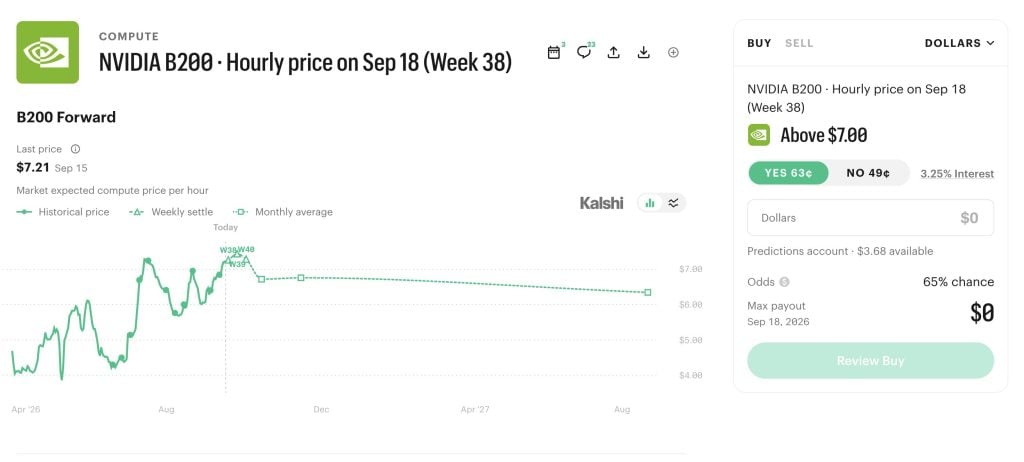
The reported intervention involved Kalshi’s GPU compute forward curve, a non-tradable tool built from several markets to show where traders expected Nvidia chip rental costs to move.
Semafor reported that Kalshi “quietly complied” with the request last month. But forward-curve displays for B200, H100, H200 and A100 were visible on Kalshi market pages as of Wednesday, Sept. 16.
The Commerce Department disputed the report. A spokesperson told Semafor the department “has never once asked Kalshi to take down this market or any other markets,” while another said, “This story is false.”
Semafor did not report that Commerce ordered Kalshi to remove the underlying contracts. Instead, it said officials directed Kalshi to unpublish the forward curve over national security concerns and separately pushed the CFTC to effectively halt approval of new compute contracts.
Kalshi forward curves visible again
Kalshi launched the GPU pricing feature in July, using contracts with weekly, monthly and quarterly expirations to estimate future rental costs for Nvidia chips including the A100, H100, H200 and B200.
The company said the curves let users see “what the market expects” compute to cost at different points in the future. A July 22 Kalshi Research report, for example, showed its B200 curve falling from about $7.20 per hour to $5.50 as traders anticipated increased supply.
There is evidence the feature was unavailable for at least part of the period described by Semafor. A Sept. 2 post on X showed an H100 market page without the forward-curve display and asked whether Kalshi had removed the view.
As of Wednesday, however, Kalshi pages for B200, H100, H200 and A100 were again displaying “Forward” charts with market-implied prices extending beyond the present. It remains unclear when the feature returned or whether its temporary disappearance was connected to the reported Commerce intervention.
CFTC had touted Commerce partnership
The reported push came only weeks after CFTC Chairman Michael Selig publicly described the Commerce Department as a partner in developing US compute markets.
On Aug. 19, the CFTC opened a 60-day request for comment on compute derivatives, seeking input on liquidity, market manipulation, customer protections and perpetual futures.
Selig called it “the first step toward establishing clear rules of the road for American compute markets.”
A day later, Selig told the CFTC’s Innovation Advisory Committee, “we’re partnering with the Department of Commerce to get this done.” He said feedback from the review would help shape a regulatory framework for compute markets.
New compute products face different regulatory paths
The reported pause came as several exchanges were pursuing new products tied to future compute prices, using different contract structures and CFTC filing routes.
Polymarket US operator QCEX self-certified two Compute Index Value Contracts on Aug. 20, one day after the CFTC announced its request for comment on compute derivatives. The binary event contracts let traders take positions on whether a GPU price index will be above a specified level at a future date. The CFTC lists them as certified, although they do not appear to have launched on Polymarket US.
CME-owned NYMEX took a different route. Its proposed H100 and B200 products are conventional futures tied to Silicon Data GPU rental-price indexes and were submitted for formal CFTC approval on Aug. 11.
Those contracts remain listed as ‘Approval Pending (45),’ meaning they are still within the CFTC’s initial 45-day review period for products submitted for formal approval.
Semafor did not specify whether the reported 60-day pause applied to all new compute listings or only products requiring formal CFTC approval. It said the pause could delay planned products from CME, ICE and Architect Financial Technologies.
National security concern remains unclear
Semafor said Commerce officials cited national security concerns, but reported that the specific reason for the intervention was unclear.
Market participants told the outlet one possible concern was that thinly traded compute markets could be manipulated, or move sharply on their own, in ways that suggested older Nvidia chips were rapidly losing value. AI infrastructure providers including CoreWeave have used older GPUs to secure billions in debt. Chip values also factor into data-center transactions.
Semafor described the opposite risk as another source of uncertainty, with companies expanding their use of AI concerned that limited power and infrastructure could make compute more expensive. That volatility is helping create demand for ways to manage future costs.