
Is Kalshi legal in Michigan? Kalshi and other prediction market platforms remain active in The Wolverine State, but selected contract categories are restricted. This page outlines the current legal status, key court orders, and Michigan’s sports betting laws.
Prediction Markets in Michigan: Where Things Stand
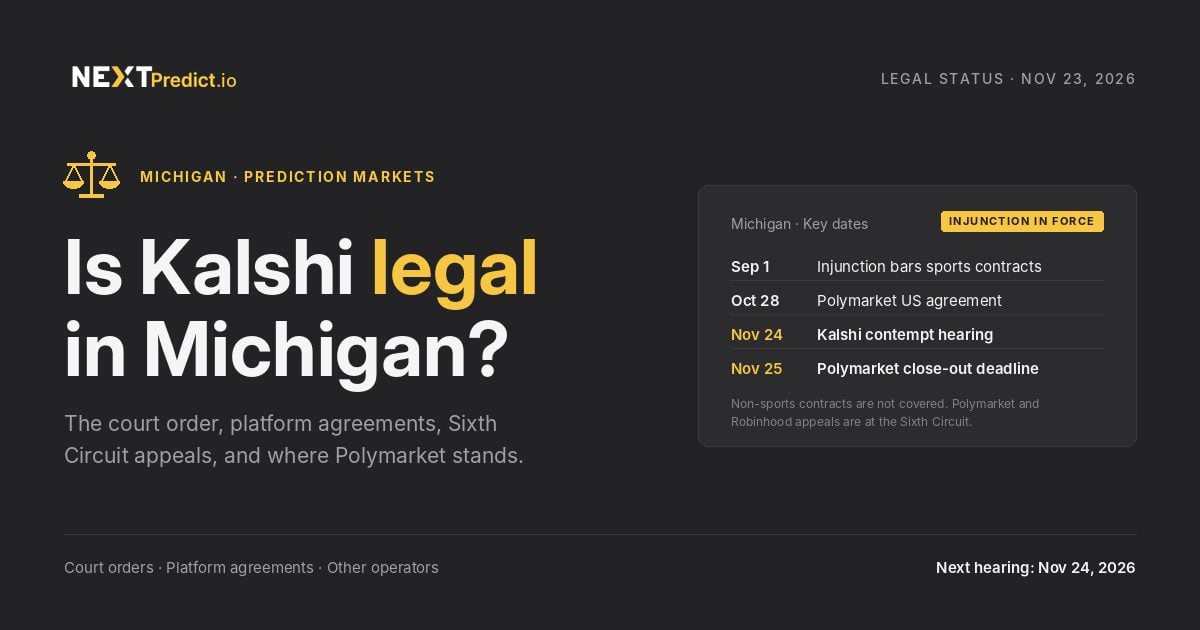
There is no clear answer to “is Kalshi legal in Michigan?”. Access varies between platforms and contract types, with an Ingham County Circuit Court preliminary injunction signed on September 1, 2026, blocking Kalshi from offering sports event contracts to anyone located in the state.
Polymarket US, Robinhood, and Coinbase have all reached an agreement with the Michigan Gaming Control Board (MGCB) to stop offering sports contracts to Michigan traders. As of November 23, 2026, legal action taken by the state has targeted sports contracts only.
Economics, politics, culture, and weather contracts are not covered by the Kalshi order or three agreements with Polymarket, Robinhood, and Coinbase. The table below shows the status of prediction markets as of November 23, 2026.
| Platform | Sports contracts | Non-sports contracts | Legal basis | Date |
| Kalshi | Barred | Not covered by the order | State court preliminary injunction | Signed September 1, 2026 |
| Polymarket US | No new contracts. Open positions closed by November 25 | Not covered by the agreement | Court-approved stipulation with the MGCB | Announced October 28 2026 |
| Robinhood | No new contracts. Positions closed by October 9 | Not covered by the agreement | Court-approved stipulation | Announced September 9, 2026 |
| Coinbase | No new contracts. New positions closed by October 10 | Not covered by the agreement | Court-approved stipulation | Announced October 7, 2026 |
| Crypto.com | Not offered in Michigan | Not stated | Company decision | December 2025 |
Three questions remain unanswered. A contempt hearing against Kalshi is set for November 24. The Sixth Circuit has not ruled on the Polymarket and Robinhood appeals, and a federal directive on geofencing takes effect December 5.
Michigan’s Sports Betting Law
Kalshi’s case with Michigan rests on the Lawful Sports Betting Act, Public Act 149 of 2019. Governor Gretchen Whitmer signed it on December 20, 2019, and it took immediate effect. Retail sportsbooks opened in March 2020, and online platforms went live on January 22, 2021.
The Act gives the Michigan Gaming Control Board licensing authority over internet sports betting. Three rules matter for prediction markets:
- Licensing: Only Detroit’s commercial casinos and federally recognized tribes holding an internet sports betting license, according to the Attorney General’s complaint.
- Age: The Act defines an authorized participant as someone at least 21 years old. Kalshi accepts customers from age 18.
- Enforcement: The Attorney General is able seek injunctions against unlicensed operators, and the Act also carries civil and criminal penalties.
The age gap was key to the Kalshi case. Judge Rosemarie Aquilina cited the risk to Michigan residents aged 18 to 20 upon granting the first restraining order. She also cited the advantage Kalshi holds over licensed operators paying state tax and following MGCB rules.
The broader debate over whether prediction markets are gambling turns on the same distinction. Michigan treats a sports contract as a sports wager, while platforms treat it as a federally regulated derivative.
Kalshi in Michigan
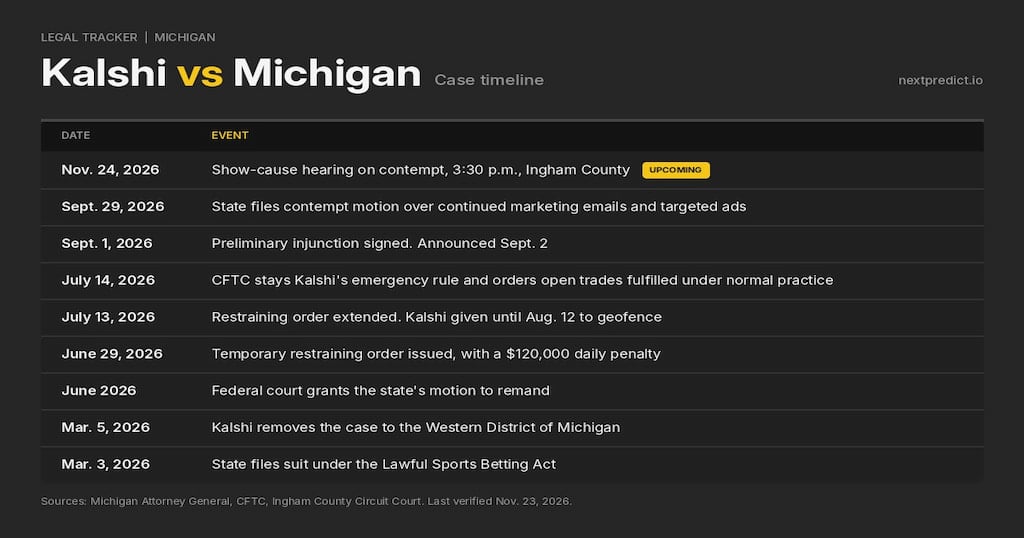
Kalshi traders in Michigan can’t buy sports event contracts while the state’s lawsuit proceeds. Attorney General Dana Nessel sued KalshiEX LLC in Ingham County Circuit Court on behalf of the state and the MGCB, case No. 26-001087-CZ. Court records show a March 3, 2026, filing date, and the Attorney General announced the suit on March 5.
The September 1 Injunction
Judge Rosemarie Aquilina signed the preliminary injunction on September 1. The order requires Kalshi to:
- Stop offering, listing, executing, clearing or settling sports contracts for anyone located in Michigan.
- Geofence the state through a third-party geolocation provider licensed by the MGCB.
- Stop advertising or marketing the covered contracts to people in Michigan.
- Send the order within three business days to every futures commission merchant offering its sports contracts.
Each day of noncompliance with the geolocation requirement carries a penalty of up to $500,000. The order stays in force until the court enters a final order.
The July clash set Michigan apart from other states. The court required Kalshi to cancel certain Michigan sports trades and refund users. The CFTC then ordered Kalshi to fulfill those trades, but Kalshi said it had already unwound them to comply with the court.
Each Side’s Position
- Attorney General Nessel argues the contracts are unlicensed internet sports betting. Her March statement said, “Corporations cannot circumvent state gaming laws.”
- Kalshi argues the Commodity Exchange Act gives the CFTC exclusive jurisdiction over contracts on its exchange. Kalshi has also said it may seek to dissolve the injunction if Michigan does not act against its competitors.
Polymarket in Michigan
Now you understand Kalshi’s position, let’s answer “is Polymarket legal in Michigan?”. Polymarket US is still able to list non-sports markets, but its sports contracts end in Michigan on November 25, 2026. Polymarket Michigan users must close sports positions by then or the platform will close them.
Polymarket US was the first to make a move. Its operating company, QCX LLC, sued Attorney General Nessel and MGCB officials in the Western District of Michigan on March 4, 2026. However, the court rejected both of Polymarket’s requests for early relief:
- March 2026: The court denied a temporary restraining order.
- June 17, 2026: Judge Paul L. Maloney denied a preliminary injunction. He found Polymarket unlikely to succeed and concluded sports contracts are not swaps under federal law.
Polymarket appealed to the Sixth Circuit, No. 26-1552, which remains pending.
The October Agreement
On September 10, the Attorney General’s office told Polymarket US it would take legal action unless sports contracts stopped. The MGCB announced a stipulation on October 28, approved by the federal court. Its terms:
- No new sports-related event contracts for Michigan customers.
- Open positions not closed by customers are closed by the end of the day Eastern time on November 25, 2026.
- The state agrees not to bring enforcement action while Polymarket US complies.
Michigan has not filed its own enforcement suit against Polymarket US, based on the records reviewed for this page. The stipulation covers QCX LLC only. Polymarket’s international platform is a separate venue not accepting US users.
MGCB Executive Director Henry Williams said operators who want to serve Michigan residents need a Michigan license. Polymarket has not conceded a position, and its appeal continues.
Robinhood, Coinbase and Other Platforms
Robinhood and Coinbase lost federal bids to block Michigan enforcement, before agreeing to pull sports contracts. Each agreement preserves both sides’ legal arguments until the Sixth Circuit, or the Supreme Court, rules. Robinhood said it does not believe the contracts violate any state law.
Robinhood’s other event contract categories remain available to Michigan traders. Coinbase Predict customers lost access to sports contracts listed on Kalshi and other exchanges. Judge Kumar’s ruling found Coinbase had not shown it was likely to succeed on its preemption claim.
In December 2025, Crypto.com announced it did not offer sports contracts in Michigan. Its standalone platform, OG, has not been the subject of any Michigan action found for this page. The MGCB has also warned its licensed operators not to take part in or facilitate sports event contracts.
The Federal Question
Crypto.com argues the Commodity Exchange Act gives the CFTC exclusive jurisdiction over swaps traded on a designated contract market. However, states argue contracts on a game’s outcome is a sports wager, so state gambling law applies.
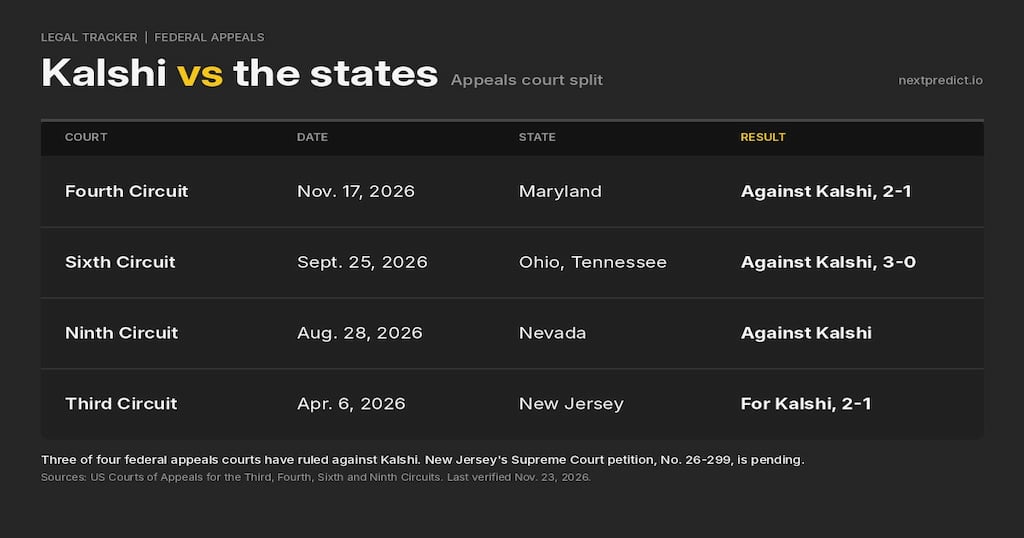
The most important ruling in Michigan came on September 25, 2026. In KalshiEX LLC v. Schuler and KalshiEX LLC v. Orgel, Nos. 26-3196 and 26-5235, a unanimous Sixth Circuit panel ruled against Kalshi in the Ohio and Tennessee cases. It held:
- Kalshi had not shown its sports contracts are swaps.
- Even if they were swaps, federal law does not preempt Ohio or Tennessee gambling law.
- Geofencing is feasible, so Kalshi is able to comply with both regimes.
Michigan sits in the Sixth Circuit, and the published opinion binds the panel hearing the Polymarket and Robinhood appeals.
The CFTC’s Geofencing Directive
On November 5, 2026, the CFTC issued an interpretation of its impartial access rule, meaning exchanges generally cannot restrict US traders by location and must drop such restrictions by December 5 or explain why they cannot. The guidance does not itself overturn Michigan’s court order.
What This Means for Michigan Residents
The Kalshi order covers Michigan residents and anyone inside the state’s borders. The Polymarket US, Robinhood and Coinbase agreements cover Michigan customers. Here is what has changed:
- Sports contracts: You cannot open new sports positions on Kalshi, Robinhood, Coinbase or Polymarket US while you are in Michigan.
- Open positions: Polymarket US closes any sports position you have not closed by the end of the day Eastern time on November 25. The Robinhood and Coinbase deadlines passed in October. Kalshi unwound certain Michigan sports trades in July under the restraining order.
- Non-sports contracts: Economics, weather, politics and other non-sports event contracts are not covered by any Michigan order or agreement.
- Licensed sportsbooks: If you are 21 or older, you are allowed to use one of the online sportsbooks licensed by the MGCB.
This page is not legal advice, and four dates could change the picture quickly:
- November 24, 2026: Kalshi contempt hearing in Ingham County.
- November 25, 2026: Polymarket US close-out deadline.
- December 5, 2026: CFTC deadline for exchanges to drop geographic restrictions.
- Pending: Sixth Circuit rulings on the Polymarket and Robinhood appeals, and the Supreme Court’s decision on whether to hear No. 26-299.
Conclusion
As of November 23, 2026, Kalshi is legal in Michigan for non-sports contracts only. A state court injunction bars its sports contracts. Polymarket US, Robinhood and Coinbase have agreed to stop offering sports contracts, and Polymarket’s close-out ends on November 25.
The Kalshi case continues in Ingham County, and the Polymarket and Robinhood appeals sit before a Sixth Circuit, which has already ruled against Kalshi on the same questions. The Supreme Court and the CFTC could still reshape the outcome. Michigan’s approach mirrors action in other states. Compare it with Kalshi’s status in Illinois, New York, Washington and Utah.
Frequently Asked Questions
Is Kalshi legal in Michigan?
Kalshi operates in Michigan, but not for sports. An Ingham County Circuit Court preliminary injunction signed on September 1, 2026, bars Kalshi from offering sports event contracts to anyone located in Michigan. Non-sports contracts are not covered, and a contempt hearing over Kalshi’s marketing is set for November 24, 2026.
Is Polymarket legal in Michigan?
Polymarket US remains available for non-sports markets. Under a court-approved agreement announced on October 28, 2026, it stopped offering new sports contracts to Michigan customers. Any open sports positions closed by the end of the day Eastern time on November 25, 2026, and its federal appeal, No. 26-1552, is still pending.
Why did Michigan act against Kalshi?
Attorney General Dana Nessel argues Kalshi’s sports contracts are unlicensed internet sports betting under the Lawful Sports Betting Act. Only licensed casinos and tribes can offer it, and only to people 21 or older. Kalshi argues federal law gives the CFTC exclusive authority over its contracts
What happens to open positions in Michigan?
It depends on the platform. Polymarket US closes any sports position you have not closed by the end of November 25, 2026. Robinhood and Coinbase closed remaining positions on October 9 and October 10, and Kalshi unwound certain Michigan sports trades in July under a court order.
Are prediction markets legal in Michigan?
Prediction markets are not banned in Michigan. Every state action to date targets sports contracts on Kalshi, Polymarket US, Robinhood and Coinbase. Economics, weather, politics and other non-sports contracts remain available, though federal appeals could still change the rules.
Resources: State of Michigan | CFTC | SBS Americas | Dockets & Filings