
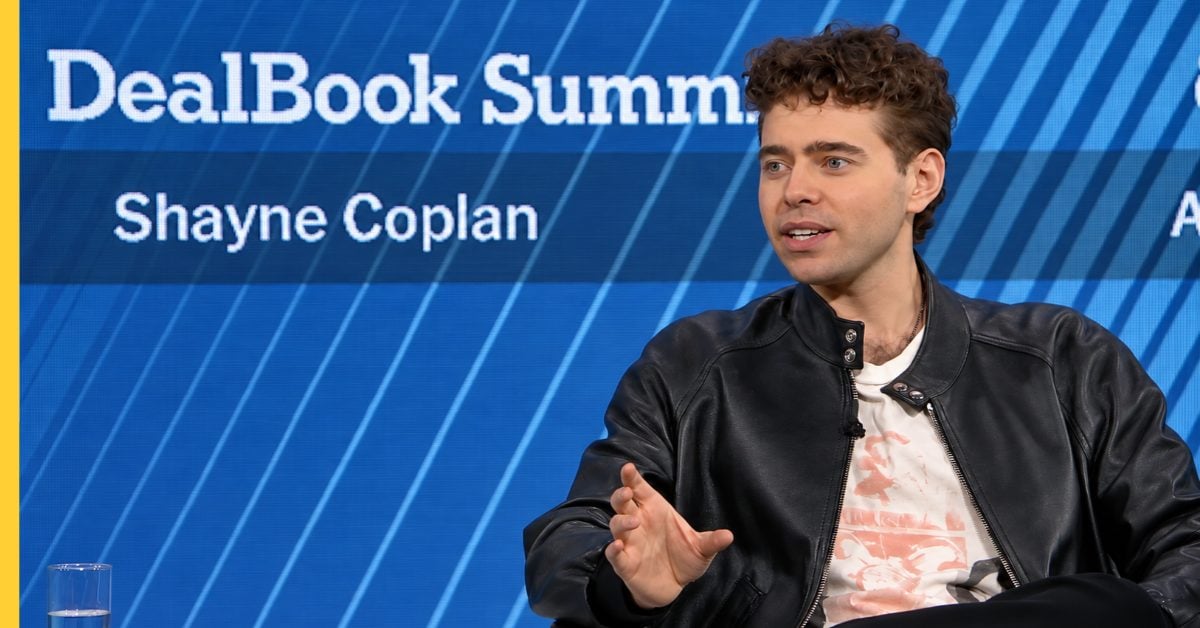
Speaking at The New York Times‘ DealBook Summit in New York on Wednesday, Polymarket founder and CEO Shayne Coplan made an effort to build bridges between the sector and the states, telling attendees, “We’re here and we’re ready to engage.”
That relationship hasn’t been friendly on either side to date, so Coplan’s conciliatory stance towards state regulators, litigators and, seemingly, state taxation was a notable softening.
Coplan was interviewed by DealBook founder Andrew Ross Sorkin at the annual summit, which brings together business, technology and political leaders. He appeared alongside Robinhood CEO Vlad Tenev and Nasdaq CEO Adena Friedman.
Coplan declared that sportsbooks have enjoyed their regulated success because they agreed to pay substantial taxes in exchange for legalization. In contrast, federally regulated prediction market exchanges like Polymarket generally operate outside the state tax regimes that apply to sportsbooks.
From his perspective, prediction markets, due to their peer-to-peer model, are “fundamentally better for consumers.”
“There’s this butting of heads in terms of the tax revenue,” Coplan added. “So I think ultimately, that’s the root of this.”
Coplan doesn’t outright say that Polymarket would be willing to pay larger, sports betting-esque state tax rates to avert the ongoing legal conflicts, but he came quite close.
Having suggested that tax is at the root of all the issues, Coplan commented:
“I think that they have valid points. And ultimately what it’s about is engagement and going and finding a common ground. And I think ultimately there’s a way, commercially, economically to go and solve these things.”
State AGs present a united front
State attorneys general have put up a pretty unified front against prediction markets in the past few months.
In April, 38 of them joined together to file an amicus brief in support of the state of Massachusetts’ lawsuit against Kalshi.
By July, when a letter was delivered to the Commodity Futures Trading Commission (CFTC) arguing that the agency doesn’t have authority to negate states’ own gambling laws, the number of state AG signatories had swelled to 44.
And this week, an Ohio-led coalition of 43 state AGs and the District of Columbia filed a comment urging the CFTC to withdraw its proposed rule, which would explicitly classify sports event contracts as swaps. The coalition argued that the agency lacks the authority to make that determination and warned it would undermine states’ ability to enforce their gambling laws.
States take different approaches to prediction market taxes
States have also begun trying to collect tax revenue from prediction markets. Three — Kentucky, Illinois and North Carolina — have passed legislation imposing taxes on prediction market operators, although the approaches differ. Kentucky’s 14.25% tax on transaction fees and North Carolina’s 6% tax on net trading fee revenue are scheduled to take effect in January.
North Carolina’s approach is particularly notable because its legislation also recognizes the right of federally regulated prediction markets to operate without additional state licensing requirements. Kalshi lobbyists reportedly met with staff for House Speaker Destin Hall shortly before the provision was added to the state budget, according to a September Bloomberg investigation.
Illinois has taken a more contentious approach, bringing sports event contracts under its sports wagering laws and imposing a transaction tax. Kalshi challenged the legislation in federal court, winning a preliminary injunction against key provisions, while lawmakers have introduced bills to repeal the tax altogether.
Coplan seeks common ground with state AGs
During the panel, Coplan actively gave credit to the states and their AGs. He claimed that Polymarket’s lawyers are working hard to find consensus now, adding:
“They’re going and they’re meeting with the AGs and they’re engaging. And I think that’s ultimately played out where maybe we haven’t gotten into as many butting of heads.”
It’s true that Polymarket has been involved in fewer state lawsuits than its rival Kalshi: 19 across 14 states compared to Kalshi’s 42 across 24.
Though, while a lot of Kalshi’s long-running cases were beginning, Polymarket was still barred from serving US customers on its international platform under an earlier CFTC settlement. It has since returned to the US through its acquisition of a federally regulated exchange.
But Coplan was keen to stress that the constructive approach he’s advocating for is more of a continuation than a sudden change of gear.
“We’re less gung-ho about it,” he said, “which I know is a narrative violation because we’re supposed to be the people like that, but we’re not.”
State attorneys general like New York’s Letitia James, a vocal opponent of prediction markets, may take some convincing.