Kalshi has added three transparency tools to its 2026 midterm election markets as political trading on the prediction markets platform reaches levels previously reserved for presidential races.
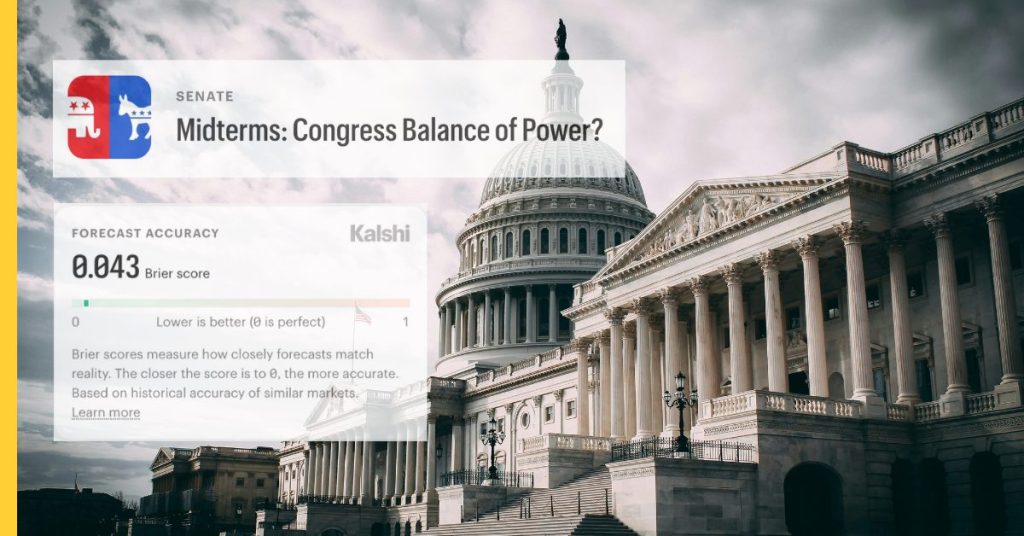
The exchange introduced Brier scores Brier scores, low-volume labels and more prominent real-time trade feeds across its election markets this week, Kalshi announced in a Monday press release. Their inclusion is meant to address prediction markets’ growing visibility: far more people now read market prices than actually trade them, according to Kalshi.
Kalshi CEO Tarek Mansour has previously stated that three-quarters of its users don’t trade. Kalshi announced on Monday its midterm markets attract five times as many viewers as traders.
That makes the presentation of a 65-cent contract increasingly important. It represents a market-implied probability, not 65% support in a poll or a forecast produced by Kalshi itself.
Brier scores provide a measure of reliability
Brier scores give users another way to test the market’s track record. Instead of looking only at the probability on screen, the score looks backward. It compares earlier forecasts with what actually happened to provide a measure of forecast reliability.
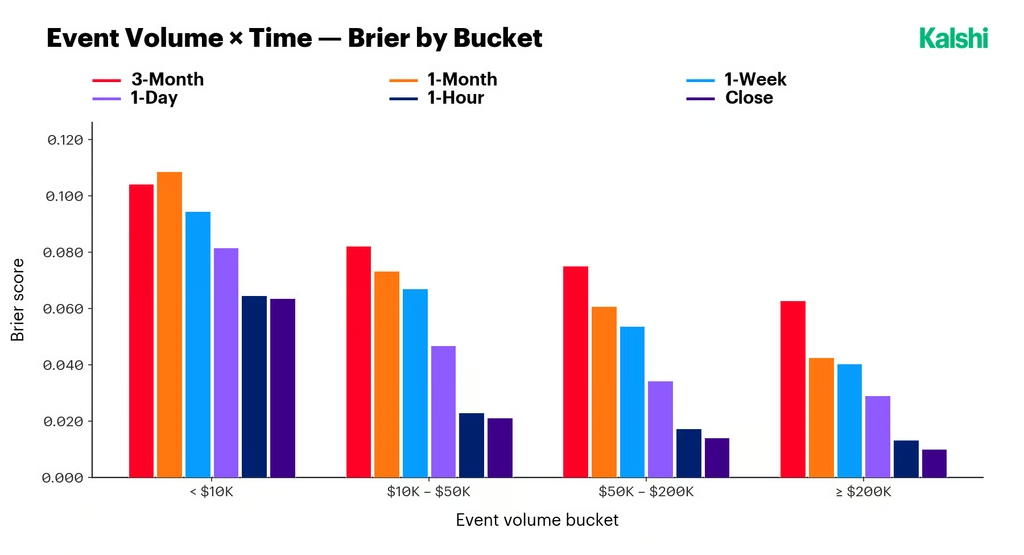
Kalshi says its calculation draws on millions of historical observations. Trading volume is part of the formula, as is the amount of time left before a market resolves.
That changes the usefulness of the number. A market price shows what traders think now. The Brier score shows how probabilities have performed before.
A 70% price should not be read as a prediction carved in stone. Even a well-calibrated 70% forecast will miss sometimes: three in ten times, by definition. But the score is useful across a large run of markets, where repeated hits and misses start to show whether those probabilities were reliable.
The new Brier score tags on Kalshi markets note that a lower Brier score is better, 0 being perfect.
“We’re adding Brier scores so every site visitor has a transparent view into the overall confidence level they should put in each individual forecast,” Kalshi said.
Liquidity is getting similar treatment
Kalshi’s new tags identify markets with comparatively low trading volume. The company says markets below $10,000 have still produced Brier scores comparable with leading human forecasters.
Thin markets nonetheless warrant extra attention. Markets will low liquidity can see fewer orders move prices more sharply, while deeper markets generally make it harder for one trade to materially alter the displayed probability.
The activity feed tackles that issue from another direction. Individual transactions will now appear more prominently, allowing visitors to see how market prices are being formed trade by trade.
For active traders, that provides more immediate context around abrupt price moves. For non-traders, it makes it more clear that Kalshi prices emerge from transactions between participants rather than an internal odds-setting process.
Political markets have become a much larger focus of Kalshi’s forward-facing operations. The company says 2026 election volume has already exceeded its 2024 presidential-election volume.
Its Midterms Hub was showing roughly $844m in volume Wednesday morning. Kalshi offers markets covering Senate, House and gubernatorial races nationwide.
Election coverage taking prominent position
The platform has also moved closer to conventional election coverage. Associated Press vote counts and race figures appear alongside its forecasts, while CBS News and 270toWin are incorporating Kalshi data into their election products.
Kalshi does not itself call races for settlement purposes. Its election contracts generally require at least four of eight designated news organizations to call a winner, with none disagreeing.
The added transparency could also help prediction markets serve a wider forecasting role. Polls measure voter responses at a particular point in the past. Market prices continuously absorb polling, fundraising, campaign developments and traders’ competing assessments.
Liquidity, past calibration and the trades behind the price give users more to work with than the headline probability alone as we inch closer to the 2026 midterm elections.