
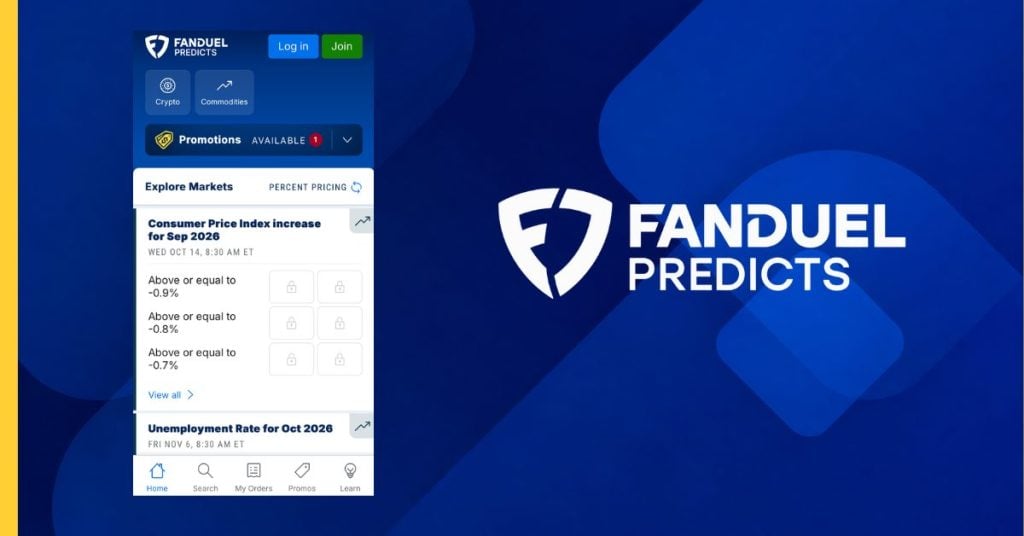
FanDuel has secured registration for a new futures commission merchant (FCM), giving the company another potential route for operating its prediction-market business outside the structure it currently shares with CME Group.
National Futures Association (NFA) records show that New Venture III LLC was registered as an FCM and approved as an NFA member on Oct. 5, six months after FanDuel filed the application. FanDuel Group is listed as a principal of the entity.
The approval comes after FanDuel’s relationship with CME shifted significantly over the summer. FanDuel Predicts now sources its sports and other non-financial event contracts from Crypto.com’s OG Prediction Markets, while CME continues to provide financial markets. Flutter Entertainment, FanDuel’s parent company, said in August that the change was made “in coordination with CME” and would allow FanDuel Predicts to bring new products to market more quickly.
The new FCM approval is notable because the gaming company already operates FanDuel Predicts through FanDuel Prediction Markets LLC, an FCM created through its joint venture with CME.
The difference is control: New Venture III gives FanDuel an FCM of its own at a time when the company has been seeking more flexibility over the exchanges and contracts available through its prediction-market platform.
Flutter said new FCM would give FanDuel ‘further optionality’
Then-Flutter CEO Peter Jackson foreshadowed the strategy on the company’s May earnings call. Asked specifically about the new FCM application, Jackson said FanDuel wanted to be able to “adapt and do what we need to do in order to win.” He added that the application would provide the company with “further optionality.”
That optionality could be particularly important because FanDuel’s existing FCM is part of a joint venture it does not control outright. CME owns 51% of FanDuel Prediction Markets Holdings LLC, while FanDuel owns the remaining 49%.
The economics of that partnership are also significant. Flutter said in its first-quarter earnings release that CME receives approximately 50% of the gross revenue generated by FanDuel Predicts before promotional spending. FanDuel, meanwhile, bears all costs associated with supporting the app, including sales and marketing, promotions and non-exchange costs.
New Venture III gives FanDuel an FCM outside that ownership structure. It does not make FanDuel an exchange or allow it to list event contracts itself. But it could eventually give the company more direct control over the intermediary layer between FanDuel Predicts customers and the exchanges supplying those contracts.
Jackson also noted on the May call that FanDuel was already “connecting to other venues.” The company subsequently demonstrated that an additional exchange could be integrated through its existing FCM when it connected to OG Prediction Markets, meaning New Venture III is not necessary simply to access contracts beyond CME.
Its potential advantage instead lies in giving FanDuel a wholly controlled vehicle through which those relationships could eventually be managed.
CME pushed back on standalone FCM
CME initially pushed back on the idea that FanDuel’s standalone FCM application signaled a change in the companies’ partnership. On CME’s April earnings call, Bank of America analyst Craig Siegenthaler asked whether FanDuel might favor an FCM where it could retain more of the economics.
CME President and CFO Lynne Fitzpatrick said the company knew FanDuel intended to apply and stressed the difference between filing an application and launching an FCM.
“So this actually doesn’t signify any change in our relationship or the partnership going forward,” Fitzpatrick said, adding that there were “contractual restrictions in terms of operating alternative venues during our partnership.”
Terry Duffy, CME Chairman and CEO, went further, saying FanDuel could not simply obtain another FCM license and use it to compete with the joint venture.
“They can’t just get an FCM license, apply for one or buy one and compete with the JV that we put together with them,” Duffy said. “That is obviously contractually against what we originally stated with them.”
CME cools on sports contracts
CME was already making clear, however, that sports contracts were not the main reason it entered the FanDuel partnership. Earlier on the same call, Duffy said CME’s original objective in the partnership “had nothing to do with sports” and was instead focused on markets and distribution.
By July, his position had hardened. Asked about prediction markets on CME’s second-quarter earnings call, Duffy said the company would “try to keep the sports out of it,” arguing that many sports event contracts were gambling rather than markets. He said CME did not want to participate in that activity at the time.
That set the stage for the August arrangement under which FanDuel moved its sports and other event contracts to OG Prediction Markets while CME continued supplying financial markets. The move did not end the CME partnership, but it narrowed CME’s role in the parts of FanDuel Predicts most closely associated with sports.
What FanDuel could do next
Exactly how much New Venture III changes FanDuel’s economics or contractual relationship with CME is unclear. The full terms of the partnership are not public, including whether revenue generated through a separate FanDuel-owned FCM would remain subject to CME’s revenue share or the restrictions Duffy and Fitzpatrick referenced in April.
If FanDuel eventually uses New Venture III for Predicts customers, one logical next step could be to expand the number of exchanges supplying contracts to the platform.
One possible fit is ProphetX, a sports-native exchange that also features some non-sports markets, including politics. The CFTC-regulated exchange has been aggressively expanding third-party distribution of its contracts and markets itself to outside operators as infrastructure that can be embedded into existing platforms. ProphetX also recently partnered with Plaee to make onboarding new distribution partners faster and easier.
Owning more of that infrastructure would fit with Flutter’s stated ambition for the business. In its second-quarter earnings release in August, Flutter said FanDuel’s pricing and risk-management capabilities put it in a strong position to “capture a large portion of the economics within the Prediction Market ecosystem.”