
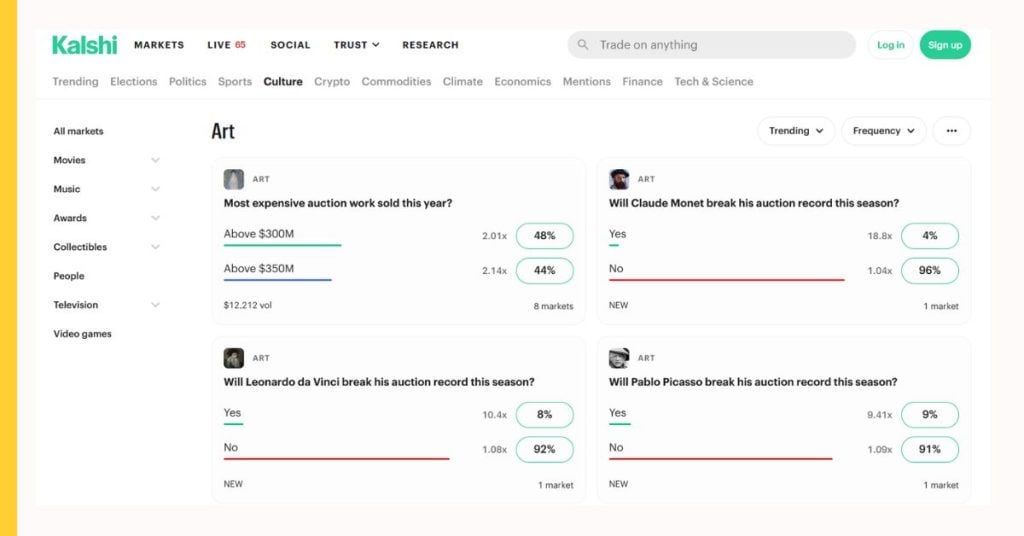
Kalshi launched prediction markets tied to fine art auction results on Monday (25 May), letting traders take positions on lot prices and total realised values at the world’s leading auction houses.
The contracts are available now, with more markets planned ahead of the autumn auction season, according to a Kalshi press release.
The new category adds fine art to what has quietly become a substantial real-world asset marketplace.
Over the past eight months, according to Kalshi, the company has introduced contracts on luxury watch prices through a partnership with authenticated timepiece marketplace Bezel. It has also begun to offer markets on Pokémon card resale values and sneaker prices.
The latter is through a tie-up with StockX announced in November.
In April, the company launched a Commodities Hub spanning natural gas, coffee, copper, sugar, corn, soybeans, wheat, nickel, diesel and lithium, alongside the gold and oil contracts it already offered.
The art markets are structured around specific, verifiable outcomes, such as the hammer price on a named lot, for instance, or total realised value across an evening sale. Each contract settles against publicly reported auction results.
Valeria Vouterakou, legal counsel at Kalshi, said: “Art is one of the largest and least liquid asset classes on earth, and it has historically been one of the hardest to hedge.
“A collector sitting on ten million dollars in impressionist paintings has no efficient way to manage that exposure—until now. We’re giving the art world the same financial infrastructure the rest of the economy takes for granted.”
A potential shift away from questionable markets
The push into apolitical asset classes comes at a telling moment for Kalshi. The company was sued in March over its handling of $54m in contracts tied to whether Iranian Supreme Leader Ali Khamenei would leave office.
When US-Israeli strikes killed Khamenei, Kalshi invoked a “death carveout” clause and settled the market at the last-traded price before his death rather than paying out winners in full. The class action is ongoing.
Six Democratic senators separately urged the Commodity Futures Trading Commission (CFTC) to ban contracts settling on an individual’s death.
The Khamenei episode was not Kalshi’s first brush with political controversy. The company fought a lengthy legal battle with the CFTC to offer election contracts, eventually winning in court in 2024.
That victory opened the door to sports markets, which the company launched in January 2025 and which now account for roughly 89% of fee revenue.
Sports contracts have, in turn, drawn cease-and-desist orders from ten states, prompting the CFTC to sue Arizona, Connecticut and Illinois in April to block state enforcement.
Against that backdrop, contracts tied to Rolex auction prices and Basquiat hammer prices carry obvious appeal for a company keen to demonstrate the utility of prediction markets beyond politics and sport.
The art market launch is timed to precede what auction houses typically call their most important selling season. Major New York sales from Christie’s, Sotheby’s and Phillips are scheduled for November.
Whether the new contracts attract meaningful volume before then will depend on how quickly institutional art funds and collectors warm to the instrument, a constituency that has historically regarded derivatives with suspicion.