
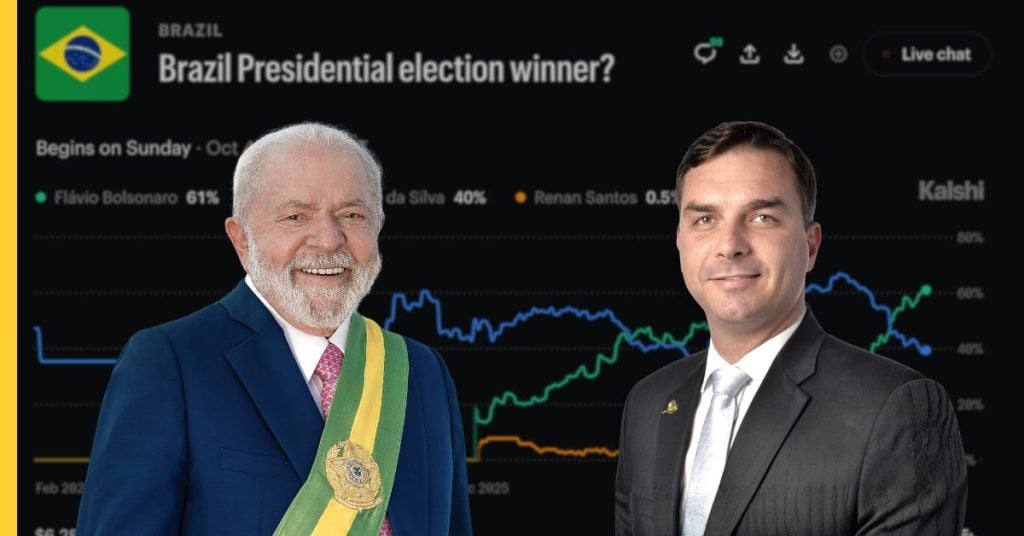
Brazil’s presidential election is shaping up to be a high-profile test of one of the prediction-market industry’s biggest claims: that markets can provide a clearer signal than traditional polling.
President Luiz Inácio Lula da Silva holds the stronger position heading into Sunday’s first round. He has led Flávio Bolsonaro in major polls and is also favored by prediction markets to finish first, with recent surveys putting Lula several points ahead.
The picture changes when the race is projected beyond Sunday. Recent polls have generally shown Lula and Bolsonaro statistically tied in a potential Oct. 25 runoff. Meanwhile, Polymarket and Kalshi forecasts give Bolsonaro a noticeably stronger chance of ultimately winning the presidency. One major poll released Thursday even gave Lula a slight numerical lead in a potential runoff.
That split gives Brazil a place in the long-running debate over polls and prediction markets. Traders are not rejecting the polling consensus that Lula is likely to lead the first round, but they are expressing considerably more confidence in that outcome. And they’re making an even sharper call about what happens after the field narrows to two candidates.
The distinction echoes the 2024 US presidential election, when polls showed Donald Trump and Kamala Harris virtually deadlocked heading into Election Day, while prediction markets gave Trump a clearer advantage. Trump’s eventual decisive victory has since become a prominent example cited by prediction-market proponents who argue that market prices can reveal information traditional polling misses.
Prediction markets favor Lula in first round, Bolsonaro overall
Brazil’s presidential election uses a two-round system. All candidates compete in the first round this Sunday, Oct. 4, but a candidate must win more than half of the valid votes to be elected outright. If nobody reaches that threshold, the top two finishers advance to an Oct. 25 runoff.
That structure creates the central puzzle in prediction markets. Lula is favored to finish first Sunday, consistent with his stronger position in first-round polling. But the pricing also implies that traders expect votes going to eliminated candidates, many of them on the right, to shift disproportionately toward Bolsonaro in a runoff.
In other words, Lula can lead a crowded first round without being favored in a two-candidate race.
On Polymarket, Lula is currently priced at 73% to win the first round, compared with 28% for Bolsonaro. The market has generated about $586,000 in trading volume.
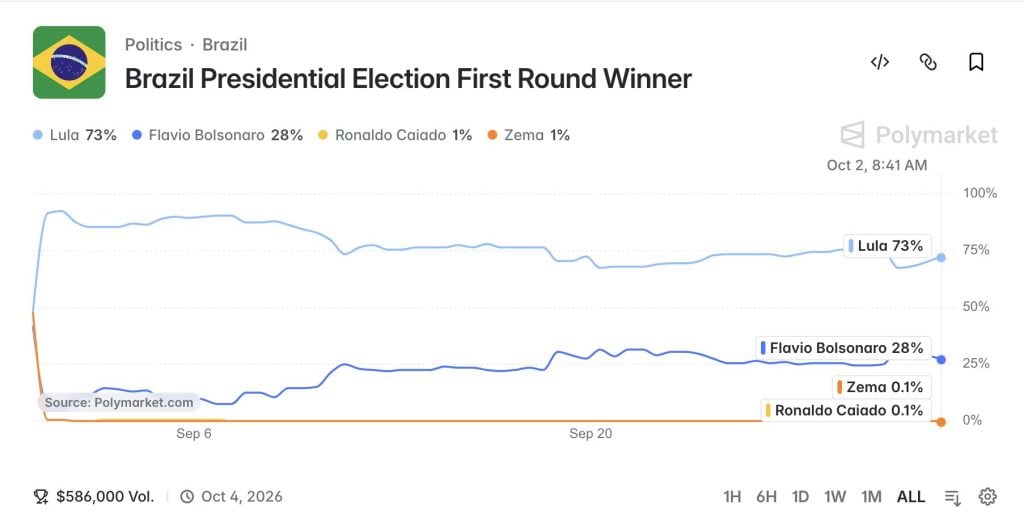
That advantage disappears in the overall presidential market. Polymarket currently gives Bolsonaro about a 56% chance of ultimately winning the presidency, compared with 44% for Lula.
Kalshi traders are even more bullish on Bolsonaro, pricing him as of early Friday at around 61% to win compared with 39% for Lula.
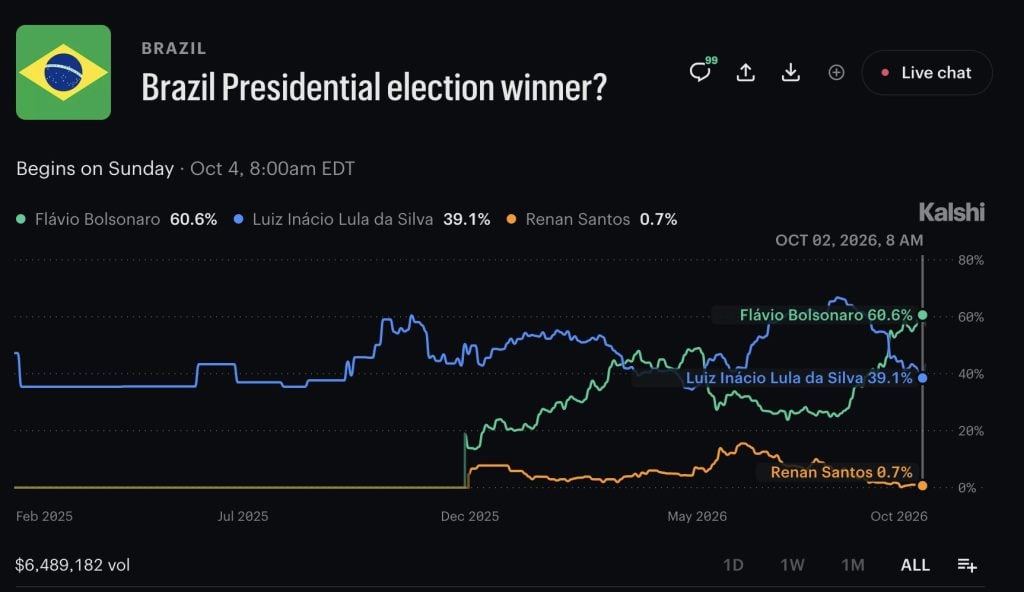
The presidential winner markets have attracted substantial activity, with just over $159m traded on Polymarket’s presidential-winner market and $6.49m on Kalshi’s.
The markets’ implied path is straightforward: Lula finishes first Sunday, neither candidate reaches 50%, and Bolsonaro becomes the clear favorite once the field narrows to two.
Polls show a much tighter race
Recent polling presents Brazil’s election as considerably closer than the prediction markets do in either round.
A Quaest poll released this week put Lula at 39% and Flávio Bolsonaro at 34% in the first round, a five-point gap with a two-point margin of error. The same survey had the two candidates tied at 42% in a potential runoff.
Datafolha’s latest survey, released Thursday evening, put Lula at 42% and Bolsonaro at 38% in the first round. In a potential runoff, Lula led 48%-45%, still a statistical tie within the poll’s two-point margin of error.
That marked a modest improvement for Lula from Datafolha’s Sept. 24 survey, which had him ahead 40%-36% in the first round and 47%-45% in a runoff. Both candidates gained two points in the first-round polls, leaving Lula’s four-point advantage unchanged, while Lula gained one point in the runoff and Bolsonaro remained at 45%.
Prediction markets are making much stronger calls than the polls in both rounds. And, unlike the latest polling, they favor Bolsonaro to win the presidency. Polymarket traders give Lula nearly a three-in-four chance of finishing first Sunday despite polls showing only a modest lead. Those numbers flip to a nearly 56% chance of Bolsonaro ultimately winning the presidency.
That means the markets are not simply departing from polling in the runoff. They are expressing greater confidence at both stages: first that Lula will finish ahead Sunday, and then that Bolsonaro will prevail once the field narrows.
Why traders may favor Bolsonaro in a runoff
One possible explanation for the prediction markets’ stronger Bolsonaro lean is what happens to voters backing the smaller first-round candidates.
Datafolha’s latest detailed breakdown shows that support does not split evenly in a hypothetical Lula-Bolsonaro runoff. Among voters currently backing Ronaldo Caiado, 50% said they would move to Bolsonaro compared with 33% for Lula. Among Renan Santos voters, Bolsonaro led 54% to 14%.
The picture is less clear among supporters of Augusto Cury, the strongest of the other candidates. Datafolha found them nearly evenly divided in a runoff, with 35% choosing Bolsonaro and 33% Lula, while 30% said they would cast a blank vote.
Those subgroup results come with much larger margins of error because of the smaller samples, so they should not be treated as precise forecasts. But they offer one indication of why traders may expect Bolsonaro to benefit more once the field narrows, particularly from voters currently supporting other right-of-center candidates.
Brazil becomes a test for prediction markets
Brazil is an unusual place for election prediction markets to get a high-profile test, because the people voting in the election cannot legally trade on it themselves.
In April, Brazilian authorities moved to block Polymarket, Kalshi and other prediction-market platforms after concluding that contracts tied to elections, politics, sports and entertainment were not permitted under the country’s regulatory framework. Brazil still allows derivatives tied to economic and financial benchmarks such as interest rates, currencies, securities and commodities.
That means Sunday’s presidential race can attract substantial trading activity abroad while remaining off limits as a legal prediction-market product for ordinary Brazilians at home.
Thiago Vancellote, founder of Predictions BR, a Brazilian community focused on prediction-market analysis and education, thinks that could make what happens next particularly important for the sector’s visibility in the country.
“A poll asks people who they intend to vote for, while a prediction market asks participants to put money behind what they believe will actually happen,” Vancellote wrote on LinkedIn this week, calling the election an important “real-world test” for prediction markets in Brazil.
His argument is that Brazilians do not necessarily need to be trading the contracts for the markets to become influential. If prediction-market prices ultimately prove more informative than traditional polling, particularly if they identify shifts in the race earlier, people may begin treating market-implied probabilities as another source of information about uncertain events.
“If the outcome eventually converges with what these markets have been pricing,” Vancellote wrote, “millions of Brazilians may suddenly start paying attention to something that is still relatively niche here.”
Polls and prediction markets diverge after Lula’s betting ban
Lula made two major moves on Sept. 25, nine days before the first round, banning online betting and unveiling a sweeping household debt-relief program. The betting ban was broadly popular, with a new Datafolha survey finding 78% support, while the debt plan aims to restructure as much as 150bn reais in overdue household debt.
Flávio Bolsonaro called the betting ban “politically motivated,” arguing Lula was using it for an advantage in the election. The announcements were the biggest policy developments of the campaign’s final week.
Prediction-market prices moved toward Bolsonaro over the same period. At 8 p.m. on Sept. 25, after the betting ban was announced, Polymarket priced Bolsonaro at 57.4% to win the presidency and Lula at 43%. Over the following days, Bolsonaro’s odds climbed while Lula’s fell. By Thursday afternoon, Bolsonaro had reached 62.2% and Lula had dropped to 38%.
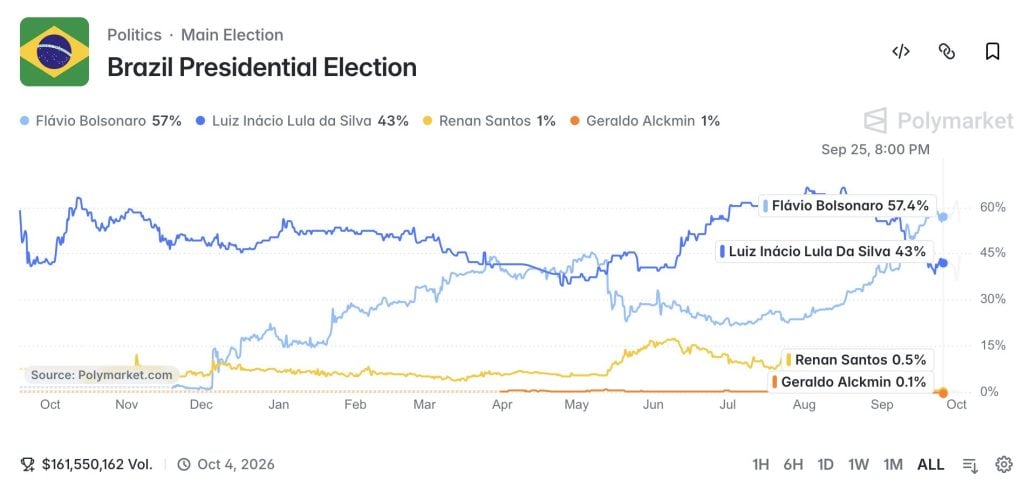
The market partially reversed overnight after the latest Datafolha poll was released. By 8:21 a.m. Friday, Bolsonaro had fallen to 55.6% and Lula had climbed to 44%, though Bolsonaro remained the clear favorite.
Those results show a striking divergence: Lula nudged higher in polling conducted after the voter-friendly announcements Bolsonaro suggested were political ploys to gain support. But prediction markets initially moved more toward Bolsonaro before narrowing following the latest poll.
That illustrates how prediction markets can react quickly to fresh polling without simply mirroring it.
Brazil revives the polls vs. prediction markets debate
Prediction-market proponents have repeatedly cited the 2024 US presidential election as evidence that market odds can outperform traditional polling.
On the eve of that Nov. 5 election, the RealClearPolitics national polling average had Donald Trump and Kamala Harris tied at 48.5%. Polymarket, by contrast, priced Trump at 58.6% to win at 7 p.m. on Nov. 4, compared with 41.4% for Harris.
Trump went on to win 312 electoral votes to Harris’ 226 and also carried the national popular vote, helping cement the 2024 race as a showcase for prediction-market advocates who argued that market pricing had better captured the eventual outcome than the polls.
Brazil is not an exact repeat. Polls and prediction markets currently agree that Lula is more likely to finish first Sunday, while differing substantially in how confident they are. The bigger divide is over what happens next: polls continue to show a potential runoff effectively tied, while prediction markets make Bolsonaro the clearer favorite.
That gives the industry two chances to test its signal. Sunday will show whether traders were right to express considerably more confidence than pollsters in a Lula first-place finish.
If the race proceeds to an Oct. 25 runoff, the larger test will be whether the markets’ Bolsonaro lean proves more informative than polls that have so far found little separating the two candidates.