
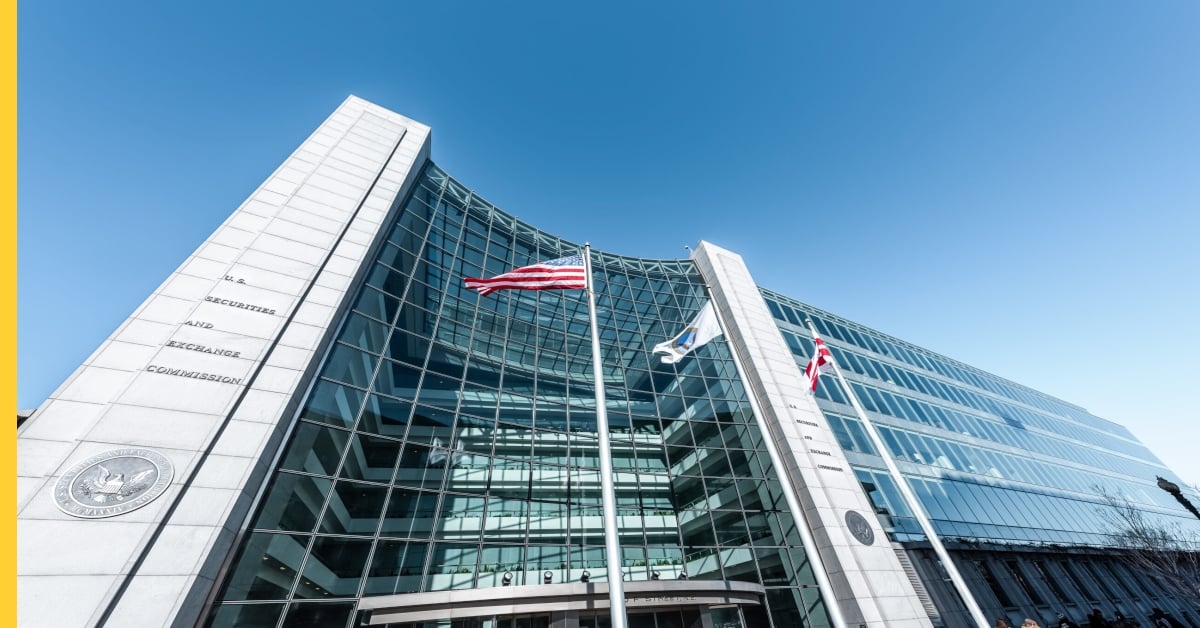
The Securities and Exchange Commission (SEC) has sided with the Commodity Futures Trading Commission (CFTC) in a closely watched dispute over perpetual futures tied to individual US stocks.
Its brief, submitted Nov. 9 and accepted by a federal judge the following day, challenges claims that the CFTC improperly bypassed securities regulation when it allowed the controversial products to trade.
The SEC’s support comes with an important qualification. The agency takes no position on whether the exchanges’ rule changes should be overturned.
Whether single-stock perpetuals qualify as security futures or security-based swaps sits at the heart of the lawsuit brought by the Capital Markets Alliance Association (CMAA), whose members include Cboe Global Markets, Citadel Securities and Healthy Markets.
In its filing, the SEC rejected the association’s portrayal of a regulator acting without proper oversight, describing its allegations as depicting a “CFTC gone rogue, and an SEC gone missing.”
The securities regulator maintains that it retains authority over security futures and works with the CFTC on products subject to their joint jurisdiction. The SEC also retains the ability to overturn the exchanges’ relevant rule changes, with its review period extending through Dec. 31.
Its position matters because CMAA has argued that the CFTC’s actions would allow an alternative market for US stocks to develop beyond the SEC’s regulatory protections.
The lawsuit followed the Nov. 3 effective date of rule changes submitted by Kalshi, Coinbase and Bitnomial to list single-stock perpetual contracts. Unlike conventional futures, perpetual contracts have no fixed expiration date and use funding adjustments to keep their prices aligned with underlying assets.
US District Judge Valerie Caproni denied CMAA’s initial request for a temporary restraining order on Nov. 3. However, she found the association likely to succeed on its argument that the CFTC had exceeded its statutory authority.
Caproni declined immediate relief because CMAA had not demonstrated sufficiently imminent, irreparable harm. The preliminary injunction request is now before Judge Lorna Schofield in Manhattan.
CFTC challenges lawsuit and questions Cboe’s position
The CFTC’s Nov. 6 opposition attacked both the association’s legal arguments and its standing to bring the case.
According to the regulator, perpetual futures share the essential features of conventional futures, including centralized clearing, margin requirements and exposure to changes in an underlying asset’s price.
It also challenged CMAA’s argument that futures must contain a fixed expiration date or delivery obligation.
The CFTC pointed to Cboe’s May 21, 2025, submission supporting the development of regulated perpetual-style futures.
Cboe had argued that such contracts could support investment strategies and risk management. It subsequently marketed cryptocurrency continuous futures with expirations extending as far as 120 months.
CMAA disputes the relevance of those earlier comments to contracts referencing individual stocks.
The regulator also challenged the association’s legal standing, questioning whether the newly established organization meets the requirements for representing its members in federal court.
There is a separate dispute over what the CFTC actually approved. The commission maintains that exchanges submitted their contracts under established procedures and that the applications were deemed approved after the statutory review period expired.
Because the regulator did not affirmatively approve the submissions, it argues that CMAA has failed to identify a reviewable agency action under the Administrative Procedure Act.
CMAA rejects that distinction, arguing that allowing the applications to take effect carried immediate legal consequences.
Coinbase, Kalshi and trading firms defend perpetual futures
Six financial and cryptocurrency companies sought to weigh in on the dispute Nov. 9, supporting the CFTC’s opposition to an injunction.
Coinbase, Kalshi and Kraken and Bitnomial parent Payward joined DRW Holdings, Jump Trading and Paradigm Operations in submitting an amicus brief. Their central argument is that perpetual contracts qualify as security futures under existing federal law, despite lacking conventional expiration dates.
The companies also emphasized the oversight arrangements established by Congress for security futures, which involve both the CFTC and SEC.
They maintained that prohibiting the products would restrict access to regulated US markets and undermine efforts to bring trading activity onshore.
The distinction has commercial consequences. Coinbase, Kalshi and Bitnomial, which is owned by Payward, have submitted applications to list the contracts, while the other firms have interests in derivatives trading and liquidity provision.
On Nov. 10, Schofield accepted the six companies’ brief but rejected Coinbase’s request to participate in oral arguments on their behalf.
CME and investor advocates join opposition
Support for CMAA grew considerably on Nov. 10, when several organizations and securities law specialists sought permission to submit opposing briefs.
Chicago Mercantile Exchange (CME) asked to participate, citing its separate lawsuit against the CFTC over the earlier approval of cryptocurrency perpetual futures. That case, Chicago Mercantile Exchange v. Selig, is proceeding in federal court in Washington, DC.
CME argued that the cases share important legal questions concerning the classification of perpetual contracts.
Better Markets also sought permission to file a brief alongside former SEC Commissioner Allison Herren Lee and Harvard Law professor John Coates, a former SEC general counsel.
The organization has previously warned about the risks perpetual derivatives pose to retail investors and broader financial markets.
Another proposed filing came from securities law professors John Coffee, James Cox, Gina-Gail Fletcher, George Georgiev and Joel Seligman.
Their submission addresses the statutory distinction between security futures and security-based swaps, including the significance of contracts without expiration or final settlement dates.
The American Securities Association (ASA), which represents regional broker-dealers and investment advisers, submitted a further request.
ASA focused on potential harm to retail investors and established equity markets, rather than the competitive losses emphasized by CMAA.
Alliance cites $375m in trading activity
CMAA’s Nov. 10 reply cited additional evidence intended to overcome the weakness identified in Caproni’s initial ruling. The association reported that Kalshi began trading four single-stock perpetual contracts shortly after the court rejected emergency relief.
Within two days, the platform had listed more than 50 contracts, with approximately $375m in reported trailing 24-hour notional trading volume.
CMAA argues that this activity demonstrates the immediate competitive consequences of allowing the products to trade.
Cboe maintains that some transactions could migrate away from established securities and options markets, depriving it of trading-related revenue.
Citadel Securities similarly claims that perpetual contracts could divert transactions from businesses in which it provides execution services and liquidity. The association argues those losses cannot subsequently be recovered from the government.
It also disputes the CFTC’s interpretation of futures law, insisting that contracts without future delivery obligations fall within the legal definition of security-based swaps.
CMAA cited the SEC’s own brief, observing that the securities regulator has not yet resolved the classification question.
CFTC opposes additional briefs over timing
The procedural disagreement continued Nov. 11, when the CFTC formally opposed the four requests supporting CMAA. Its objection concerned timing rather than the applicants’ qualifications.
The agency argued that the submissions arrived alongside CMAA’s Nov. 10 reply, leaving the government without an opportunity to answer their arguments.
It contrasted that arrangement with the SEC and industry briefs supporting the defendants, which arrived Nov. 9 and could be addressed in CMAA’s response.
The CFTC also noted that CME had previously acknowledged that certain perpetual derivatives could qualify as futures, depending on their structure.
The regulator asked Schofield to reject the late submissions.
As of Nov. 11, the court had accepted the SEC’s brief and the joint submission from Coinbase and its five co-signatories. The four requests supporting CMAA remained pending.
Schofield must now decide whether to block trading under the disputed rule changes while the underlying lawsuit proceeds.
For the exchanges and trading firms involved, that decision will determine whether single-stock perpetuals can continue operating under the existing arrangements during the litigation.
The broader legal question remains unsettled, notwithstanding the SEC’s intervention: whether contracts with no expiration date can qualify as security futures under federal law.