
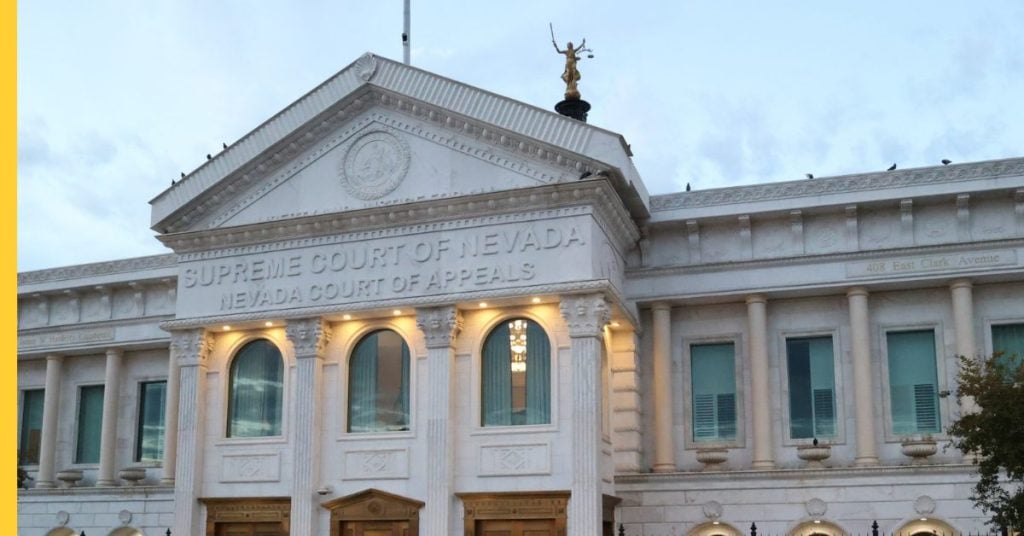
The Nevada Supreme Court has refused to pause a lower court injunction against Kalshi in its fight with the state over sports-related contracts and how it blocks Nevada users.
The order, filed under case number 92771, rejects Kalshi’s emergency motion for a stay pending appeal.
Kalshi asked the court to freeze a district court preliminary injunction while its broader appeal moves forward. Justices Pickering, Parraguirre and Bell weighed four standard factors before ruling against the company, including whether Kalshi would suffer serious harm without a stay and whether Nevada would suffer harm if one were granted.
The panel found the balance did not favor Kalshi.
The injunction at issue requires Kalshi to keep Nevada residents from accessing sports, election and entertainment event contracts. The denial of a stay means that requirement remains in force while the appeal continues.
The ruling comes as a separate contempt proceeding intensifies before Carson City District Judge Jason Woodbury. Gaming attorney and analyst Daniel Wallach explained on LinkedIn that a full-day evidentiary hearing is set for July 16, with a possible extension to July 31, to determine whether Kalshi violated the injunction.
The hearing will examine whether the company took reasonable steps to keep Nevada users off restricted markets.
Court filings point to statements from two Kalshi executives that could shape that inquiry. Xavier Sottile, the company’s head of markets, told a federal court in Nevada that building geofencing capability could cost the company tens of millions of dollars each year.
Kalshi pokes at geofencing methodology
Kalshi’s co-founder and chief operating officer, Luana Lopes Lara, separately told the Commodity Futures Trading Commission (CFTC) on April 30 that blocking users by IP address alone does little to stop determined users.
She further noted that virtual private networks let people get around such checks cheaply and that operators sometimes have financial reasons to look the other way.
Sottile said much the same in his own declaration. An IP address alone, he acknowledged, is not enough to verify a user’s location reliably. The process must also compare GPS data with signals from cell towers, WiFi networks and Bluetooth beacons.
Those statements have drawn scrutiny because Kalshi reportedly spent roughly $190,000 on its Nevada geofencing system, which relies on IP address checks alone rather than the layered approach Sottile described.
That gap between the company’s public estimates and its actual spending, along with Lara’s own criticism of IP-based blocking when describing offshore platforms, is expected to factor into whether Woodbury finds Kalshi’s compliance efforts were adequate.
Nevada retains its active, court-enforced ban on certain Kalshi contracts, while more than 20 states pursue similar disputes with prediction market exchanges.
A recent federal appeals ruling in New Jersey favored Kalshi, deepening a split that could eventually draw in Congress or the US Supreme Court.