
A new study using Kalshi temperature-market data dating back to 2021 found that the prediction market produced more accurate next-day forecasts than the leading public US weather forecast in six of seven cities examined.
The market-implied forecast beat the National Blend of Models (NBM), which the study identified as the most accurate single public forecast, by about 10% in root-mean-square error at the end of the market’s first hour of trading. Kalshi maintained an advantage through the rest of the day, overnight and into the day being forecast.
The findings come from Prediction Markets Beat the Weather Forecast on Tomorrow’s High Temperature, a paper by Alexander W. Crosier posted to arXiv on Sept. 21. The paper analyzed Kalshi temperature markets in seven US cities and compared their implied forecasts with leading American and European weather forecasts.
Kalshi CEO Tarek Mansour highlighted the research on X, drawing attention to evidence that the weather markets were not merely reacting to public forecasts but were often incorporating useful information before it appeared in them.
“That’s the value of price discovery on an open exchange: trading produces useful information for everyone,” Mansour wrote.
How Kalshi compared with public weather forecasts
Crosier analyzed 7,590 city-days of Kalshi temperature markets across New York, Chicago, Miami, Austin, Philadelphia, Denver and Los Angeles. The New York and Chicago markets were the oldest in the sample, first listing in August 2021, shortly after Kalshi launched. The other cities were added between 2023 and 2025.
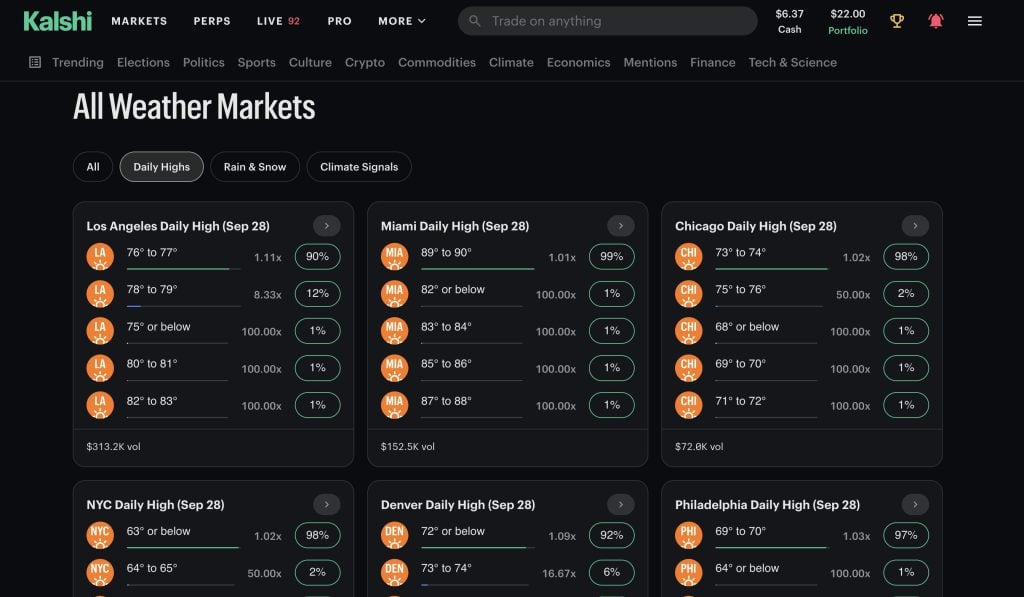
Kalshi’s daily temperature markets consist of a series of contracts covering mutually exclusive ranges for the next day’s high temperature. Crosier used the prices across those contracts to derive a single market-implied forecast, then compared it hour by hour with six publicly available weather forecasts.
Five of those forecasts came from the National Weather Service (NWS), including the NBM. The study also included a forecast from the European Centre for Medium-Range Weather Forecasts. Among the individual public forecasts tested, the NBM was the most accurate.
Kalshi’s advantage was largest in Philadelphia, Chicago and New York during the winter, when the study said forecasters face more difficulty timing the arrival of cold fronts. The market’s edge was smallest in Miami, where high temperatures tend to vary less from day to day.
The study used markets through Aug. 12, when Kalshi still settled the contracts using NWS daily climate reports. Kalshi later changed the settlement source for its temperature markets to The Weather Company, announcing the partnership later in August.
Public forecasts moved farther toward Kalshi
The study also looked at whether Kalshi traders were simply reacting to new information released by public weather forecasts. Crosier found evidence pointing in the other direction.
When Kalshi and the NBM disagreed, subsequent NBM forecasts moved toward the market about 4x farther than the market moved toward newly released NBM forecasts. Crosier also found little evidence of a sudden reaction in Kalshi prices when an updated NBM forecast was published.
“The market does not react to new weather forecast updates; instead, the forecast slowly publishes information that the market had already shared publicly,” Crosier wrote.
That did not require traders to build better weather models from scratch, Crosier said.
“Traders do not need to make a better weather model than the meteorologists,” he wrote. “They only need to start from what has been published and add anything that the weather guidance missed.”
Mansour echoed that explanation.
“Markets give people a financial incentive to be right,” he wrote. “Traders build sophisticated models, analyze public forecasts, and seek out information others have missed. They compete to identify and offer better prices, incorporating that information into the market’s forecast.”
Kalshi’s edge narrows against combined forecasts
Kalshi’s advantage was smaller when Crosier compared the market with an optimally weighted combination of all six public forecasts rather than with any single forecasting product.
Against that combined benchmark, Kalshi’s error was 3.1% lower at the end of the market’s opening hour and 4.3% lower that evening. By the NBM’s final forecast the following morning, the advantage had narrowed to 3%, a difference the study found statistically significant only at the 10% level.
Crosier described the combined forecast as a tougher benchmark because it draws on information from all of the public forecasts rather than comparing Kalshi with any one product.
“For any consumer of next-day temperature forecasts, prediction markets offer a public, continuously updated, and more accurate forecast than any other public product,” Crosier wrote.
Kalshi pitches market prices as forecasts for non-traders
Kalshi has increasingly sought to position the information generated by its markets as a product in its own right.
“The benefits extend to everyone: the resulting forecast is available to people who never place a trade,” Mansour wrote. More broadly, he said about 75% of people who use Kalshi come to view the probabilities generated across its markets, which span areas including politics, economics, sports and weather, rather than to trade.
Mansour also pointed to The Weather Company and Fox Weather as users of Kalshi weather data. Kalshi’s partnership with The Weather Company, which operates weather.com and The Weather Channel app, calls for its real-time weather probabilities to eventually appear in select experiences on those digital platforms.
The Crosier study is a preprint and has not yet undergone peer review.