

Card deposits to Kalshi and Polymarket US rose sharply between the first and third quarters of 2026, while six major betting operators recorded declines, according to new consumer spending data.
New consumer spending figures from American Spend show that card deposits to Polymarket US increased 495% between the first and third quarters of 2026. Kalshi recorded a 207% increase over the same period.
The figures appear in The State of Prediction Markets Q3 2026, a report published by Predicted that examines trading activity, consumer spending and the industry’s expanding reach.
Traditional betting operators moved in the opposite direction. Card deposits declined 4% at DraftKings, 8% at FanDuel and 10% at BetMGM. PrizePicks fell 13%, while Fanatics recorded the largest decline at 17%. Hard Rock Bet was down 6%.
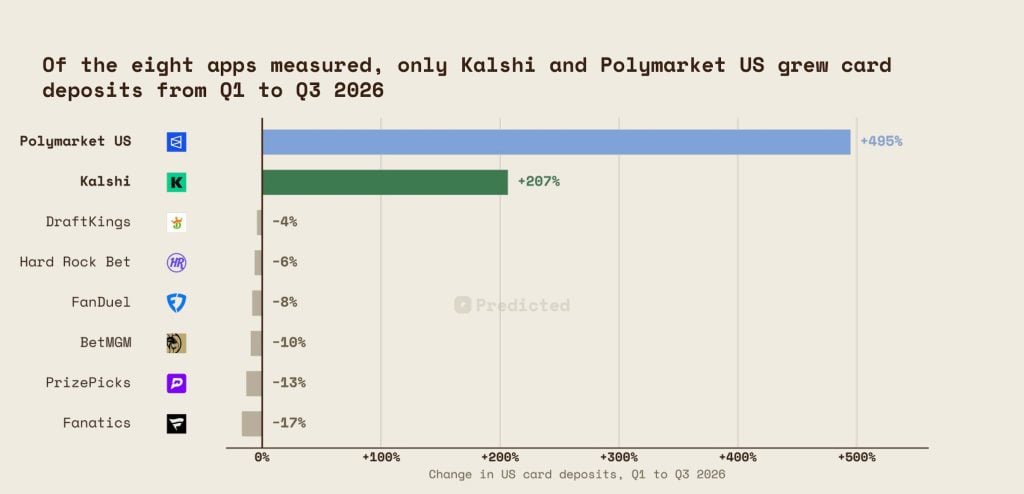
The contrast is particularly striking given the scale of the shift. Kalshi and Polymarket US accounted for 11% of card deposits across eight major betting and prediction market operators during the third quarter.
Their combined share was just 3% in the first quarter and 6% in the second.
The report’s consumer spending findings draw on data from American Spend’s Spend Graph, which covers $1.2 trillion in annual consumer spending. The dataset encompasses more than 150 million monthly active accounts and approximately 2 billion transactions each month.
The figures represent card deposits observed in American Spend’s data, rather than total platform deposits or trading volume. Bank transfers and other non-card payment methods are excluded.
More customers, larger deposits
Kalshi’s growth reflected both an increase in the number of card depositors and higher average deposits per customer.
The number of customers funding Kalshi accounts by card increased 127% between the first and third quarters. Average deposits per customer climbed another 35%.
Polymarket US recorded a different pattern. Its number of card depositors surged 1,265%, although the average amount deposited per customer declined 56%.
That distinction matters. Polymarket’s growth came overwhelmingly from an increase in card depositors, while Kalshi also benefited from higher average deposits per customer.
Sportsbooks recorded weaker results. DraftKings increased its card depositor count by 2%, but average deposits fell 6%. FanDuel‘s card depositor count declined 8%, alongside a 1% decline in average deposits.
The report also challenges the assumption that prediction markets are primarily taking customers away from sportsbooks. The report found relatively little overlap between prediction market customers and traditional sportsbook users who funded their accounts by card.
Of the people who deposited money into Kalshi by card during the third quarter, 88% did not make a card deposit to DraftKings, FanDuel, BetMGM or Hard Rock Bet during that period.
At Polymarket US, 72% of card depositors also did not make deposits to those four sportsbooks during the quarter.
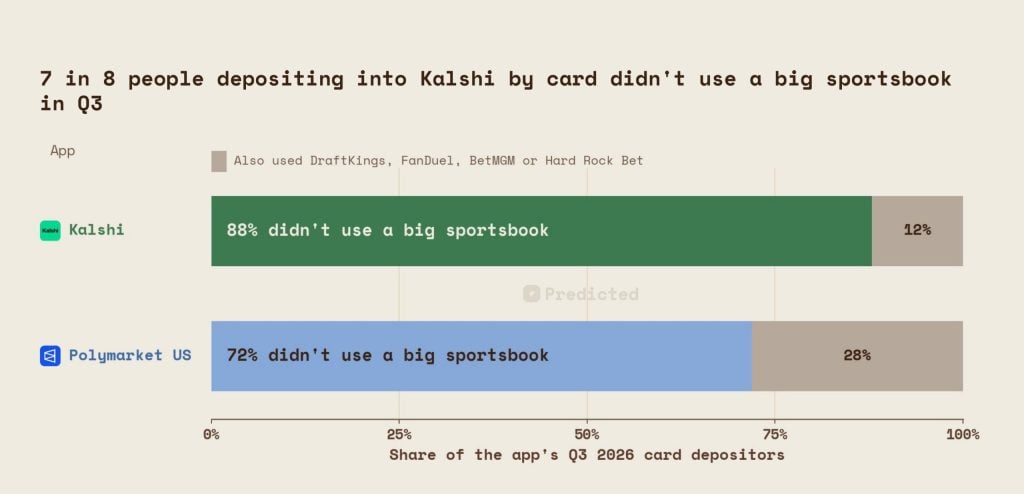
The finding suggests limited overlap in observed card funding activity, although it does not establish whether those customers previously used sportsbooks or funded them through other payment methods.
States without legal sports betting drive Kalshi spending
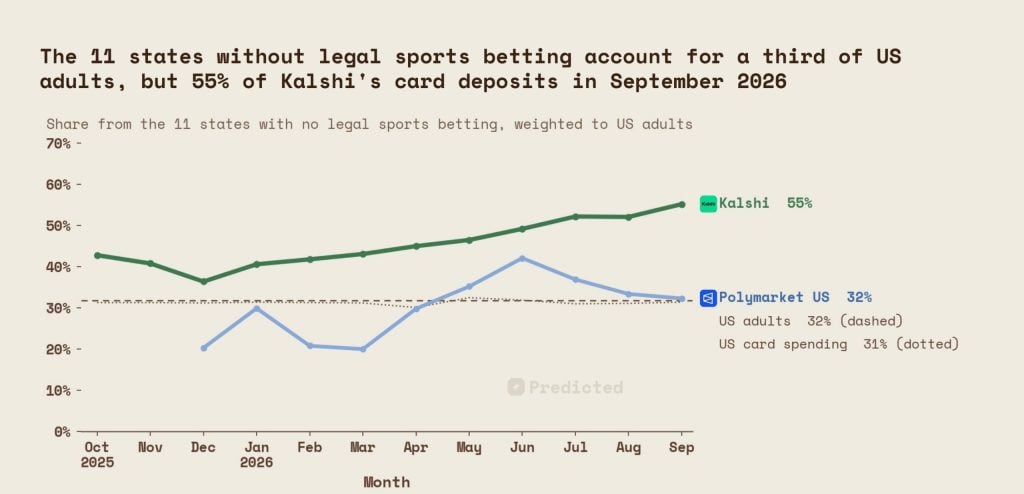
Geography provides another explanation for Kalshi’s expanding customer base. Some 53% of its third-quarter card deposits originated in 11 states without legal sports betting, according to American Spend.
Those states accounted for approximately 31% of overall US card spending and 32% of the adult population. Polymarket US received 34% of its card deposits from the same states. PrizePicks had an even greater concentration at 66%.
The contrast with conventional sportsbooks was substantial. Just 4% of DraftKings’ card deposits came from those jurisdictions, compared with 1% apiece for FanDuel and BetMGM.
Kalshi’s exposure to these markets also increased during the year. By September, the 11 states accounted for 55% of its card deposits, up from approximately 43% in October 2025.
A broader group of 21 states without legal sports betting or where courts ruled against prediction market platforms during Q3 accounted for 70% of Kalshi’s card deposits, according to the report. Those states represented 56% of the US population.
Kalshi operates under federal commodities regulation and maintains that its sports event contracts are not subject to state gambling laws. State regulators have challenged that position in court, arguing that the contracts constitute gambling subject to state licensing requirements.
Younger Americans account for a large share of deposits
American Spend’s demographic findings reveal another difference between prediction markets and traditional sportsbooks.
Cardholders aged 18 to 24 accounted for 30% of Kalshi’s card deposits during the third quarter, according to the report. The same age group contributed 39% of Polymarket US deposits but just 16% at DraftKings. FanDuel was at 13%.
The next age bracket, 25 to 34, accounted for another 30% at Kalshi and Polymarket US.
Combined, customers under 35 were responsible for 60% of Kalshi’s deposits and 69% of Polymarket US deposits among cardholders whose ages were known.
Kalshi’s card depositors also showed a different relationship with neighborhood income levels. In states permitting online sports betting, cardholders in the highest-income neighborhoods were about as likely to deposit into Kalshi as those in the lowest-income neighborhoods (1.02 times the rate), suggesting it draws depositors across income levels.
Polymarket US skewed toward higher-income areas (1.31 times), while DraftKings and FanDuel skewed the other way, at 0.68 and 0.53 times the lowest-income rate respectively. The comparison concerns the likelihood of making a deposit, rather than the average amount deposited.
Prediction market volume reaches record $194.1bn
The consumer spending figures accompany a record quarter for prediction market trading. Total notional volume reached $194.1bn during the third quarter, an increase of 75% from $111.2bn in the preceding three months.
US-regulated exchanges accounted for $172.5bn, representing 89% of the global total.
Kalshi dominated activity, processing $141.9bn in notional volume, more than double its second-quarter figure. Polymarket US recorded $17.3bn, or 2.4 times its second-quarter volume.
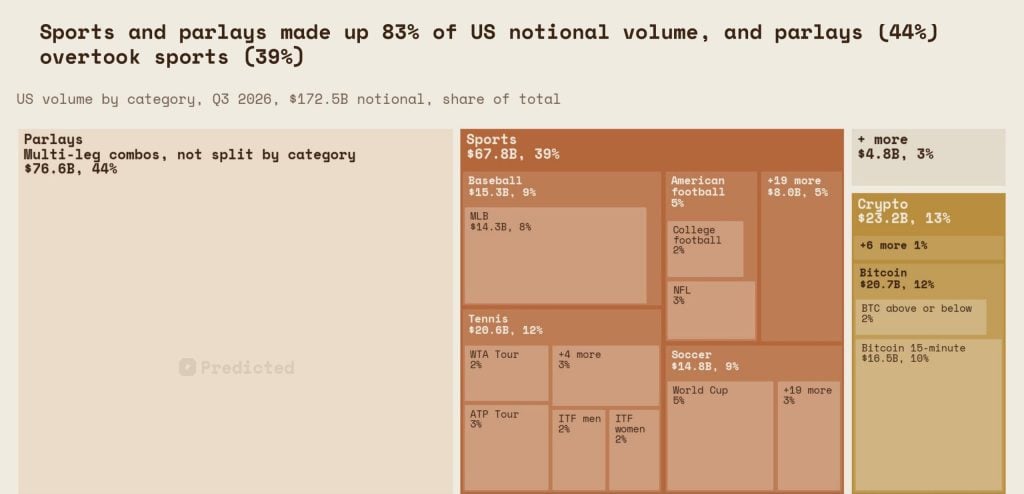
Much of the expansion came from parlays, which accounted for $76.6bn in US notional volume, representing 44% of the domestic market and 58% of its quarterly growth. However, the report estimates that the $76.6bn in parlay notional volume represented just $5bn in cash traded. The discrepancy reflects how notional volume measures the potential payout of a contract, rather than the amount traders paid for it.
The American football season was especially important. Kalshi’s September volume reached $60.8bn, compared with $41bn in July and $40bn in August.
Trading growth was not accompanied by a similar increase in online search interest. Search demand for prediction market brands declined 41% during the third quarter, according to Blask data cited in the report.