

In a Nov. 4 recap, Kalshi reported more than $2.5bn in trading volume on the 2026 US midterms, up from $1.3bn during the 2024 election cycle. The rounded figures implied growth of roughly 92% at the time.
The 2024 benchmark includes trading after Election Day, while Kalshi reported its 2026 total on Nov. 4 with some races still unresolved. By Monday, Nov. 9, that total had climbed to $3.17bn, according to the volume tracker on Kalshi’s website.
Using TickerTracker data, NEXTPredict.io found that Kalshi’s Elections category traded $726.9m on Nov. 3, nearly triple the $243.5m recorded on Election Day in 2024. Volume in the six days before each vote was about $300m.
TickerTracker’s Eric Ramsey said he had expected more day-to-day trading before the election, including in the final few days.
“Total volume ends up looking pretty modest overall despite that big surge for a few hours on Tuesday night,” he told NEXTPredict.io.
Election Day drives the increase
Across the 30 days ending on each Election Day, Kalshi’s Elections volume rose 79% from $732.3m to $1.31bn. The windows cover Oct. 7-Nov. 5, 2024, and Oct. 5-Nov. 3, 2026. Election Day supplied $483.5m of the $579.0m increase, lifting its share of the 30-day total to 55% from 33%.
Volume in the first 23 days of the matched 30-day windows rose 51% to $284.9m from $188.9m. That stretch supplied the entire pre-election increase, as trading in the final six days edged lower. Election Day alone exceeded the $460.5m recorded across October 2026 in the Elections category.
Within the Elections category, midterm markets generated $716.7m on Election Day. Of that, $497m traded between 8 p.m. and midnight ET, accounting for 69% of the day’s midterm volume. Trading rose from $50.6m between 7 and 8 p.m. to $141.5m in the following hour, then peaked at $146m between 9 and 10 p.m.
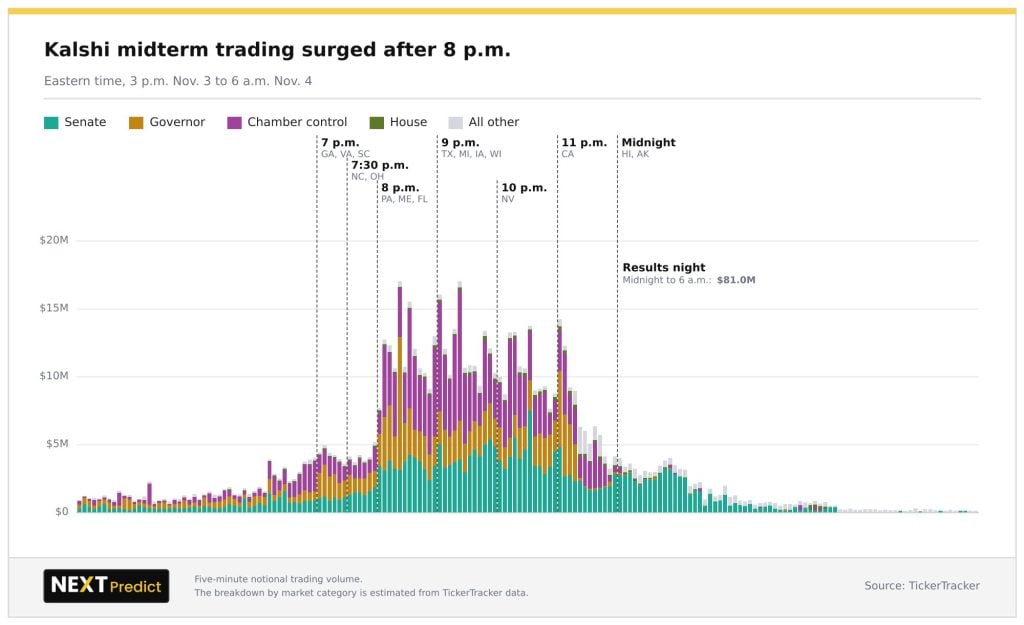
The Texas Senate, Texas governor and House control markets generated $84.0m, $77.6m and $70.2m, respectively, during those four hours. Together, they supplied nearly half of the evening window’s trading.
The category includes elections outside the midterms and covers a different period and set of contracts from Kalshi’s Nov. 4 midterm volume recap. All category figures measure notional volume, counting a contract’s full payout value each time it trades. Repeated trading therefore adds to volume without representing an equivalent amount of customer spending.
Texas Senate leads trading around Election Day
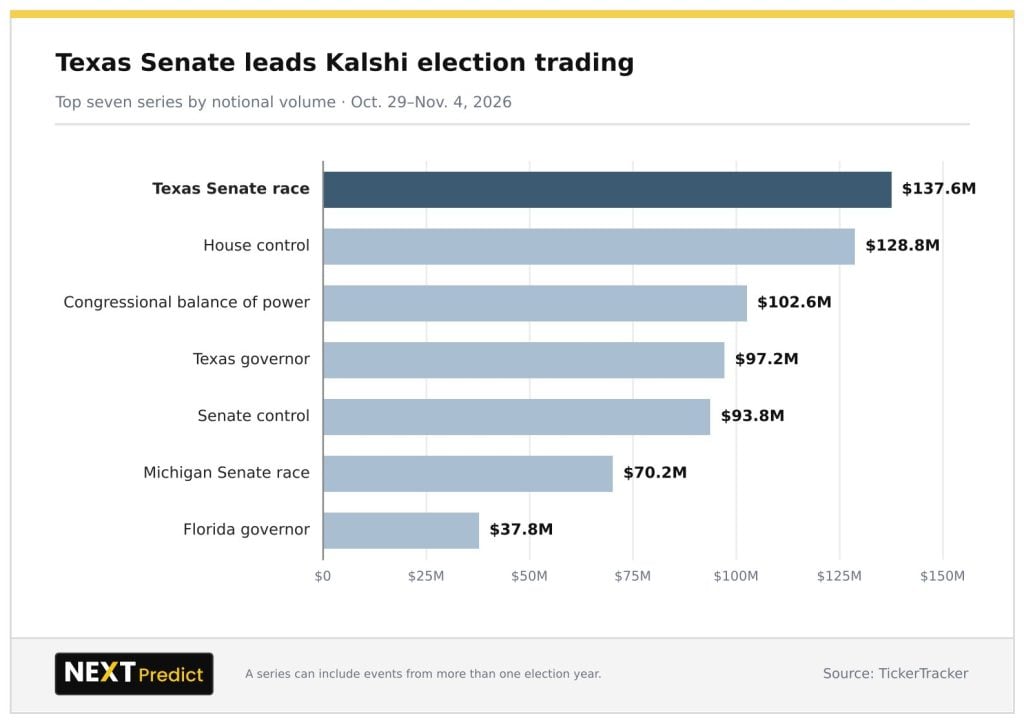
The Texas Senate race led election trading on Election Day and from Oct. 29 through Nov. 4, drawing $137.6m for the week. House control followed at $128.8m.
The Texas Senate and Texas governor races generated $234.8m combined, about a fifth of the category’s weekly volume. House control, Senate control and the combined balance of power in Congress drew $325.2m between them.
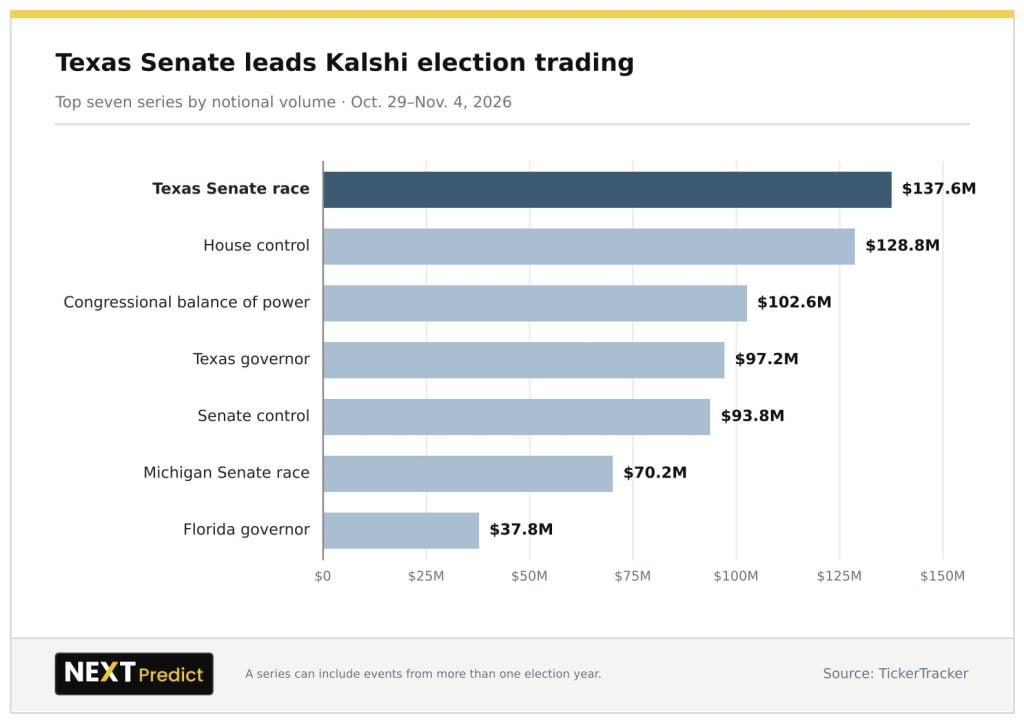
All $137.6m in Texas Senate trading that week came from the 2026 winner market, which had recorded $186.6m in lifetime volume at that point.
The five leading groups of related markets, which Kalshi calls “series,” generated $559.9m, accounting for 49% of the category’s volume that week. The House control and Texas Senate markets had also attracted substantial activity earlier in the campaign, together accounting for 47.1% of standalone US midterm winner volume in NEXTPredict’s Oct. 1-11 analysis.
Including primaries and other related contracts, Texas Senate markets generated $237.7m through Nov. 5, with primaries contributing $49.9m.
Kalshi’s 2026 midterm markets generated $141.2m on Nov. 4, down 30% from the $202.0m TickerTracker recorded for the day after the 2024 presidential election. About $81m, or 57% of the Nov. 4 total, traded between midnight and 6 a.m. ET as results continued to come in.
Michigan’s Senate race led Kalshi’s broader Elections category on Nov. 4 with $25.1m in trading.
Kalshi’s Nov. 4 recap identified the Mississippi and Alaska Senate races and several House races as still outstanding. Mississippi and Alaska generated $18.1m and $11.7m in trading that day, respectively.
Kalshi says its election markets can generally settle early once at least four of eight designated news outlets call a winner, with none disagreeing. That process can extend beyond Election Day while votes are counted and news organizations assess the results.
Senate-race volume reaches 28 times its 2024 level
Senate races generated $661.3m through the day after the 2026 election, about 28 times the $23.5m traded through the equivalent point in 2024.
By Oct. 4, 2024, Kalshi’s presidential winner market was live, just over a month before the Nov. 5 election. Two days earlier, a federal appeals court had denied the Commodity Futures Trading Commission’s request to pause a lower-court ruling that allowed Kalshi to offer contracts on which party would control each chamber of Congress.
Kalshi’s Oct. 4 announcement described individual congressional races and state-level presidential outcomes as still to come. Its 2026 Midterm Election Hub was already live in July.
Kalshi also gained a larger role in election coverage. CBS News named it an official prediction market sponsor and planned to incorporate its data into midterm reporting.
The growth came without a presidential contest. In 2024, the presidential winner series alone generated $342.0m, nearly 47% of Kalshi’s Elections volume in the 30 days through Election Day. The longer trading period and expanded selection of markets in 2026 remain important context for the comparison.
Polymarket reports nearly $700m in midterm trading
Polymarket told Reuters that traders generated nearly $700m in volume during the election cycle across its US and international platforms. Together with Kalshi’s Nov. 4 total, that put the two exchanges at about $3.2bn in combined trading, based on the companies’ figures.
TickerTracker’s separate Election Day comparison covers Kalshi’s midterm markets and Polymarket US’s election markets, excluding Polymarket’s international platform. It measures both exchanges from midnight to midnight ET on Nov. 3.
Across that window, Polymarket US generated $68.1m in election volume, compared with $716.7m in Kalshi’s midterm markets alone. Together, they recorded $784.8m in trading, with Kalshi supplying about 91% of the total.