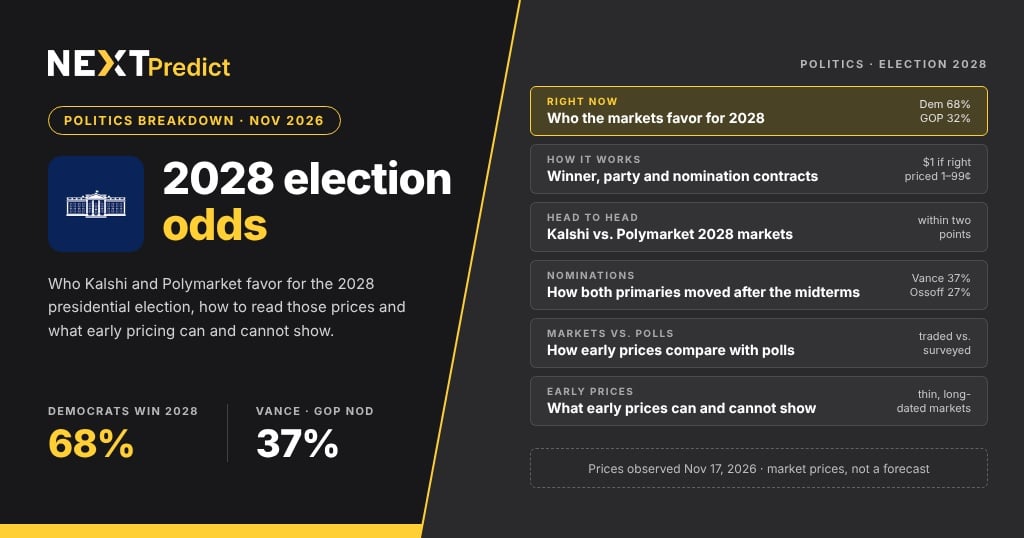
Prediction markets began pricing the 2028 presidential field years before either party’s primaries, as our guide to political prediction markets explains. On November 3, 2026, the day of the 2026 Midterms, Kalshi priced J.D. Vance at 31% to win the Republican nomination, meanwhile Jon Ossoff led the Democratic nomination market at 21% that night.
This page sets out who Kalshi and Polymarket currently favor with 2028 election odds in both parties and how to read those prices. It also compares market prices with polls and explains what early prices do and do not indicate.
What the 2028 Presidential Election Odds Show Right Now
Readers searching for 2028 presidential election odds will find prediction markets pricing both the general election and each party’s nomination. Kalshi and Polymarket both list contracts on the winning party and on each party’s nominee. The tables below record prices observed on November 17, 2026.
Winning party, 2028 Presidential election odds
| Contract | Kalshi | Polymarket |
| Democratic Party | 68% | 68% |
| Republican Party | 32% | 33% |
Democratic nomination
| Candidate | Kalshi | Polymarket |
| Jon Ossoff | 27% | 26.3% |
| Alexandria Ocasio-Cortez | 14% | 14.6% |
| Gavin Newsom | 11% | 10.3% |
Republican nomination
| Candidate | Kalshi | Polymarket |
| J.D. Vance | 37% | 37.1% |
| Marco Rubio | 18% | 16.6% |
| Ron DeSantis | 16% | 14.5% |
Prices observed November 17, 2026. NEXTPredict does not operate a licensed real-time odds feed, and prices might differ from live exchange prices.
Each figure is the market’s displayed probability, not a NEXTPredict forecast. Kalshi rounds to whole percentages, while Polymarket shows one decimal place, which accounts for small gaps between the two. Party prices on each platform sum to about 100%, with any excess reflecting the spread. Party-market volume stood at about $878,000 on Kalshi and about $2.75 million on Polymarket.
Nomination markets list many candidates, and each table shows the three highest-priced names. Both nomination tables use the same structure, platforms, and timestamp. The top three prices sum to well under 100%, because other candidates hold the remainder. Our guide to election betting odds covers how election contracts settle.
How 2028 Election Contracts Work
Kalshi and Polymarket list three main types of 2028 event contract. Overall winner contracts ask which named candidate wins the presidency, with one contract per candidate. Winning party contracts ask whether the Democratic or Republican nominee takes the White House. Nomination contracts ask which candidate each party nominates.
Each contract trades between 1¢ and 99¢ and pays $1 if its outcome occurs. A 26¢ price implies a 26% chance, as our guide to price as probability explains. Nomination and overall winner markets spread probability across dozens of candidates, so individual prices run lower than party prices. Polymarket’s overall winner market listed more than 58 candidates on November 17, 2026.
Both platforms restrict who trades election contracts. Kalshi bars candidates and campaign staff from election markets under its published rules and has suspended three candidates for five years in April 2026 after they traded on their own races.
A candidate’s overall winner price also reflects the chance of winning the nomination first. Each market’s rules name its resolution source and settlement date. Kalshi’s published election terms allow early settlement once at least four of eight designated media sources call the same winner. Polymarket’s 2028 markets list an end date of November 7, 2028, with rules on each market page.
2028 Presidential Election Odds on Kalshi and Polymarket
Readers comparing Kalshi 2028 president markets with Polymarket 2028 president markets will find a similar structure on both platforms. Kalshi and Polymarket each list overall winner, winning party, and nomination contracts for both parties.
The table below compares how each platform presents them.
| Feature | Kalshi | Polymarket |
| Overall winner market | Listed, $104m+ volume | Listed, 58+ candidates, $745m+ volume |
| Winning party market | Listed, $878,000+ volume | Listed, $2.75m+ volume |
| Democratic nomination | Listed, $296m+ volume | Listed, 58+ candidates, $1.32bn+ volume |
| Republican nomination | Listed, $97m+ volume | Listed, 43+ candidates, $739m+ volume |
| Price display | Whole percentages | One decimal place |
Observed November 17, 2026. Polymarket figures are from its international site.
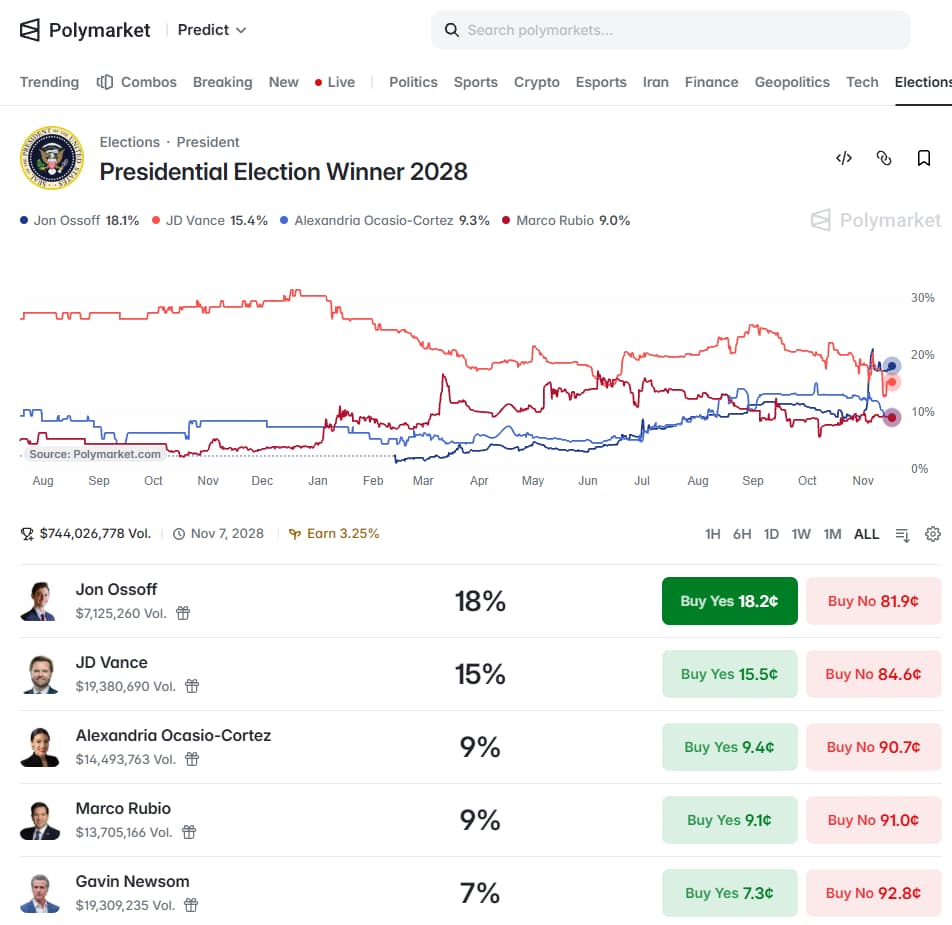
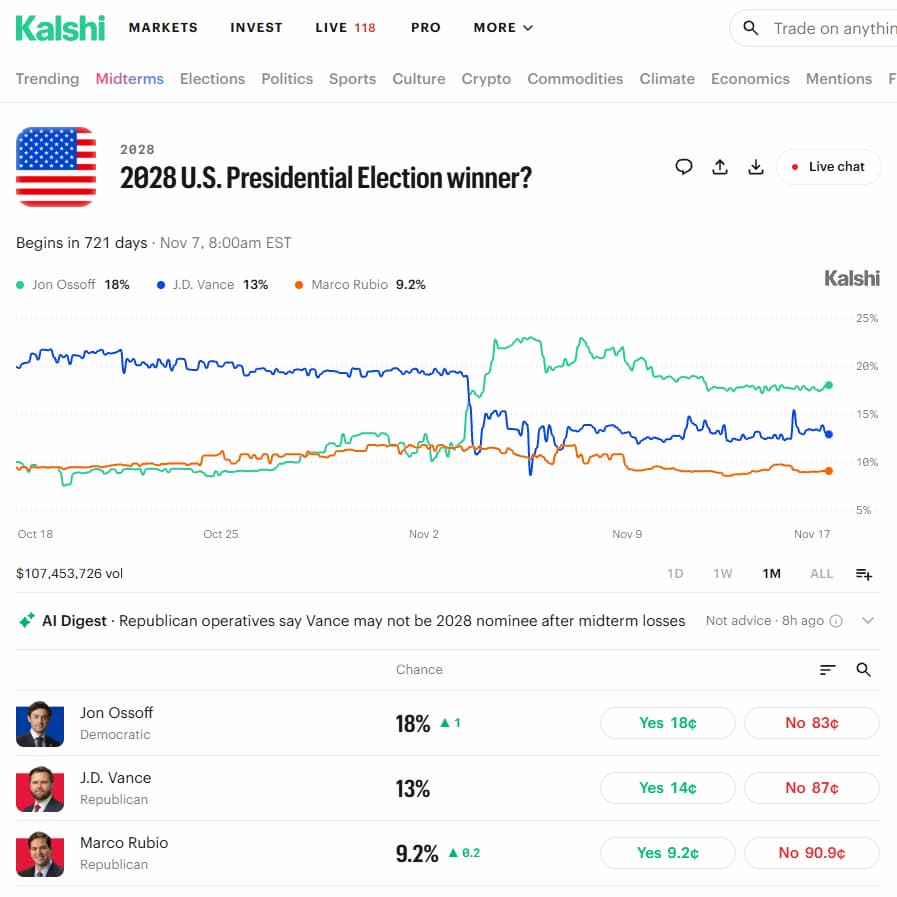
Prices on the two platforms sat within two points of each other on November 17, 2026. The widest gaps were on two Republican nomination contracts. Ron DeSantis traded at 16% on Kalshi and 14.5% on Polymarket. Marco Rubio traded at 18% and 16.6% respectively.
On the Democratic side, the largest gap was 0.7 points, on both Jon Ossoff and Gavin Newsom. Gaps of this size often reflect rounding, spreads and separate pools of traders.
Election contracts on both platforms face scrutiny in Washington. In October 2026, Sens. Elizabeth Warren and John Curtis wrote to both chief executives about insider trading and manipulation risks.
Our Kalshi vs Polymarket guide compares fees and account rules in more detail. Both platforms offer CFTC event contracts to US users, and our state legal status hub tracks access by state.
Republican and Democratic Nomination Markets
Both parties’ nomination markets moved after the midterms on November 3, 2026. The tables below show each party’s three highest-priced contenders on election night, and two weeks later.
Republican nomination
| Candidate | Kalshi, Nov 3, 11pm ET | Kalshi, Nov 17 | Polymarket, Nov 17 |
| J.D. Vance | 31% | 37% | 37.1% |
| Marco Rubio | 24% | 18% | 16.6% |
| Ron DeSantis | 19% | 16% | 14.5% |
Democratic nomination
| Candidate | Kalshi, Nov 3, 11pm ET | Kalshi, Nov 17 | Polymarket, Nov 17 |
| Jon Ossoff | 21% | 27% | 26.3% |
| Alexandria Ocasio-Cortez | 13% | 14% | 14.6% |
| Gavin Newsom | 14% | 11% | 10.3% |
November 3 prices from NEXTPredict’s election-night report. November 17 prices observed on each platform. NEXTPredict does not operate a licensed real-time odds feed.
Each side shows the same structure and platforms. Prices on both sides shifted by between one and seven points over the two weeks. Both nomination markets also list long-shot candidates priced below one cent. Prices on those contracts often rest on thin trading, so small orders move them.
Constitutional eligibility also bears on some listings. The Twenty-Second Amendment, ratified on February 27, 1951, states: “No person shall be elected to the office of the President more than twice.” The full text is published by the National Archives. Donald Trump, elected in 2016 and 2024, appears in Polymarket’s Republican nomination market at 0.6¢ on November 17, 2026. He appears in Polymarket’s overall winner market at 1.4¢ on the same date.
How Early 2028 Prices Compare With Polls
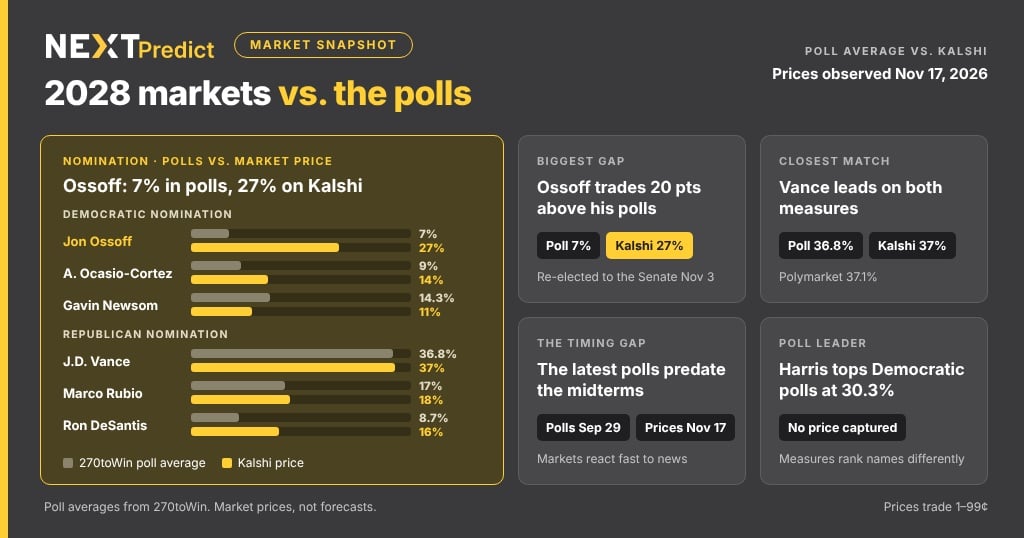
Polls and markets measure different things. A primary poll records which named candidate respondents prefer today. A market price reflects what traders pay for a contract on who wins the nomination. Our guide to prediction markets vs polls covers how the two compare on accuracy.
Republican nomination
| Candidate | 270toWin poll average | Kalshi, Nov 17 | Polymarket, Nov 17 |
| J.D. Vance | 36.8% | 37% | 37.1% |
| Marco Rubio | 17% | 18% | 16.6% |
| Donald Trump Jr. | 14% | Not captured | Not captured |
| Ron DeSantis | 8.7% | 16% | 14.5% |
Democratic nomination
| Candidate | 270toWin poll average | Kalshi, Nov 17 | Polymarket, Nov 17 |
| Kamala Harris | 30.3% | Not captured | Not captured |
| Gavin Newsom | 14.3% | 11% | 10.3% |
| Pete Buttigieg | 10% | Not captured | 5.3% |
| Alexandria Ocasio-Cortez | 9% | 14% | 14.6% |
| Jon Ossoff | 7% | 27% | 26.3% |
Poll averages from 270toWin, whose most recent included poll is dated September 29, 2026. Market prices observed November 17, 2026.
The newest polls in both averages predate the November 3 midterms, while the market prices came two weeks after. Polls also include candidates who have not declared, as do the markets. Some names rank in a different order on each measure, on both the Republican and Democratic sides.
Markets react quickly to new polls. Columbia economist Rajiv Sethi described the market reaction to a late 2024 Iowa poll as “very strong, very quick, but very wrong.” That poll showed Kamala Harris ahead in Iowa, while Donald Trump carried the state by about 13 points.
Why Early Prices Move and What They Cannot Show
Contracts on the 2028 election settle about two years from now, and long-dated contracts often trade in thin markets. With fewer orders resting on each side, a single large trade moves the displayed price further. Volume also varies by market with Polymarket’s party contracts holding about $2.75m, against $1.32bn on its Democratic nomination market.
Early prices also react sharply to news. On election night, November 3, 2026, Ron DeSantis rose about 14 points in Kalshi’s Republican nomination market within three hours. Jon Ossoff gained 9 points in Kalshi’s overall winner market over about five hours the same night.
NEXTPredict’s report tied the DeSantis move to his public break with Donald Trump the day before the election. Ossoff’s rise followed his re-election to the Senate in Georgia the same night.
A price is not a forecast. It records what traders paid for a contract at one moment, based on the information and positions held at that time. The prices on this page are not predictions, and NEXTPredict draws no conclusion about any candidate or party. Many factors that will shape the 2028 race, including who enters, have not yet occurred.
Conclusion
Kalshi and Polymarket price the 2028 race through overall winner, winning party and nomination contracts. On November 17, 2026, both platforms priced the Democratic Party at 68% and the Republican Party at 32-33%. Nomination prices on both sides shifted after the midterms and remain early-stage figures.
Current prices sit on each platform’s live market pages, including Kalshi’s party winner market and Polymarket’s 2028 winner market. Our politics hub, linked at the top of this page, covers the wider range of political contracts.
This page updates as prices move and as candidates declare.
Last updated: November 17, 2026.
Frequently Asked Questions
Who is the early favorite to win the 2028 presidential election?
On November 17, 2026, Jon Ossoff held the highest price in Polymarket’s overall winner market at 18.1%. J.D. Vance followed at 15.4%.
Kalshi also lists an overall winner market, but its prices did not display when NEXTPredict checked. Prices change continuously, and these figures are a snapshot, not a prediction.
Which party do prediction markets favor in 2028?
On November 17, 2026, Kalshi priced the Democratic Party at 68% and the Republican Party at 32%. Polymarket priced them at 68% and 33% respectively. The small excess above 100% on Polymarket reflects the spread between buyers and sellers.
Can you trade 2028 election contracts on Kalshi and Polymarket?
Yes. Kalshi and Polymarket both listed overall winner, winning party, and nomination contracts. Polymarket’s US users trade through its separate CFTC-regulated exchange. Access depends on the platform and the user’s state, which our legal status hub tracks.
How do you read 2028 Presidential election odds on a prediction market?
Each contract trades between 1¢ and 99¢ and pays $1 if its outcome occurs. The price approximates the market’s implied probability, so a price of 40¢ implies roughly a 40% chance. Our pricing explainer, linked above, covers the details.
Are prediction markets more accurate than polls for 2028?
Polls ask voters which candidate they prefer at a given moment. Markets price what traders pay for a contract on who wins. Poll averages and market prices for 2028 appear side by side earlier on this page. Our prediction markets vs polls guide, linked above, compares the two methods on accuracy.
Can Donald Trump run in 2028?
The Twenty-Second Amendment, ratified on February 27, 1951, states: “No person shall be elected to the office of the President more than twice.” The full text is published by the National Archives. The amendment had not been repealed or amended as of November 17, 2026.
Are election prediction markets politically biased?
A Dartmouth working paper covering elections since 1880 found no overall partisan bias across 216 election dates. Markets tracking short-term polling averages overpriced left-leaning outcomes by about 1.4 points.
The paper has not been peer-reviewed, NEXTPredict reported in November 2026.
Resources: Polymarket | Kalshi | National Archives | 270toWin | Fulcrum | WSB TV