
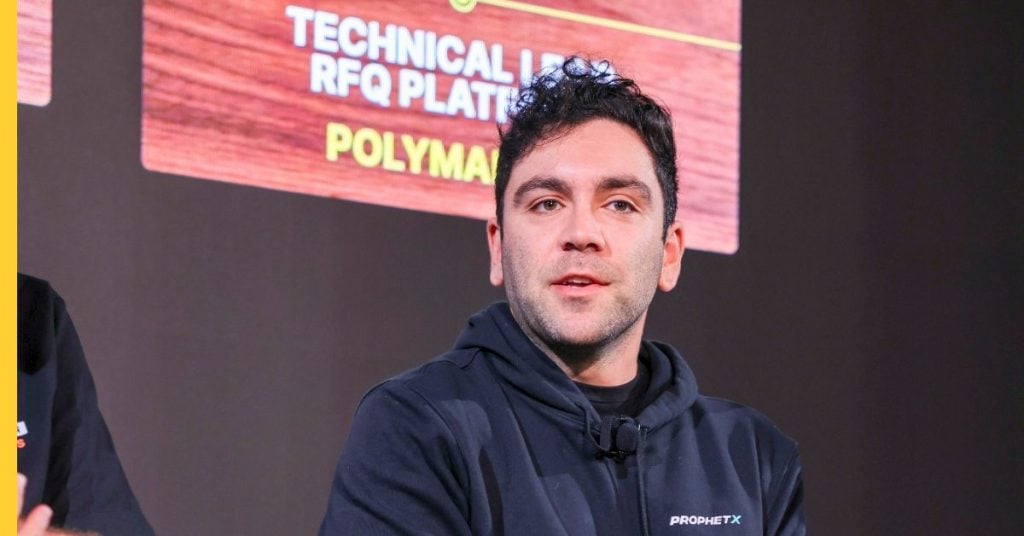
We headed into the Markets and Liquidity Hall for the first time where Dustin Gouker of Closing Line Consulting has just hosted a discussion on request for quote (RFQ) prediction markets.
First things first: a request for quote means a trade suggested by a user, often a complex parlay of some kind, that is then passed on to a suite of market makers, who compete to offer the best price.
The question being debated is whether RFQs are going to be the next big market structure – but by the sounds of things, they already are.
What problem does RFQ solve?
The big problem RFQs initially take on is how to integrate a form of parlay into prediction market products and give retail users a more flexible way of trading sports. Essentially, the question is: “How can we continue to erode the edge that the sportsbooks have left?”
The panel agreed with Gouker that, a year or so ago, you weren’t seeing RFQs, but Bernard Marantelli, founder of White Swan Data, threw out some numbers that tell the story of the instrument’s “hyper-growth” since then.
In the seven days from Oct. 20, Marantelli says $18bn worth of risk was being taken up by market makers via parlays across the prediction markets industry.
By Christmas, he reckons that’ll be $30bn. “Growth is out of control…in a good way,” he adds.
What does the RFQ structure mean for the consumer?
“Is there value here beyond sports?” is a question that’s relevant in almost every conversation you have about prediction markets at the moment. But it’s certainly relevant with regards to RFQs.
Taking that to a natural extreme, might we see weather parlays or the like, Gouker wonders?
It’s a serious question, and Jacob Meleka, a technical engineer at Polymarket, is clear about that. With Polymarket’s international audience, he says, it’s something “we’re looking into.”
The question he’s trying to answer first of all is: “Can you trade these complex, non-sports related contracts in a fun way.”
Marantelli says it’s “hugely possible.” He tells us about a friend of his, who hedges weather for Chicago Airport, insuring snow on Christmas, Thanksgiving and so on.
Now for Chicago Airport that’s OK, but for smaller businesses, like restaurants for example, “transactional friction” would historically have prevented them from doing the same.
With RFQs, maybe this problem goes away. No $10,000 in legal fees, no reams of paperwork, just an RFQ trade on Polymarket, ProphetX, or wherever else.
What does it mean for market makers?
Dean Sisun represented ProphetX on the panel, and the founder had some valuable insights into the other big opportunity presented by RFQs: that’s the opportunity for market making enterprises themselves.
Traditionally, when you think of market makers, you think of big institutional capital, and Sisun points out that, to date, it’s been extremely hard to build a business in this space from scratch.
ProphetX’s RFQs are met by around 30 to 40 high frequency market makers, who are: “plugged in to respond to orders in half a second to a second after a user comes in.”
How do you beat that? According to Meleka, smaller shops of one or two people have been finding an edge in the more niche parlays, perhaps away from sports. Maybe weather parlays, but definitely political parlays.
For instance, if you can figure out how a particular midterm result is going to impact the presidential elections later down the line and price that better than big capital, you’ve got a way in.
As Marantelli puts it to some ripples of laughter: “Some Bill and Ted’s will be the next Susquehanna.”
We’ll see. Earlier on today, Neal Berger of Eagle’s View Asset Management suggested that prediction markets could be bigger than the stock market. He’s betting on a future that might include sports, but certainly features far broader market expansion outside of sports.
RFQs could be one of the ways the sector opens itself up to help realize that future.
Follow live updates from NEXTPredict Summit NYC all conference long on our Live Blog for Day 1 and Day 2.