
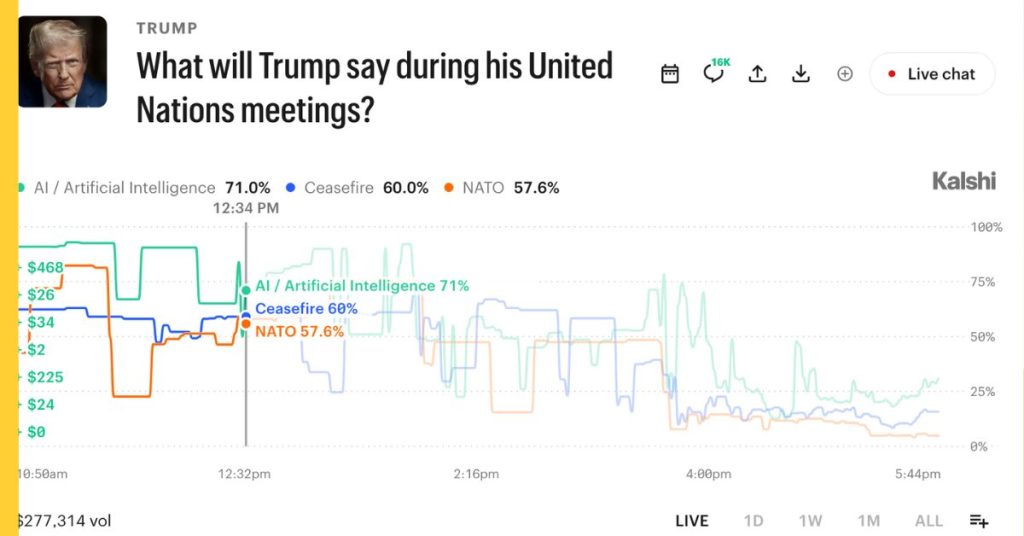
The Commodity Futures Trading Commission is signaling tougher oversight of one of prediction markets’ most distinctive product categories.
The CFTC’s Division of Market Oversight (DMO) issued a staff advisory Tuesday covering mention markets, which allow users to trade on whether someone will use certain words or phrases, as well as contracts tied to whether someone appears at an event or interacts with another person. The advisory groups all three types together under the term “Mention Markets.”
Mention markets have become a regular fixture on major prediction platforms, with both Kalshi and Polymarket maintaining dedicated categories for them. DMO said it may view such contracts as “presumptively readily susceptible to manipulation,” meaning exchanges should expect to make a stronger case that a contract meets federal requirements before listing it.
The advisory pointed in particular to markets in which the outcome can be influenced by a small number of people or is difficult to independently verify.
“These risks are compounded where Mention Markets settle on outcomes that lack independent verification or substantial public scrutiny,” DMO staff wrote. “When settlement turns on conduct occurring in informal or private settings — or on the actions of a person not subject to public scrutiny — manipulation may be harder to detect and easier to conceal, and those with influence over the outcome may exploit their position with less risk of exposure.”
How the manipulation could work
DMO illustrated the risk with a market on whether a live-streamed podcast host says a particular catchphrase. The host could determine the outcome simply by saying it, while a trader might try to induce the result by submitting a question or purchasing an on-air acknowledgement.
The agency also pointed to the potential advantage held by people with access to scripts, prepared remarks, guest lists or unpublished content before it becomes public. DMO said such information can create trading advantages for those closest to the settlement outcome.
Manipulation could also come from outside the subject’s immediate circle. The advisory said traders or others could try to influence an outcome through social engineering, inducements or public-pressure campaigns directed at the person whose conduct determines settlement.
Real-world cases exposed the risks
Concerns about mention markets had already surfaced through several high-profile examples in which the subject of a market, or people close to an event, knew or could influence the outcome.
MS NOW host Chris Hayes highlighted the issue after taping a January appearance on The Late Show with Stephen Colbert. Hayes learned after leaving the studio, but before the prerecorded interview aired, that Kalshi had a market on what he would say during the appearance. That meant Hayes, members of the studio audience and others involved in the production already knew the outcome while the market remained open.
An even more direct example came during Coinbase’s October 2025 earnings call. CEO Brian Armstrong acknowledged that he was looking at prediction markets tied to words he might say, then deliberately rattled off several terms listed in the markets. Roughly $84,000 had reportedly been traded across Kalshi and Polymarket contracts tied to the call.
The concern later moved from hypotheticals to enforcement. In August, the CFTC ordered former White House teleprompter operator Gabriel Perez to give up more than $107,500 in profits and pay a $65,000 penalty after finding that he used advance access to President Donald Trump’s prepared remarks to trade presidential mention contracts. The CFTC credited Kalshi with assisting the investigation.
Attendance markets raise similar concerns
The agency has also acted against contracts that do not involve what someone says. Former Rep. George Santos was ordered in July to pay $35,000 after the CFTC found that he traded on whether he would attend the 2026 State of the Union, then made misleading public statements about his plans that moved prices in his favor. Kalshi later gave Santos its first lifetime trading ban.
That case helps explain the broader scope of Tuesday’s advisory. DMO is applying the same manipulation concerns not only to traditional mention markets, but also to contracts based on whether someone attends an event or interacts with another person, where the person at the center of the market may similarly control or influence its outcome.
What exchanges may have to do
DMO left a path for the contracts to remain available. It said an exchange may be able to overcome the manipulation presumption if the contract’s structure and its safeguards sufficiently reduce the risk.
But exchanges seeking to list such markets should expect to explain those safeguards in detail. DMO said they should consider whether the person controlling the outcome is subject to legal, professional or other obligations that discourage manipulation, whether outsiders could pressure or induce that person, and whether the underlying conduct can be independently verified and subjected to meaningful public scrutiny.
The advisory also lays out unusually specific compliance measures. Exchanges could identify people connected to a contract and place them on restricted lists, use outside screening tools to uncover affiliations, require traders to confirm they have no connection to the event, impose position limits and watch for unusual trading shortly before information becomes public.
DMO said future filings for these contracts should include a “thorough evaluation” of the risks and enough detail about the safeguards for staff to determine whether they are sufficient.
Kalshi had already pulled sports mention markets
Kalshi had already backed away from one part of the category before Tuesday’s advisory. The exchange stopped listing sports announcer mention markets in late July. The move came amid a CFTC inquiry into potential manipulation of mention contracts.
The sports markets had attracted substantial trading. More than $47m had been traded on Kalshi’s NFL announcer mention markets by early February, while the platform’s overall mention-market volume had risen to $117m in January.
The NFL had separately raised similar integrity concerns. In March, the league asked prediction-market operators to avoid contracts that could be easily manipulated or determined in advance, specifically including what announcers say during broadcasts and which celebrities attend games.
Kalshi has continued to offer mention markets outside sports, including contracts tied to politics and television appearances. Tuesday’s advisory does not prohibit those markets, but it makes clear that DMO expects CFTC-regulated exchanges listing them to demonstrate that their controls are strong enough to address the manipulation risks the agency has identified.