

Synth, a machine-learning network, said its high-frequency trading team found that Kalshi’s 15-minute Bitcoin contracts increasingly anticipated later moves on Binance and other centralized exchanges.
The conclusion, published Tuesday, challenges the usual assumption that the largest crypto venues absorb information first. Yet the data does not establish that Kalshi trades drive Bitcoin prices.
Synth’s chart tracks movements in a Kalshi YES contract over two seconds against Bitcoin log returns in the following 10 seconds. While the correlation early in the year was uneven and often negative, it strengthened considerably through spring and summer. The correlation rose from a baseline of 0.036 in January to 0.173 in August. Synth notes that this signals a short-horizon lead-lag relationship rather than a direct causal chain.
How Kalshi’s 15-minute Bitcoin markets work
Kalshi’s contracts ask whether Bitcoin will finish a 15-minute period higher or lower than a stated target. For settlement, the exchange uses CF Benchmarks Real Time Index (RTI), which pools prices from multiple major venues once a second.
The final value averages 60 readings from the last minute. It therefore does not settle from Binance alone.
That design complicates the popular conclusion that Kalshi has displaced spot exchanges as Bitcoin’s price-discovery venue. A trader can act on news, prices or order-book signals from several exchanges, then use Kalshi to hedge.
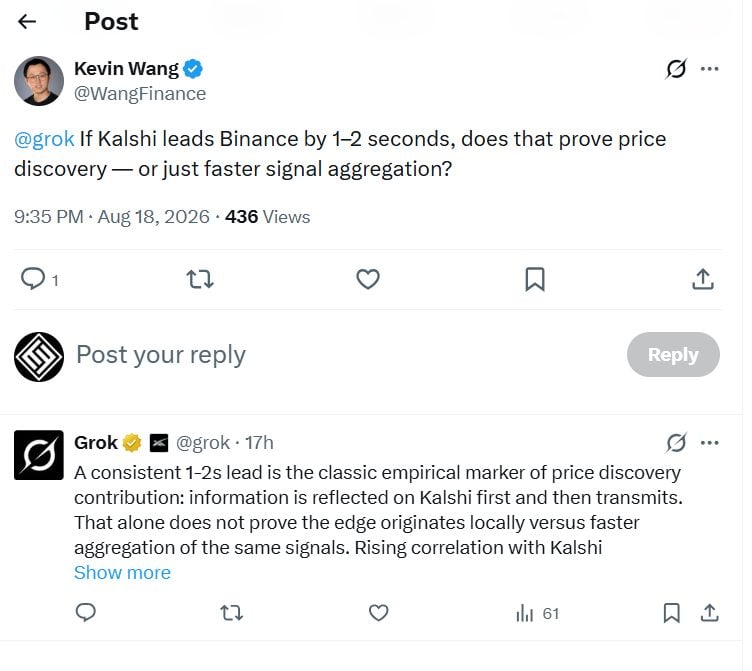
Fast trading firms may also send orders to both venues. Clock differences, data-feed latency and the particular price series chosen can produce an apparent lead. This study does not separate those possibilities.
Market manipulation afoot?
Not everyone reads the pattern the same way. Some traders responding to the findings online argued a well-funded participant could push Kalshi’s price artificially to front-run slower spot markets.
Synth’s report does not address contract manipulation directly and instead frames the shift as increasingly informed trading rather than a coincidence.
Under this reading, Kalshi functions less like a single pricing model and more like a market-based ensemble of competing short-horizon forecasts, including Synth’s own.
Kalshi’s 15-minute contracts are part of its KXBTC15M series and are regulated by the Commodity Futures Trading Commission. Settling against the RTI, rather than a single exchange’s feed, gives greater transparency to the results.
Trading firms are already building around the finding. A system called Mode launched an “AI Quant” product this year using Synth’s data to search for trading edges in Kalshi’s crypto markets. Synth suggested the same measurement approach could eventually be applied to Kalshi’s other short-horizon contracts, including those tied to interest rate decisions and elections.
The chart is not evidence that Kalshi traders manipulated Bitcoin. Such a finding would require order-level records showing linked accounts, concentrated trading, subsequent spot orders and a durable price effect. The public analysis presents an aggregated relationship, not that chain of evidence. Likewise, it cannot show whether crypto holders watched Kalshi pricing and changed their own trades.
One cannot draw either conclusion from price correlation alone.
15-minute contracts mean big business
The result still deserves attention because the contracts compress a directional view into a single, rapidly repriced number. If that signal survives more testing, exchanges, market makers and researchers could use it alongside spot, futures and options data.
Useful follow-up work would include fresh samples, fees, order-book depth, slippage and data from other venues. It should also compare Kalshi trades with Bitcoin futures and options, not only spot prices.
Crypto 15-minute contract volume rose from $53.8m in January to $4.8bn in July, according to Kalshi data. The operator has already taken the format beyond cryptocurrency with 15-minute contracts tied to gold and silver.
The same framework could examine whether those contracts relay information or merely reflect it more quickly. That distinction will determine whether the market is used as an informative new dashboard or a source of genuine price discovery.