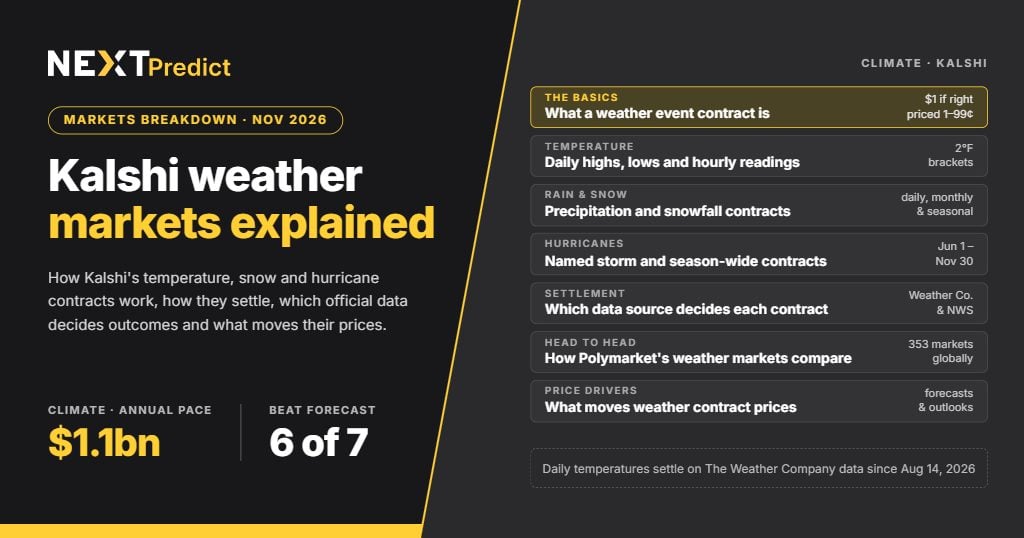
Kalshi partnered with The Weather Company in August 2026 to settle its weather contracts on the company’s data. The Weather Company plans to show Kalshi’s real-time probabilities to some users of weather.com and The Weather Channel app.
A September 2026 preprint found Kalshi’s next-day temperature prices outperformed the leading public forecast in six of seven cities studied. Not only that, but Kalshi says its climate and weather category has grown 500% and is approaching an annual volume of $1.1 billion.
This page explains how Kalshi weather markets work, how the prediction market platform structures its temperature, snow and hurricane contracts and how each one settles. It also covers what moves weather contract prices and why the settlement source matters to traders.
What Are Kalshi Weather Markets?
A weather event contract is a binary contract on a measurable weather outcome at a named location and date, paying $1 if the outcome occurs and nothing if it doesn’t. Kalshi lists contracts on daily temperatures, rain, snow and hurricanes, as our weather prediction markets hub sets out.
Prices trade between 1¢ and 99¢ before settlement. A 30¢ price implies roughly a 30% chance of the outcome, as our pricing explainer shows. For the basics, see what is a prediction market.
Kalshi operates as a CFTC-regulated exchange and groups these contracts under a dedicated climate category. Since August 14, 2026, its daily temperature contracts settle on The Weather Company data, replacing National Weather Service reports.
Robinhood also lists weather contracts under a Climate section in its prediction markets hub, routing them through several exchanges, including KalshiEX and ForecastEx. The Robinhood temperature contracts link to ForecastEx terms and settle on Weather Underground station data. Each contract’s rules name its exchange and settlement source.
Temperature Contracts
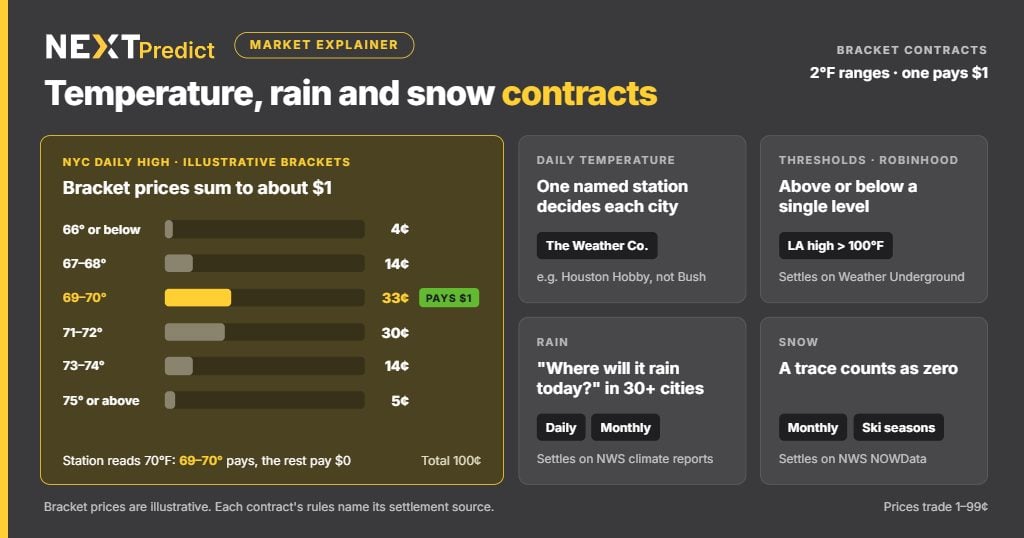
Daily temperature event contracts track the high or low temperature at a named weather station on a given date. Kalshi’s climate page listed daily markets for more than a dozen US cities on November 9, 2026. They included New York, Chicago, Miami, Austin, Los Angeles, San Francisco, Houston, Denver and Atlanta. Each city settles on a single station, such as Houston’s Hobby Airport rather than Bush Intercontinental.
Most Kalshi temperature markets use bracket contracts. Each bracket covers a two-degree Fahrenheit range, such as 70°-71°, and only one bracket pays out. Edge brackets cover everything above or below the listed range, so the set covers every possible reading. As only one bracket pays, prices across a city’s brackets sum to roughly $1.
Threshold contracts instead ask whether a reading lands above a single level. Robinhood’s ForecastEx temperature contracts use this format, such as a Los Angeles high above 100°F. Kalshi’s climate page showed brackets, not thresholds, for temperature.
Hourly contracts settle on the temperature at a set hour rather than the day’s extreme. Kalshi lists them under a separate hourly temperature category. Data provider minuteTemp reports Kalshi hourly markets settle on a weighted index of several airport stations, whereas daily contracts, by contrast, settle on one station’s official report.
Precipitation and Snowfall Contracts
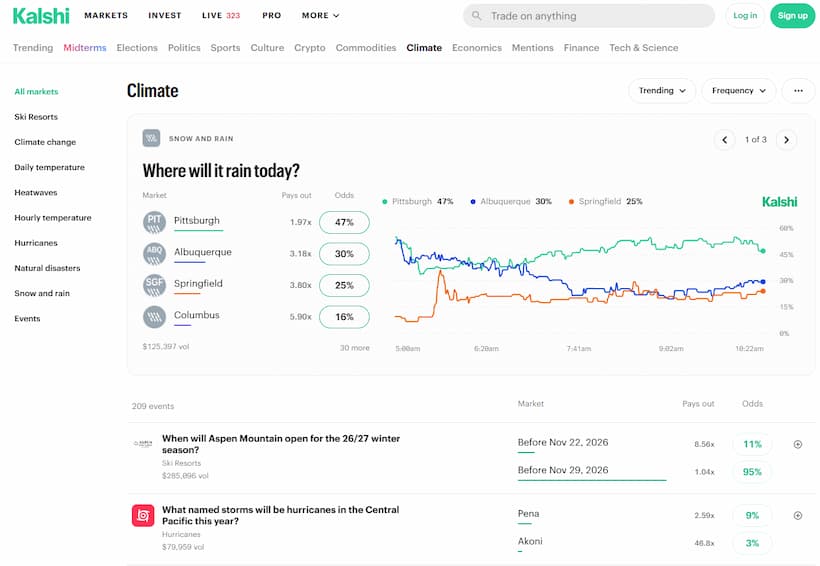
Kalshi’s rain contracts ask whether measurable rain falls at a named location over a set period. On November 9, 2026, its climate page listed a daily “Where will it rain today?” market across more than 30 cities. A separate weekend market covered November 7 and 8 in cities including New York and Houston.
Kalshi also lists monthly rain markets for cities such as New York, under the title “Rain in NYC this month?” These markets settle on National Weather Service climate reports, not The Weather Company.
Snowfall contracts follow the same yes-or-no structure but run on a seasonal calendar. Kalshi lists monthly snow markets for cities such as New York and seasonal accumulation markets for ski areas. Monthly snowfall settles on the NWS NOWData system, which sums daily new-snow readings. A trace reading counts as zero, so a dusting does not trigger a payout.
Snow listings vary through the year at prediction market apps, so open markets and their rules show what is available.
Hurricane and Named Storm Contracts
Kalshi’s storm contracts track the Atlantic hurricane season, which runs from June 1 to November 30 each year, according to NOAA. Season-wide contracts stay open for months and expire on December 1, after the season closes. Prices on these contracts shift as storms form, strengthen or fail to develop.
Formation contracts count storms across the season, such as “Number of tropical storms in the Atlantic this year?” Kalshi’s climate page priced “Above 10” at 50% on November 9, 2026. Intensity contracts ask whether a named storm reaches a set strength, such as Category 3 at 111 mph sustained winds. Related markets ask which named storms become hurricanes or how many major hurricanes form.
Kalshi’s terms for single-storm intensity contracts name The Weather Company first and the National Hurricane Center second as source agencies. Contracts resolve on the initial non-preliminary values those agencies publish.
This section reflects the 2026 season, which closes on November 30.
How Weather Contracts Settle
Every Kalshi weather market names its settlement source in its rules, and only that source counts. Kalshi’s help center says hourly temperature contracts settle on The Weather Company’s reading for a named station, such as KORD for Chicago. Settlement processes about 25-35 minutes after the market closes.
Kalshi’s July 2026 help article tied daily contracts to the final NWS Daily Climate Report, usually issued the next morning. In August 2026, Kalshi partnered with The Weather Company, which now runs observations through its own quality control before settlement. Rain and snow contracts still settle on NWS data.
NWS climate reports use local standard time all year. During daylight saving time, the reported daily high covers 1:00 a.m. to 12:59 a.m. the next day, local time. A reading at 12:30 a.m. therefore counts toward the previous day’s figure. Daylight saving time ended on November 1, 2026, so the two clocks match until March 2027.
A weather app might show a reading from a different station than the one a contract names. Traders comparing app forecasts with contract prices should check the station code in the market rules first.
Polymarket Weather Markets
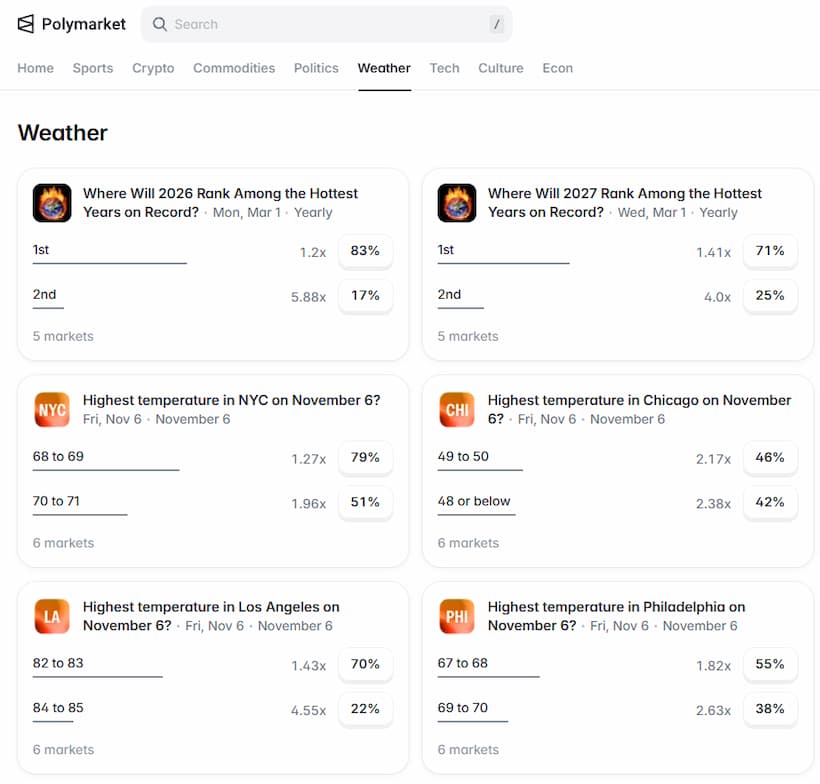
Polymarket lists weather contracts on both its international site and US exchange. On November 9, 2026, Polymarket’s global weather page showed 353 markets, including 259 temperature contracts. Daily highest-and-lowest-temperature markets covered roughly 49 cities, among them New York, Chicago, London, Tokyo and Seoul. Its US site for Polymarket weather isn’t as vast and showed 29 questions on the same date.
Like Kalshi, Polymarket uses brackets for daily temperature markets, with only one bracket paying out. US cities trade in two-degree Fahrenheit brackets, while cities abroad trade in one-degree Celsius steps. Polymarket also lists longer-dated contracts, including global temperature rankings, US tornado counts and a Category 4 US landfall market.
Settlement sources vary by contract and appear in each market’s rules. International markets commonly settle on a named station of Weather Underground, with Polymarket US daily temperature contracts settling on NWS Daily Climate Report and offer a narrower, US-focused menu.
Polymarket moved its Paris contracts to a different airport station after an April 2026 tampering probe.
What Moves Weather Contract Prices
Weather contract prices move as new forecast information reaches traders. For daily temperature contracts, updates from National Weather Service forecasts and the National Blend of Models shift expectations through the day. A September 2026 preprint found later NBM forecasts moved toward Kalshi prices when the two disagreed.
Longer-dated contracts respond to seasonal outlooks. NOAA’s Climate Prediction Center issues 90-day outlooks once a month, near mid-month. NOAA also updates its Atlantic hurricane outlook during the season, as it did on August 6, 2026. Storm formation and National Hurricane Center advisories move season-wide contracts.
Kalshi says businesses use its weather contracts to hedge, citing ice cream shops and logistics firms. Kalshi reports its climate and weather category is pacing toward $1.1bn in annualized volume, with the push sitting alongside Kalshi’s Commodities Hub for gold, oil and crops. These figures come from Kalshi and are not independently verified.
Kalshi operates under CFTC oversight, and state treatment of event contracts varies, as our legal hub sets out.
Conclusion
Weather markets at prediction market platforms such as Kalshi and Polymarket cover temperatures, rain, snow and hurricanes, mostly through binary contracts paying $1 or nothing. Each contract settles only on the source its rules name, such as The Weather Company or an NWS report.
A different station or time window changes the result, so the market rules, not a weather app, decide the payout. Our weather markets hub tracks current listings and settlement changes.
Last verified: November 9, 2026.
Frequently Asked Questions
What are Kalshi weather markets?
Kalshi weather markets are event contracts on measurable weather outcomes, including daily and hourly temperatures, rain, snowfall and Atlantic storms.
Each contract pays $1 if the stated outcome occurs and nothing if it does not. Prices between 1¢ and 99¢ reflect the market’s implied probability.
How do Kalshi weather contracts settle?
Each market’s rules name its settlement source, and only that source counts. Kalshi’s help center says hourly temperature contracts settle on The Weather Company’s reading for a named station.
Settlement follows about 25-35 minutes after close. Its July 2026 help article tied daily contracts to the final NWS Daily Climate Report, usually issued the next morning.
Which cities have Kalshi temperature markets?
Kalshi’s climate page listed daily temperature markets for more than a dozen US cities on November 9, 2026.
Daily high markets included New York, Chicago, Miami, Austin, Los Angeles, San Francisco, Houston, Denver, Atlanta and Minneapolis. Daily low markets included New York, Louisville, Oklahoma City and Denver.
Does Polymarket have weather markets?
Yes. On November 9, 2026, Polymarket’s international site showed 353 weather markets, including 259 temperature contracts across roughly 49 cities worldwide, with Polymarket US showing 29 live weather questions.
Polymarket also lists longer-dated contracts on global temperature rankings, US tornado counts and hurricanes. Settlement sources vary by contract and appear in each market’s rules.
Can you trade hurricane contracts on Kalshi?
Yes. Kalshi lists season-wide contracts on Atlantic tropical storm and major hurricane counts, plus contracts on which named storms become hurricanes. Single-storm contracts ask whether a storm reaches a set category, settling on The Weather Company and the National Hurricane Center. The Atlantic season runs from June 1 to November 30.
Resources: Bloomberg | Kalshi | minuteTemp | NOAA | Insurance Journal | Wall Street Journal | CPC | Artemis