An election prediction market is a place to trade the outcome of a vote. You buy and sell contracts tied to a specific electoral result, and the price moves as traders change their view of who will win. When a headline reports that $197 million traded on Polymarket midterms, this is the market it means. This page explains how these contracts work, how they settle, whether they are legal, and the court fight that decided their legality in the United States.
Election prediction markets sit inside the wider world of political prediction markets, the category that prices politician approval, legislation, and appointments as well as elections. This page is the starting point for NEXTPredict’s Politics coverage. For the current numbers on any race, see the midterm election results page.
What Is an Election Event Contract?
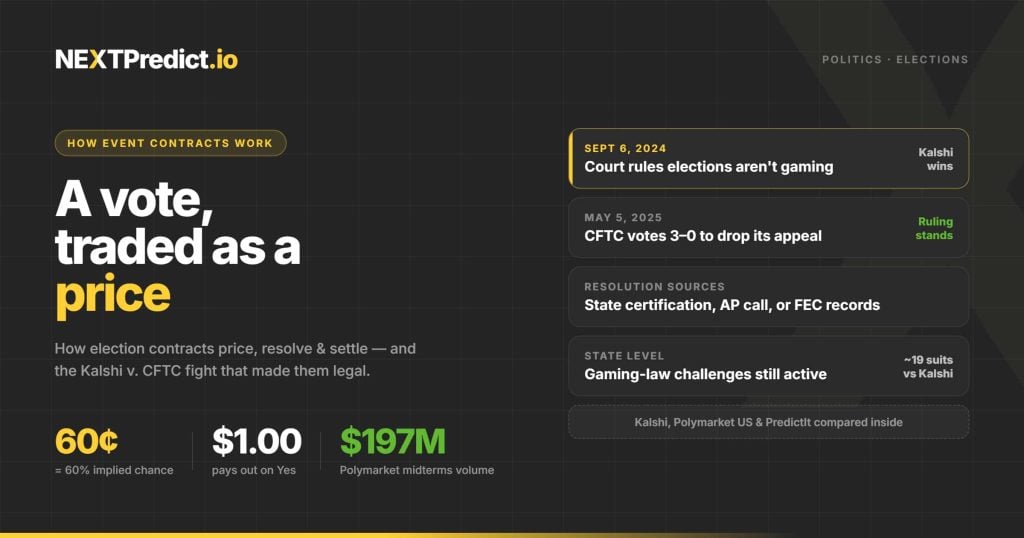
An election event contract is a binary (Yes or No) contract that resolves against a specific electoral outcome. It pays out based on a Yes-or-No question, such as whether one party will control the Senate after a given election. The contract trades at a price between 1 cent and 99 cents, and that price is the market’s implied probability of the outcome. A contract at 60 cents reads as a 60 percent implied chance of the event happening.
Each contract pays $1.00 if the outcome it names occurs and nothing if it does not. A trader who holds the correct side collects the full dollar, and the difference between the purchase price and the payout is the gain.
How Election Contracts Resolve
Every election contract names its resolution source in advance. The source is the authority the operator uses to decide who won and settle the contract. Across the industry, that source is either:
- official state certification of the result
- an Associated Press race call
- the Federal Election Commission records.
The prediction market platform states which one determines the result or each contract before trading opens.
A contested or delayed result delays the settlement. If a race is not called or certified by the expected date, the contract stays open until the resolution source has a final result. This keeps the outcome tied to the official record instead of a media estimate that may not be accurate.
Senate and House Balance of Power: Current Snapshot
The balance of power is the single most-traded election question, because control of each chamber drives the contracts that follow. This page does not carry a live count, because the numbers change rapidly.
That midterms page carries the current market-implied probabilities for control of each chamber, sourced to the operators listing those contracts. Use it for the numbers and use this page for the mechanics behind them. The two are built to work together, one for the live read and one for the explanation.
Why Kalshi Fought the CFTC Over Election Contracts
The legal status of election contracts in the United States was settled by a lawsuit. In June 2023, Kalshi, a CFTC-regulated designated contract market, self-certified contracts on which party would control each chamber of Congress. The Commodity Futures Trading Commission voted 3 to 2 to prohibit them, ruling the contracts involved gaming and unlawful activity under the Commodity Exchange Act. Kalshi sued, arguing the agency had misread the statute.
The district court sided with Kalshi. On September 6, 2024, Judge Jia Cobb of the US District Court for the District of Columbia ruled that the CFTC had exceeded its authority, finding that elections are neither unlawful activity nor gaming under the law. The CFTC appealed and won a brief administrative stay, but the DC Circuit denied a longer stay on October 2, 2024, and Kalshi’s election contracts went live. The court heard an oral argument on the appeal in January 2025.
The fight ended on May 5, 2025, when the CFTC voted 3 to 0 to drop its appeal, and the DC Circuit granted the dismissal on May 7, leaving Judge Cobb’s ruling in force. In January 2026, the agency withdrew the 2024 proposed rule that would have defined political event contracts as gaming. Federal opposition to election contracts had effectively ended.
The federal question is settled, but now states are moving to litigation to block some prediction contracts. As of early 2026, Kalshi faced roughly nineteen federal suits and state cease-and-desist letters, most aimed at its sports contracts rather than elections. For the current status of any state challenge and the operator-by-operator detail, see the Legal Status hub.
Are Election Prediction Markets Legal?
At the federal level, election prediction markets are legal on regulated venues. Federally regulated platforms like Kalshi and Polymarket US operate under CFTC oversight as designated contract markets. The CFTC’s 2025 decision to drop its Kalshi appeal removed the federal barrier to election contracts.
At the state level, the situation is still in question. Some states have challenged election and sports contracts under their own gaming laws, and those cases are active. The outcome varies by state and by operator, and it changes as courts rule.
Platforms Offering Election Contracts
Three platforms list election contracts in the United States, each with a different structure and history.
Kalshi is a CFTC-regulated designated contract market. It lists congressional control and individual race contracts, resolved against official results. See the Kalshi operator profile for its full contract range.
Polymarket is the highest-volume prediction market, and its US arm now operates under CFTC oversight after acquiring a licensed exchange. It carries the largest election markets by trading volume, including the midterm contracts that draw the biggest headline numbers. See the Polymarket operator profile for details.
PredictIt is the oldest of the three. It runs under a 2014 CFTC no-action letter, a written promise from the regulator to allow operation as long as it stays small and non-commercial, rather than the full exchange license Kalshi holds. The CFTC tried to cancel that permission in 2022, a federal court reversed the cancellation in 2025, and US operation then moved to a domestic non-profit. It lists political contracts under a fixed limit on how much each person can put into a single contract. See the PredictIt operator profile for detail.
Closing
Election prediction markets turn a vote into a tradeable price, settled against the official record and priced as a live probability. They are legal on CFTC-regulated venues at the federal level, a status secured by the Kalshi ruling, with state-level questions still open. Use this page for how the contracts work and resolve. For the wider category, see the political prediction markets coverage across the Politics vertical.
Frequently Asked Questions
What is an election event contract?
It is a binary (Yes-or-No) financial contract that settles based on the certified outcome of a specific election or electoral event. Election contracts are priced between 1 cent and 99 cents, and that price reflects the market’s implied probability of the outcome. It pays $1.00 if the result occurs and nothing if it does not.
How do election contracts know who won?
Operators specify a resolution source in advance. That source is an official state election certification, an Associated Press race call, or Federal Election Commission records. The contract settles only when the named source produces a final result, so a delayed or contested race stays open until the source declares a winner.
Are election prediction markets legal in the US?
At the federal level, yes. Federally regulated platforms like Kalshi and Polymarket US operate under CFTC oversight as designated contract markets. Some states have separately challenged election contracts under gaming laws.
Why did Kalshi go to court over election contracts?
The CFTC ruled that Kalshi’s congressional control contracts were unlawful gaming and prohibited them in 2023. Kalshi argued the agency had exceeded its statutory authority, and in September 2024 a federal court agreed. The CFTC dropped its appeal in May 2025, leaving election contracts legal on regulated venues.
Which platforms offer election prediction markets?
Kalshi, Polymarket, and PredictIt all list election-related contracts as of 2026. Kalshi and Polymarket US operate as CFTC-regulated designated contract markets, while PredictIt runs under an amended CFTC no-action letter. Contract availability and legal status vary by platform and by state.
Where can I see the current Senate and House balance-of-power odds?
See NEXTPredict’s midterm election tracker for current prediction market probabilities.
Resources: Polymarket | Justia | CoinDesk | BHFS | CNBC