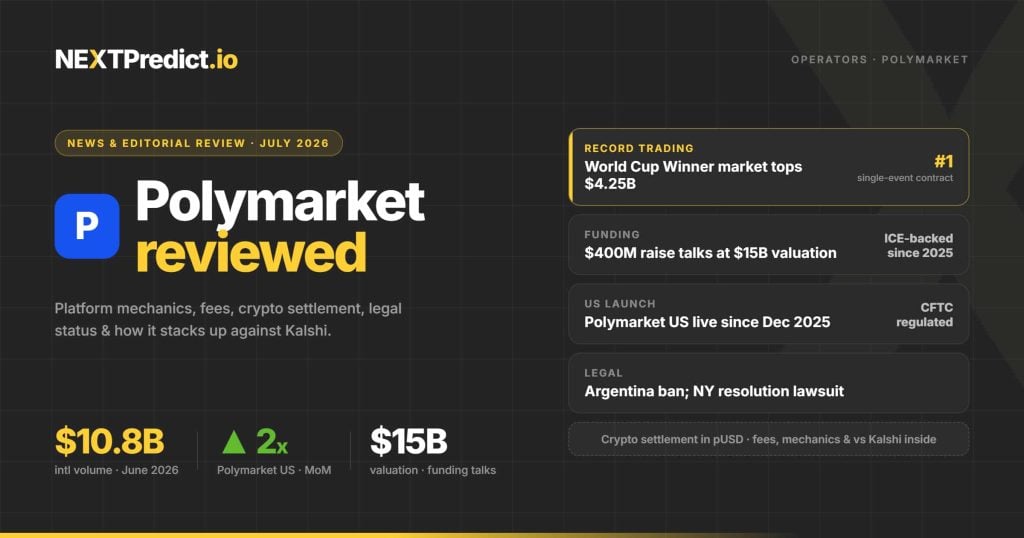
According to Polymarket news, the international exchange hit $10.8 billion in trading volume in June 2026 as the 2026 FIFA World Cup drove a surge of activity across the prediction market industry. Its U.S.-facing counterpart, Polymarket US, did about $3.5 billion over the same month, more than double May’s $1.77 billion. Those figures have kept traders and casual observers alike following Polymarket news closely, alongside developments at its main rival, Kalshi.
The World Cup Winner market alone had traded over $4.25 billion in cumulative volume as of July 15, 2026, making it one of the largest single-event contracts in the platform’s history and eclipsing the roughly $4 billion traded on Polymarket’s 2024 U.S. presidential election market.
On this page, you will find the latest developments, legal status, what Polymarket is and how it works, its mobile app, and how it compares to Kalshi.
Recent Polymarket News and Developments
New markets, funding talks, and regulatory developments pop up on a near-weekly basis, Polymarket news is required reading for traders trying to keep pace. Here’s an overview of the headlines the company made as of July 2026.
Funding Talks Value Polymarket at $15 Billion
Polymarket was in talks as of April 2026 to raise $400 million in new funding at a $15 billion valuation, up from the $9 billion valuation it reached after Intercontinental Exchange, the parent company of the New York Stock Exchange, took a stake in the platform in October 2025. Even at $15 billion, Polymarket would still sit below the $22 billion valuation Kalshi reached in its own March 2026 raise. Reports also indicate Polymarket is exploring a future public listing, though the company has not set a timeline.
World Cup Drives Record Volume
Polymarket’s international platform posted its largest monthly volume on record in June 2026, breaking a downward trend from April and May as the World Cup got underway on June 11. Open interest, the value of all active unsettled contracts, sat just under $400 million during the tournament, roughly where the international exchange has hovered for months even with the surge in trading.
Regulatory Pressure Continues
Not every recent headline has been positive. Argentina banned Polymarket nationwide in March 2026, citing alleged illegal gambling activity, and Polymarket pulled its market on nuclear weapon detonation odds the same month amid a broader product review. Polymarket and Kalshi both rolled out new insider-trading safeguards in March 2026 as U.S. lawmakers pushed for tighter sector oversight.
Separately, two traders filed suit against Polymarket and founder Shayne Coplan in New York Supreme Court over the resolution of a market tied to a Strategy Bitcoin sale, alleging the platform changed its rules after the fact. The dispute, unrelated to the World Cup markets, is a reminder that resolution rules matter as much as trading volume once a platform reaches this scale.
What Is Polymarket?
Polymarket, a prediction market operator, allows traders to buy and sell event contracts settled in crypto on its international exchange, or in U.S. dollars through its regulated American venue. Traders take positions against each other on outcomes ranging from politics and culture to crypto prices and sports.
Shayne Coplan serves as Polymarket’s chief executive officer and the operator was founded in 202 in New York City. Its core exchange runs on the Polygon blockchain, with contracts settling in pUSD, an ERC-20 token backed one-to-one by USDC.
Prediction market platforms must hold Designated Contract Market status from the CFTC to serve American traders legally. Polymarket’s path to that status runs through a separate entity: in July 2025 the company acquired QCEX, a CFTC-licensed derivatives exchange, for $112 million, and renamed it QCX LLC, doing business as Polymarket US. The CFTC issued QCX its Amended Order of Designation on November 25, 2025, and Polymarket US opened to American traders on December 3, 2025. Polymarket’s original, crypto-native global exchange, the platform most traders associate with the Polymarket name, remains geoblocked to US IP addresses under a 2022 CFTC settlement.
As of June 2026, Polymarket’s international exchange carried thousands of active markets across politics, sports, crypto, and culture, and its predictions page runs contracts years out, including an active market on the 2028 Democratic presidential nominee. Sports and crypto have driven a growing share of volume, though political and news-driven markets still anchor much of the platform’s liquidity.
How Does Polymarket Work?
Polymarket is a prediction market platform where traders take positions on whether future events will happen. You can enter or exit a market as you wish, with prices moving between $0.01 and $0.99 before a contract resolves.
Prices shift with trading activity and liquidity, much like a stock or futures exchange. Here are the platform’s key mechanics.
Order book structure
Like Kalshi, Polymarket utilizes a central limit order book, or CLOB, matching buyers and sellers on binary event contracts. Both a bid and an ask exist for each outcome, and the book depends on the mutual relationship between yes and no positions. Opposite to Kalshi, Polymarket’s global exchange settles contracts through crypto rather than USD.
Contract lifecycle
Funding your account on Polymarket’s global exchange means connecting a Web3 wallet, such as MetaMask or Coinbase Wallet, and depositing USDC, which wraps into pUSD for settlement. Polymarket US works differently: you must verify your identity and fund through approved intermediaries in U.S. dollars, without touching a crypto wallet at all. Once funded, you browse markets and place limit or market orders for shares.
Resolution process
A market reaches a resolution. Polymarket resolves contracts against a source specified in each market’s rules, verified against a primary reference such as an official certification, a scoreboard, or a government release. Most markets resolve within 24 hours of the underlying event’s conclusion, though disputed resolutions, like the Strategy Bitcoin market lawsuit noted above, can draw scrutiny when the rules and the outcome are read differently by different traders.
Polymarket pricing and implied probability
Contract prices run from $0.01 to $0.99 until settlement. Winning shares pay $1.00, while losing shares pay $0.00. The price at any given moment reflects the market’s implied probability of the outcome. A contract trading at $0.67, for example, implies a 67 percent chance the event occurs.
Liquidity note
Liquidity varies sharply by market. High-profile political, sports, and crypto contracts, like the World Cup Winner market, carry deep order books and tight spreads. Niche or long-tail markets can show wider spreads and thinner depth, so check the order book before placing a large order.
Polymarket Fees
Polymarket’s global exchange charges a taker fee on most categories and no fee at all on geopolitical and world-events markets. Only takers, orders that match immediately against the book, pay a fee. Makers, orders that rest on the book and add liquidity, are never charged, and taker fees fund a daily rebate program for makers.
|
Category |
Taker Fee Rate |
Maker Fee |
Peak Fee per 100 Shares (at $0.50) |
|
Crypto |
0.07 |
0 |
$1.75 |
|
Economics, Culture, Weather, Other |
0.05 |
0 |
$1.25 |
|
Finance, Politics, Mentions, Tech |
0.04 |
0 |
$1.00 |
|
Sports |
0.03 |
0 |
$0.75 |
|
Geopolitics |
0 |
0 |
Fee-free |
Source: Polymarket fee documentation, accessed July 14, 2026.
Polymarket charges no fee to deposit or withdraw USDC or pUSD on the global exchange. Third-party on-ramps such as Coinbase or MoonPay may charge their own conversion fees, and Polygon network gas costs apply separately. Polymarket US, the CFTC-regulated venue for U.S. residents, publishes its own separate fee schedule tied to its dollar-settled infrastructure, so check its current terms directly before trading there.
Polymarket Fees vs. Kalshi Fees
Kalshi’s own fee schedule charges takers roughly fees = round up (0.07 × C × P × (1 − P)), with makers charged a lower 0.0175 rate in the same formula, generally maxing out around $1.75 per 100 contracts near a 50 percent price. That is structurally similar to Polymarket’s own probability-weighted curve, though the two platforms apply different rates by category and settle in different assets. Polymarket’s global exchange settles in crypto rather than card-based U.S. dollar rails.
Polymarket App Review
Polymarket runs native prediction market apps on iOS and Android, alongside a fully responsive mobile website that installs as a home-screen app without a store download. The iOS app dropped its U.S. waitlist in mid-May 2026 after several delays, while Android access rolled out more gradually through Google Play.
On the Apple App Store, Polymarket’s app carries roughly a 4.7-star rating from about 30,000 to 31,000 ratings, as reported across several app-tracking sources in the second quarter of 2026. On Google Play, ratings have been reported inconsistently across sources, ranging from about 3.0 to 3.8 stars on a smaller base of roughly 7,000 reviews, a wider spread than Kalshi’s own app ratings on the same stores. Check both stores directly for current figures before relying on a specific number.
The app lets you browse markets and categories, place orders, manage your portfolio, and fund your account. Traders can also use a desktop browser to access Polymarket, with only minor differences between the two formats, mainly around biometric login and push notifications, which are app-only features.
Is Polymarket Legal in the US?
Yes, through a specific product. Polymarket US, operated by QCX LLC, received CFTC Designated Contract Market status on November 25, 2025, and opened to U.S. residents on December 3, 2025. The operator’s original global exchange remains geoblocked to U.S. IP addresses under the terms of a 2022 CFTC settlement and reaching it through a VPN or a non-U.S. wallet violates Polymarket’s terms of service.
Designated Contract Market status for Polymarket US does not extend to the global exchange. As of this writing, Polymarket has an application pending before the CFTC to open the global exchange to U.S. traders directly, filed April 28, 2026, and a separate CFTC inquiry opened in June 2026 remains unresolved.
When it comes to prediction markets regulation, federal regulation has not stopped state-level pushback. Polymarket has faced lawsuits from state gaming regulators who dispute the platforms need state licenses, while the companies maintain the CFTC has sole jurisdiction. Argentina’s outright ban on Polymarket in March 2026 shows that regulatory risk for the platform is not confined to the United States.
Kalshi vs Polymarket
Both operators are currently the largest prediction market platforms serving U.S. traders. While the two share some structural similarities, notably their CFTC oversight, there are real differences in how they settle trades, what they charge, and who trades on them. Here’s an overview.
|
Factor |
Polymarket |
Kalshi |
Polymarket |
|
CFTC regulatory status |
Global exchange is not itself a DCM and remains geoblocked to US IP addresses. Polymarket US (QCX LLC) holds DCM status since November 25, 2025. |
Designated Contract Market since November 2020, operated by KalshiEX LLC. |
Global exchange is not itself a DCM and remains geoblocked to US IP addresses. Polymarket US (QCX LLC) holds DCM status since November 25, 2025. |
|
Settlement asset |
pUSD, an ERC-20 token on Polygon backed one-to-one by USDC, on the global exchange. Polymarket US settles in U.S. dollars. |
U.S. dollars, held in FDIC-insured accounts. |
pUSD, an ERC-20 token on Polygon backed one-to-one by USDC, on the global exchange. Polymarket US settles in U.S. dollars. |
|
Deposit methods |
USDC via Web3 wallet or bridge on the global exchange. Bank-linked funding through approved intermediaries on Polymarket US. |
U.S. bank transfer, wire, debit card, Venmo, Apple Pay, Google Pay, PayPal. |
USDC via Web3 wallet or bridge on the global exchange. Bank-linked funding through approved intermediaries on Polymarket US. |
|
Fee structure |
Taker-only fee by category, ranging from 0 to 0.07, with makers charged nothing. |
Roughly $0.07 to $1.75 per 100 contracts, split between maker and taker rates. |
Taker-only fee by category, ranging from 0 to 0.07, with makers charged nothing. |
|
Market count | Thousands of active markets across politics, sports, crypto, finance, economics, and culture. |
Hundreds of active markets at any given time, concentrated in sports. |
Thousands of active markets across politics, sports, crypto, finance, economics, and culture. |
|
Participant profile |
Globally distributed, crypto-native traders on the global exchange, with a growing US base on Polymarket US. |
US retail traders funding via bank rails, heavy sports concentration. |
Globally distributed, crypto-native traders on the global exchange, with a growing US base on Polymarket US. |
Sources as noted above, accessed July 14, 2026.
The onboarding paths differ in a way the table alone cannot capture. Kalshi’s bank-linked funding suits a trader who already operates inside the U.S. banking system, since no wallet setup is required. Polymarket’s global exchange assumes crypto familiarity for onboarding, while Polymarket US narrows that gap with bank-linked funding under CFTC oversight.
Liquidity also diverges by category rather than by platform overall. Kalshi’s sports category has grown to account for the large majority of its trading volume since 2025, while Polymarket’s global exchange carries the deepest books in crypto and major political and sports markets, the categories where it has operated longest.
Notable Polymarket Markets
If you have been following Polymarket news have paid close attention to a handful of markets in 2026. The World Cup Winner contract has become the platform’s largest single-event market on record, with more than $4.25 billion traded as of July 15, 2026 and Spain trading as the frontrunner at roughly 58 percent, ahead of England at 23 percent and Argentina at 19 percent.
Politics has also produced major volume. Polymarket ran an active market on whether the Supreme Court would rule in favor of the Trump administration’s tariff authority, tied to the Federal Circuit’s August 29, 2025 decision in V.O.S. Selections, Inc. v. Trump. The market launched September 2, 2025, and has traded several million dollars in volume, with the price implying a low probability that the Court reverses the Federal Circuit.
Not every notable market has resolved cleanly. The Strategy Bitcoin sale market, referenced above, is now the subject of litigation after Polymarket resolved it as No despite an SEC filing that traders argue confirmed the opposite. The dispute is a useful reminder that resolution rules, not just prices, determine what a market actually pays out.
Conclusion
Polymarket news will continue to forge ahead. You now have a clear overview of how Polymarket works, where it currently stands with federal law, and what it costs to trade.
Frequently Asked Questions
What is Polymarket?
Polymarket is a prediction market platform that allows you to buy and sell event contracts based on real-world events outcomes. Its global exchange settles in crypto on the Polygon blockchain, while its regulated American venue, Polymarket US, settles in U.S. dollars. Categories span politics, sports, crypto, economics, and culture.
How does Polymarket work?
You connect a wallet or fund your account, then buy or sell event contracts via a central limit order book. Contract prices represent the market’s implied probability of an outcome on a $0.01 to $0.99 scale. Positions can be bought or sold before resolution, and winning contracts settle at $1.00 while losing contracts settle at $0.00.
Is Polymarket legal in the US?
Yes, through Polymarket US, operated by QCX LLC, which received CFTC Designated Contract Market status on November 25, 2025 and opened to U.S. residents on December 3, 2025. Polymarket’s original global exchange remains geoblocked to U.S. IP addresses under a 2022 settlement.
What are Polymarket’s fees?
Polymarket’s global exchange charges a taker-only fee ranging from 0 to 0.07 depending on category, with geopolitical markets fee-free. Makers who place resting limit orders pay no fee at all. Polymarket US publishes a separate fee schedule tied to its dollar-settled structure.
What is Polymarket stock?
Polymarket is a private company with no publicly traded stock as of this writing. As of April 2026, Polymarket was in talks for a valuation of $15 billion, up from $9 billion in late 2025.
Is Polymarket planning an IPO?
Reports indicate Polymarket is exploring a future public listing, though the company has not announced an official timeline. Until then, shares in the company remain privately held and are not available on any public exchange.
How does Polymarket compare to Kalshi?
Both hold CFTC Designated Contract Market status, Kalshi since 2020 and Polymarket US since November 2025. Kalshi settles in USD through bank-linked funding, while Polymarket’s global exchange settles in pUSD on Polygon. Polymarket’s global exchange carries a broader category mix. This includes a large crypto vertical, while Kalshi has built strong share in U.S. sports contracts.
Does Polymarket have a mobile app?
Yes. Polymarket offers native apps for Android and iOS with the same functionality as the desktop platform. The iOS app carries a 4.7-star rating from about 30,000, while Android ratings have varied widely across sources.
Resources: CNBC | Bloomberg | PYMNTS | PR Newswire | CFTC | Polymarket Docs | Yahoo Finance | Crypto Times | Kalshi