
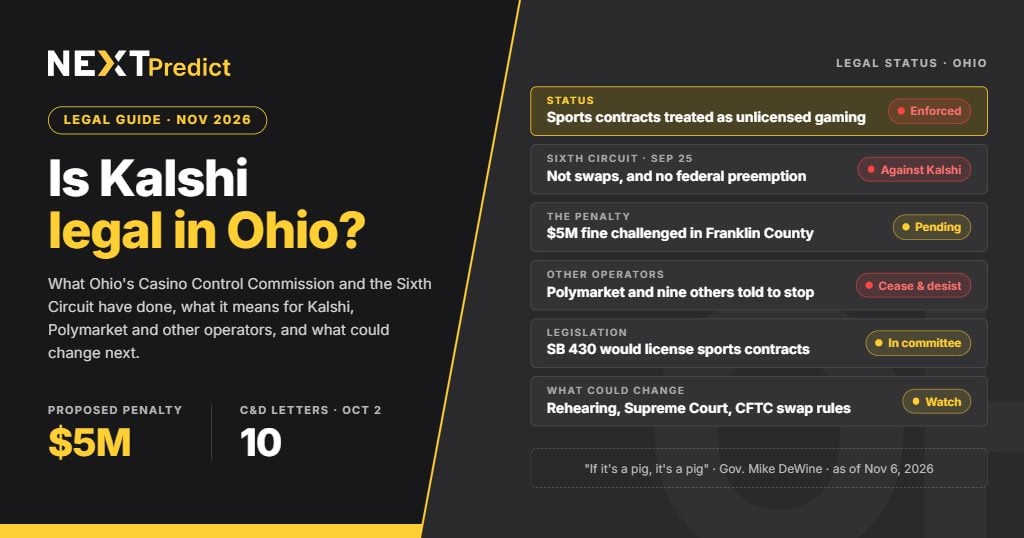
On September 25, 2026, a unanimous Sixth Circuit panel upheld Ohio’s power to enforce its sports-wagering laws against Kalshi. The court held Kalshi’s sports event contracts are not swaps and found no federal preemption of state gambling law. Days later, Gov. Mike DeWine vowed enforcement, telling reporters “if it’s a pig, it’s a pig.”
This page explains the Ohio Casino Control Commission’s actions and the Sixth Circuit’s ruling on prediction markets while also covering the impact on Kalshi, Polymarket and other Ohio operators, and developments with the potential to change their status.
Current Status in Ohio
As of November 6, 2026, Ohio’s Casino Control Commission treats Kalshi’s sports event contracts as unlicensed sports gaming. A federal appeals court has declined to block enforcement while the Kalshi Ohio case proceeds. Kalshi’s separate disputes with the commission, including a proposed $5 million penalty, remain active.
The commission ordered Kalshi to stop offering sports event contracts in Ohio on March 31, 2025. Kalshi sued in federal court, and a district judge denied a preliminary injunction on March 9, 2026. A unanimous Sixth Circuit panel affirmed that denial on September 25, 2026, holding the contracts are not swaps. Kalshi asked the full Sixth Circuit to rehear the case in October 2026.
The commission issued a notice of intent to impose a $5 million civil penalty in April 2026. Kalshi challenged the penalty in Franklin County Common Pleas Court in June, arguing it requires a jury trial. Our state legal status hub tracks enforcement in other states.
Ohio Casino Control Commission Action Against Kalshi
The OCCC regulates sports gaming in the state and holds authority to investigate and penalize violations. Its action against Kalshi has run through federal court, an administrative penalty process and a state-court challenge.
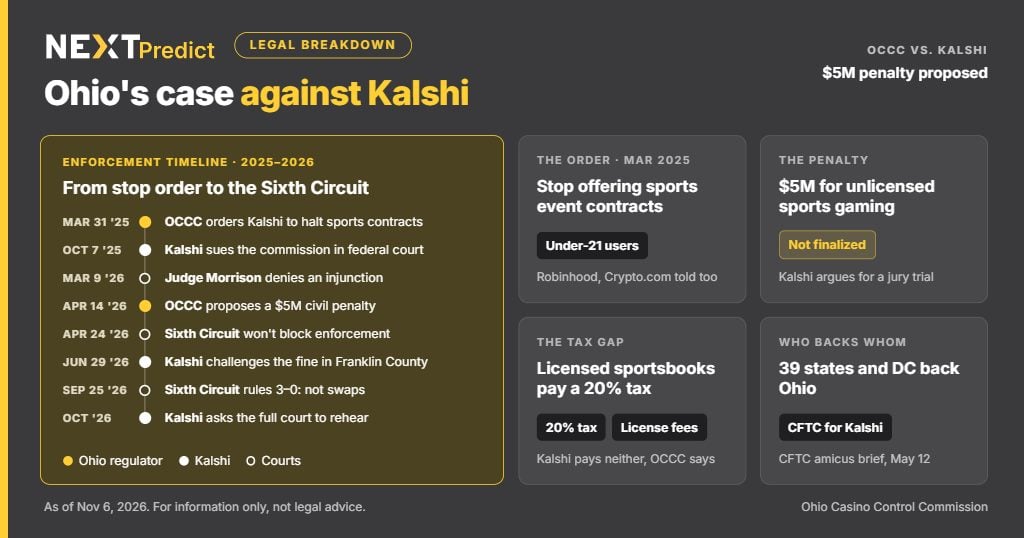
- March 31, 2025: The commission ordered Kalshi, Robinhood and Crypto.com to halt sports event contracts in Ohio. It said the contracts lacked the consumer protections Ohio law requires and reached users under 21. Written confirmation of compliance was due by April 14, 2025.
- October 7, 2025: Kalshi sued the commission in federal court for the Southern District of Ohio, seeking a permanent injunction.
- March 9, 2026: Judge Sarah Morrison denied Kalshi a preliminary injunction. She found Kalshi’s claimed harm “dwarfed by Ohio’s interest in exercising its police power.”
- April 14, 2026: The commission issued a notice of intent to impose a $5 million penalty for unlicensed sports gaming. The notice also cited failure to cooperate and conduct undermining public confidence in sports gaming. State law gave Kalshi 30 days to request a hearing.
- Mid-April 2026: Kalshi told the Sixth Circuit the proposed fine was “an extraordinary and regrettable step.”
- April 24, 2026: A Sixth Circuit motions panel refused to block Ohio’s enforcement during Kalshi’s appeal.
- June 29, 2026: Kalshi sued the commission in the Franklin County Court of Common Pleas to stop the penalty proceeding. It argues a punitive civil penalty requires a jury trial under the Ohio Constitution.
- September 25, 2026: A unanimous Sixth Circuit panel affirmed the denial of Kalshi’s injunction, holding its sports contracts are not swaps.
- October 2026: Kalshi asked the full Sixth Circuit to rehear the Ohio prediction markets case.
The commission says Kalshi pays no Ohio tax on sports gaming revenue and no licensing fees, whereas licensed Ohio sportsbooks pay a 20% tax on sports gaming receipts. Kalshi disputes the commission’s authority and argues federal law governs its contracts.
The Sixth Circuit Ruling
The Sixth Circuit’s involvement came through Kalshi’s appeal of the March 2026 ruling denying it a preliminary injunction. A motions panel declined on April 24, 2026, to halt Ohio’s enforcement during the appeal. The court then heard Ohio’s case alongside Tennessee’s, where Kalshi had won an injunction, on July 30, 2026.
On September 25, 2026, a unanimous panel affirmed the Ohio denial and vacated the Tennessee injunction. Judge Julia Smith Gibbons wrote that Kalshi had not shown its sports contracts meet the statutory definition of a swap. The panel added the Commodity Exchange Act does not preempt either state’s gambling laws meaning both cases returned to district court.
The CFTC filed an amicus brief on May 12, 2026, asserting exclusive jurisdiction over prediction markets. It said the Ohio district court took “an improperly narrow view” of that jurisdiction, according to its press release. Nevada and Utah led a June 2026 brief from 39 states and the District of Columbia backing Ohio.
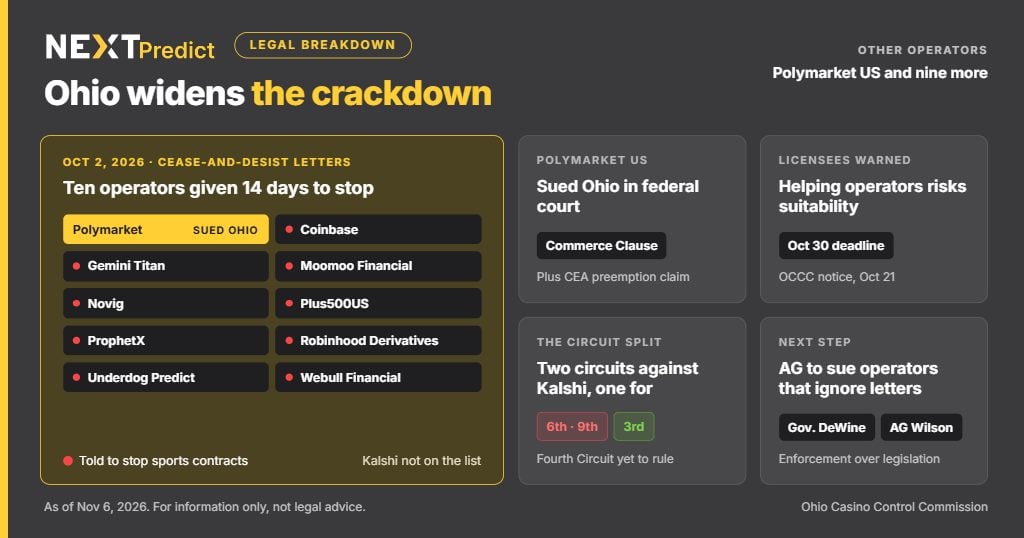
The ruling aligned the Sixth Circuit with the Ninth, which ruled against Kalshi in Nevada on August 28, 2026. The Third Circuit sided with Kalshi in New Jersey, and the Fourth Circuit had not ruled on Maryland. Gaming lawyer Andrew Kim said in March 2026 a Supreme Court decision might arrive as early as 2027.
Is Polymarket Legal in Ohio? Other Operators
As of November 6, 2026, Polymarket US faces a commission order to stop offering sports event contracts in Ohio. Polymarket has sued the state in federal court meaning its current Ohio prediction markets sports offering remains unconfirmed.
On October 2, 2026, one week after the Sixth Circuit ruling, the commission sent cease-and-desist letters to ten operators. The recipients were Coinbase, Moomoo Financial, Gemini Titan, Novig, Polymarket, Plus500US, ProphetX, Underdog Predict, Robinhood Derivatives, and Webull Financial. Each had 14 days to confirm it had stopped offering sports event contracts in Ohio. Kalshi was not among the recipients.
Polymarket sued in the Southern District of Ohio, and the commission received notice on October 20, 2026. The complaint seeks preliminary and permanent injunctions and argues the letter violates the Commerce Clause and is preempted by the Commodity Exchange Act.
On October 21, 2026, interim executive director Andromeda Morrison presented a notice warning licensees against providing services to prediction market operators. The notice said such support “raises significant suitability concerns,” and licensees had until October 30 to confirm compliance.
Ohio Legislation and the Licensing Debate
Sen. Bill DeMora, a Columbus Democrat, introduced Senate Bill 430 in April 2026 to license and regulate sports prediction markets. The bill classifies sports event contracts as sports gaming under OCCC oversight. Operators would face existing sportsbook rules, including licensing, the 20% tax and a minimum age of 21.
DeMora described the bill as a contingency if courts side with the platforms. “If somehow we lose the court cases, and they say, well, they can do this, then they ought to be taxed for it,” he told Parameter.
SB 430 was still awaiting sponsor testimony in committee as of October 20, 2026 and a second DeMora bill, SB 479, would ban election contracts and had also seen no sponsor testimony. The session ends on December 17, and bills do not carry over to 2027.
Gov. Mike DeWine has focused on enforcement over legislation. In October 2026, he said Attorney General Andy Wilson would file suits against operators ignoring the commission’s cease-and-desist letters. The commission first warned licensed sportsbooks in August 2025 their licenses might be at risk over prediction market ties.
What Could Change Next
Several steps remain pending as of November 6, 2026. Kalshi’s Franklin County suit against the commission’s $5 million penalty has produced no ruling yet, and the penalty has not been finalized. Kalshi’s request for a full Sixth Circuit re-hearing also awaits a decision.
At the Supreme Court, New Jersey’s petition in Flaherty v. KalshiEX (No. 26-299) asks the justices to resolve the circuit split. Kalshi’s response is due on November 9, 2026. Separately, the CFTC proposed rules on September 28, 2026, which would define event contracts as swaps.
In Ohio, Gov. DeWine said in October the attorney general would sue operators ignoring cease-and-desist letters. Polymarket’s federal suit against the state also remains open, SB 430 sits in committee, and unpassed bills lapse when the session ends on December 17.
Conclusion
Ohio treats Kalshi’s sports event contracts as unlicensed sports gaming, and the Sixth Circuit has upheld the state’s power to enforce. Kalshi, Polymarket and nine other operators face commission action, while court challenges and a proposed $5 million penalty remain unresolved.
The outcome now turns on Kalshi’s re-hearing request, a pending Supreme Court petition and the attorney general’s promised lawsuits against Ohio prediction markets. SB 430 offers a licensing route but faces a December 17 session deadline.
Our state legal status hub and regulation overview track each development.
Last verified: November 6, 2026.
Frequently Asked Questions
Is Kalshi legal in Ohio?
Ohio’s Casino Control Commission treats Kalshi’s sports event contracts as unlicensed sports gaming. On September 25, 2026, the Sixth Circuit upheld the denial of Kalshi’s preliminary injunction, leaving Ohio free to enforce. Kalshi’s rehearing request, its state-court penalty challenge and its federal case remain pending.
Has Ohio fined Kalshi?
Ohio has proposed a fine but has not finalized one, according to available reporting. The commission issued a notice of intent to impose a $5 million civil penalty on April 14, 2026. Kalshi sued in the Franklin County Court of Common Pleas on June 29, arguing the penalty requires a jury trial.
Is Polymarket legal in Ohio?
Polymarket US received a commission cease-and-desist letter on October 2, 2026, covering sports event contracts in Ohio. Nine other operators received letters, including Coinbase, Novig, Robinhood Derivatives and Underdog Predict. Polymarket sued the state in federal court in October.
What did the Sixth Circuit decide?
The opinion affirmed the Southern District of Ohio’s denial of a preliminary injunction and vacated Tennessee’s injunction. It held Kalshi had not shown its sports-event contracts satisfy the statutory definition of a swap. The court also found the Commodity Exchange Act does not preempt either state’s gambling laws.
Can Ohio residents still trade on Kalshi?
The commission’s actions target sports event contracts with no report of Kalshi Ohio sports contracts being withdrawn. No court order requires Kalshi to stop, though the state has said it will enforce its law. Kalshi’s app and terms show current availability.
Resources: Law360 | Bankless | DeFi Rate | SBD | US Courts | CFTC | Covers | CDC Gaming | Parameter