
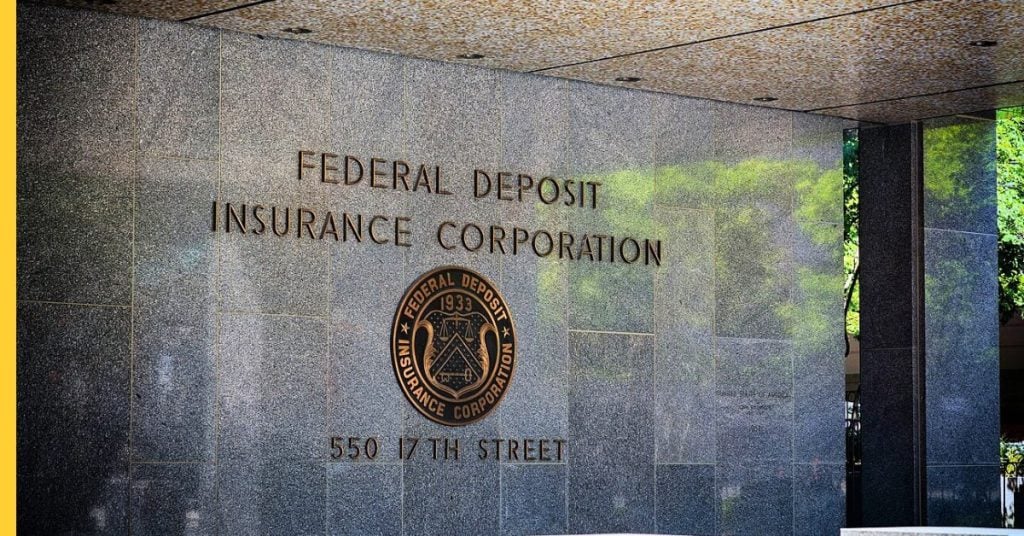
Concerns among US federal banking officials about Polymarket contracts tied to bank failures follow an earlier push from a major community banking group to get the Commodity Futures Trading Commission (CFTC) to restrict the same type of contracts.
Bloomberg reported Friday that officials at the Federal Deposit Insurance Corp. (FDIC) have discussed Polymarket contracts allowing traders to speculate on whether individual banks will fail. The concerns extend beyond FDIC employees potentially trading on confidential information.
Bloomberg reported that bank regulators and lawmakers are also concerned the contracts could contribute to financial instability and eventually help fuel a bank run. Former FDIC Chair Sheila Bair told Bloomberg the markets could also give bad actors an incentive to spread rumors or deliberately stoke panic. FDIC officials separately questioned whether the contracts provide enough legitimate commercial or investment value to justify those risks.
Months before those internal discussions became public, the Independent Community Bankers of America (ICBA) had already raised many of the same concerns directly with the CFTC.
In an April 30 response to the CFTC’s advance notice of proposed rulemaking on prediction markets, the national trade group urged the regulator to prohibit contracts tied to individual bank failures, specifically citing Polymarket’s bank-failure markets.
The concerns show how scrutiny of prediction markets is extending beyond familiar fights over contracts tied to sports, elections and geopolitical events into fears that the markets themselves could have real-world economic consequences.
ICBA warned of bank-run risk
ICBA’s April filing focused heavily on the possibility that prediction-market prices could become part of the information cycle surrounding a troubled bank.
“The mere existence of these contracts can signal to investors and depositors that a bank is at heightened risk,” the group wrote, arguing that could be true even when the institution remains fundamentally sound.
ICBA pointed to research on the 2023 banking crisis showing that news coverage and social media can shape perceptions of bank risk, and argued that prediction contracts could add another signal to that information environment. It also warned that contracts tied to individual banks could create opportunities for information manipulation, including attempts to spread false claims about an institution’s financial condition.
The group ultimately asked the CFTC to treat bank-failure contracts as contrary to the public interest, saying they could undermine confidence in otherwise sound banks and, in a period of stress, contribute to a run or broader financial instability.
Bank-failure markets remain small
The Polymarket contracts drawing scrutiny remain tiny compared with some of the platform’s larger markets. The international platform currently offers several ways to trade on trouble in the banking sector:
- “Which banks will fail by end of 2026?” includes contracts on Wells Fargo, JPMorgan Chase, Bank of America, Citigroup and other major banks. Together, the contracts have generated about $76,000 in total volume, with no individual bank currently priced above 3%.
- “Major U.S. bank bailout before 2027?” asks whether a bank with more than $50bn in assets will require specified federal intervention. It has generated only about $4,200 in total volume and currently puts the probability at about 5%.
- “US bank failure by December 31, 2026?” asks whether any US bank will fail by year-end, with the resolution based on the FDIC’s Failed Bank List. Polymarket has listed similar rolling versions of the market with different expiration dates.
The bailout market also provides an example of how dramatically a lightly traded market can move. On Feb. 5, its displayed probability briefly climbed to 55% before falling back sharply.
The February move itself does not establish manipulation. But it illustrates how a market with relatively little activity can still produce a striking probability that could attract attention well beyond the traders participating in it.
Offshore platform complicates CFTC question
There is a complication in ICBA’s request: the bank-failure contracts it cited are offered on Polymarket’s international platform, not its CFTC-regulated US exchange.
Polymarket’s international site is a separate product that is not regulated by the CFTC and blocks US residents from trading. Polymarket US does not offer contracts on individual bank failures.
The CFTC has brought enforcement cases involving trades on the international platform. This year, it brought separate insider-trading cases against a US service member and a Switzerland-based Google employee over trades on Polymarket.com. But those cases targeted alleged misuse of nonpublic information, not the types of contracts Polymarket.com may offer to international users.
It is unclear what practical action the CFTC could take against the bank-failure listings themselves.