
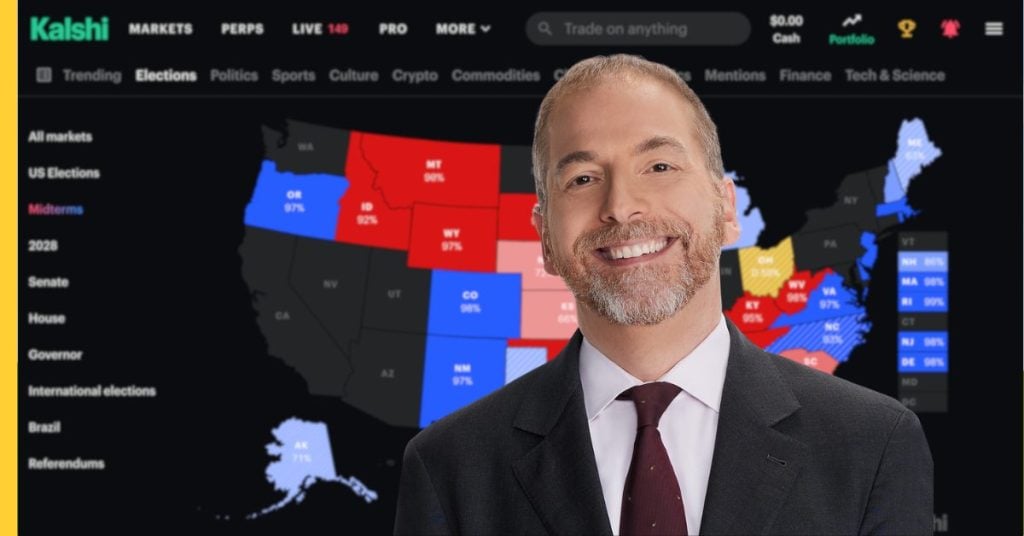
Chuck Todd, the former NBC News political director and longtime moderator of Meet the Press, sees November’s US congressional elections increasingly turning on how big Democratic gains could be as prediction markets move further in their direction.
“The only question in my mind — is it a blue wave or is it a blue tsunami?” Todd said. “That’s the only thing we don’t know.”
Democratic momentum is reflected across several midterm election prediction markets, with traders increasingly pricing stronger results for the party in November.
Todd recently discussed those markets and what traders may still be missing in a wide-ranging interview with NEXTPredict.io co-founder and managing director Pierre Lindh on the NEXTPredict Podcast. But he also went beyond individual election outcomes, raising questions about the growing role of prediction markets in US politics, how they interact with traditional polling and why people are trading on elections in the first place.
Todd will continue that discussion at NEXTPredict NYC, where he is set to take part in a “polls vs. markets” discussion. The summit takes place at Convene Hudson Yards in New York on Oct. 22-23, bringing together 2,500 business leaders and 200 speakers to discuss the state of the prediction-market industry.
‘Blue wave’ or ‘blue tsunami’?
Todd said his view is being driven largely by “pocketbook” issues, arguing that voters unhappy with the economy tend to punish the party in power.
“It’s a very rational response. You don’t like the economy, you punish the party in power. It’s what happened in 2024. It’s what’s happening in 2026,” Todd said. “I actually think we’re starting to sort of behave the way we used to behave before Trump came along, which is the pocketbook is going to decide the result of this election.”
Still, Todd stopped short of treating a more sweeping Democratic victory as inevitable. He broke the possible outcomes into three scenarios:
- Blue mirage: Democrats outperform Republicans and take the House, but only narrowly, similar to the Republicans’ limited gains in the 2022 midterms.
- Blue wave: Democrats win the House and come close to or secure control of the Senate, potentially reaching 50 or 51 seats.
- Blue tsunami: A much more decisive Democratic victory in which Republican-held seats that normally would not be considered competitive come into play.
Todd said a “tsunami” would require not only strong Democratic turnout, but also a significant number of Republican voters deciding to sit out the election. He is not yet convinced that second part will happen.
“Big waves like that happen for two reasons,” Todd said. “A whole bunch of voters for the party that was out of power show up and a whole bunch of voters for the party in power decide, ‘You know what? I’m out. I’m not voting in this election. I can’t bring myself to vote for the other party, but I’m not going to support what’s going on now.’
“And that to me, that’s the only thing keeping my prediction from going from wave to tsunami.”
Markets lean Democratic, with ‘tsunami’ still a toss-up
Prediction-market pricing on the midterms points in the same direction.
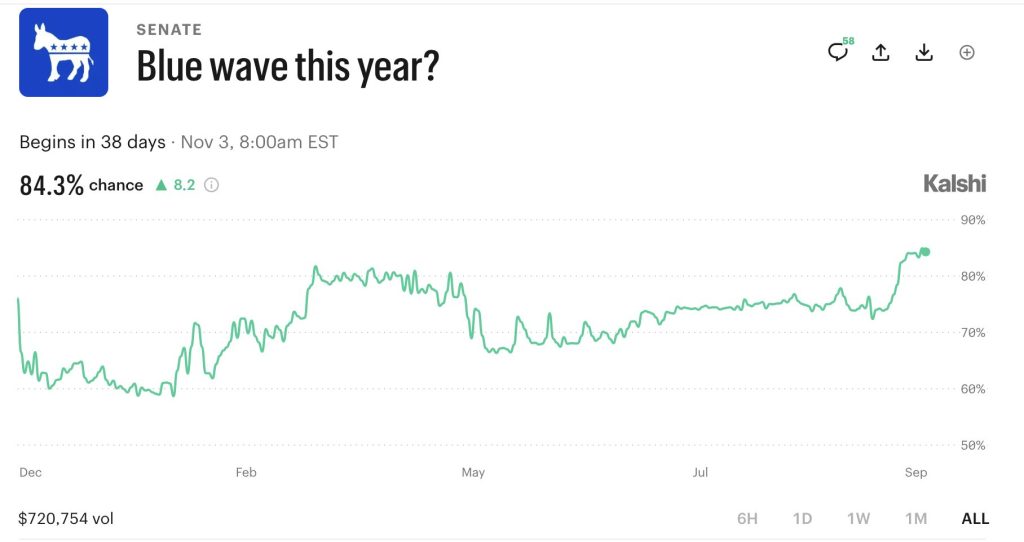
On Kalshi Friday, traders put the chance of a “blue wave” at about 84%, while the platform’s higher-threshold “blue tsunami” contract was essentially a coin flip at 50%. Kalshi defines a wave as Democrats holding at least 218 House seats and 49 Senate seats, while a tsunami requires at least 235 House seats and 51 Senate seats.
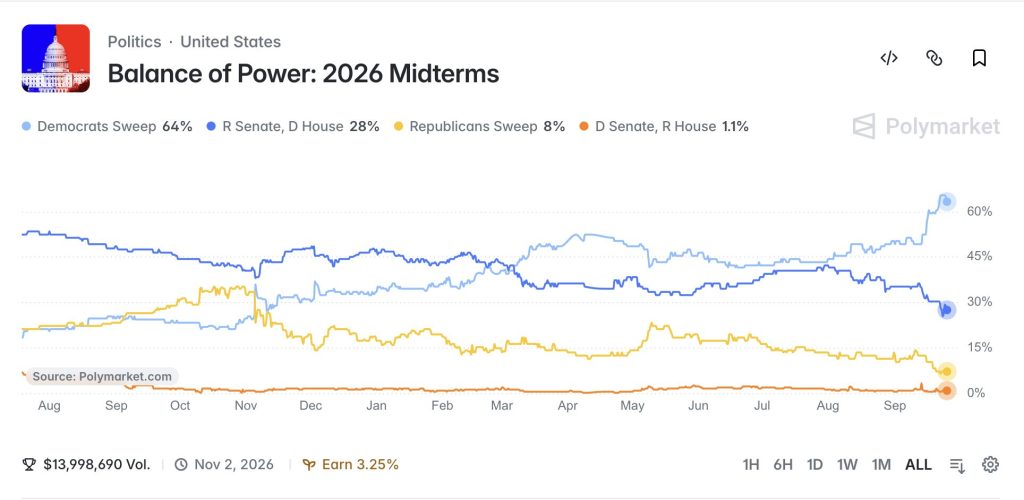
Polymarket, which recently launched a midterm election hub, gave Democrats even higher probabilities in several key markets, pricing them at 93% to take the House and 63% to take the Senate. Its market for a Democratic sweep of both chambers stood at 64%.
Texas tests how far Democrats can go
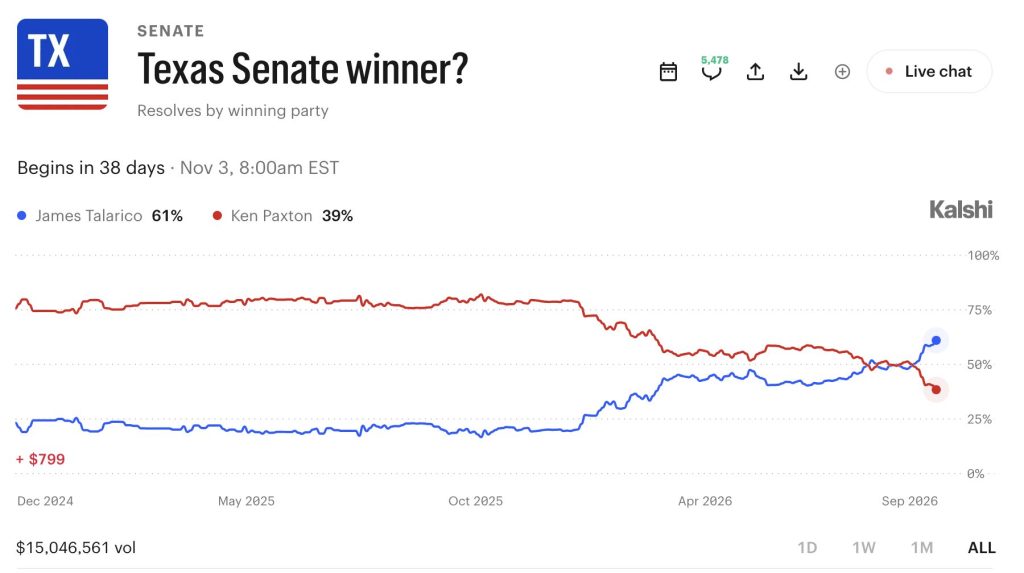
Texas may be one of the clearest tests of just how far the political environment has moved. Trump-endorsed Republican Attorney General Ken Paxton is facing Democratic state Rep. James Talarico in a state where Democrats have not won a US Senate election since 1988.
Talarico is not running simply as a centrist alternative. His platform includes a number of progressive economic and social policies, though he has moderated some positions and increasingly pitched himself toward independents and Republican-leaning voters as the general election has progressed.
Todd said the significance extends beyond one Senate seat. A genuinely competitive Texas, he argued, would alter the political map by forcing Republicans to spend money and attention defending territory that has long been reliably theirs.
“You want to talk about reshaping the map of American politics,” Todd said. “If Texas becomes a swing state, that just reorients our politics in a way that puts Republicans on the defensive. … If Republicans have to fight for Texas, that’s a nightmare scenario for their coalition.”
Lindh noted that Talarico had moved ahead in prediction markets and asked whether this could finally be the year Democrats break their nearly four-decade Senate drought in the state.
“If Democrats can’t win a Senate seat in Texas under these circumstances, when are they?” Todd said. “I never thought I’d be here this late in the campaign season believing this, but I do. I’m with the prediction markets here. I’ll be more surprised if Talarico loses than if he wins.”
Todd looks at polls vs. prediction markets
Todd said one of the questions he wants to explore at NEXTPredict NYC is how market pricing and traditional polling interact, rather than viewing them simply as competing forecasting tools.
“We keep talking about this as essentially the pollsters versus the prediction markets, right?” Todd said. “How much do they need each other? How much do they feed each other? How much do they enhance each other?”
He is also interested in what motivates people to trade on political markets in the first place.
“How much of it is truly hedging based on different investments or different things they’re worried about? And how many people are doing it for entertainment purposes?” Todd said.
Todd said he remains open-minded about what the growth of political prediction markets ultimately means, including whether they could begin affecting politics themselves.
“Is this going to be healthy for politics, that it’s subject to markets like this, or is it going to create a different class of politician?” he said. “The point is that I’m just fascinated by it.”
Prediction markets already in Todd’s orbit
Todd’s interest in prediction markets is not entirely new. FanDuel sponsors his independent podcast, The Chuck ToddCast, and some of his short-form social media content, including videos that have referenced FanDuel Predicts and its political markets.
He has also occasionally brought prediction-market pricing into his own political commentary. On X, Todd has referenced prices on Kalshi and weighed in on industry developments, even as most of his feed remains focused on traditional political analysis.
Todd said the rise of prediction markets has created something political professionals can no longer afford to ignore.
“We have an entirely new ecosystem that the political world has to pay attention to,” he said.
With NEXTPredict NYC taking place less than two weeks before the US midterm elections, Todd’s appearance will come at a particularly timely moment to assess whether the Democratic momentum now showing up in polls and prediction markets has strengthened, stalled or reversed.
Tickets for NEXTPredict NYC are available here.