
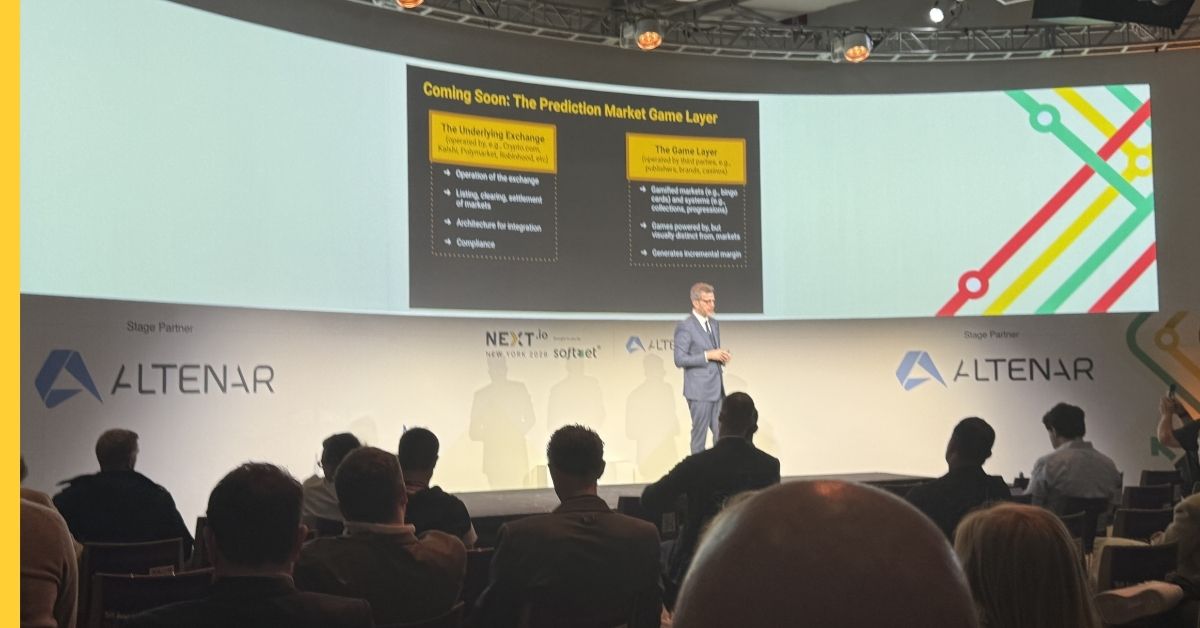
Prediction market operators may increasingly use their sky-high valuations to bring critical supplier functions in-house and accelerate product development.
That is the opinion of Chris Grove, who, speaking at NEXT NYC yesterday (10 March), suggested the vertical’s leading players could soon look to address fundamental product weaknesses and build competitive moats.
Grove, partner emeritus at Eilers & Krejcik Gaming and co-founding partner at Acies Investments, highlighted Kalshi and Polymarket’s reported $20bn valuations as possible fuel for strategic M&A activity.
The comments formed part of a broader industry outlook for 2026, in which Grove argued that prediction markets remain immature products despite their cultural momentum, and that acquisition activity represents one of the fastest routes to closing that gap.
Products ‘not yet good’ despite jaw-dropping valuations
Grove was blunt about the current state of prediction market products. He said: “These products are interesting. They’re intriguing. They’re not good, right? They are not yet good relative to the things that they compete against.”
He argued that in-housing critical supply functions offered operators both competitive differentiation and a means of accelerating development, adding: “M&A is a way that they can get good quicker.”
Grove also outlined a parallel M&A dynamic on the supplier side, predicting that global suppliers would pursue further consolidation to maintain pricing power with operators and resist encroachment on their territory.
He said: “One of the best ways to do that is just to get so big, and as you get big, increase your ability to sell more products into the operator and reduce the friction involved in the operator taking those products, which then also decreases the incentive for the operator to just do it themselves.”
On the broader operator landscape, Grove predicted that US-regulated gambling operators would increasingly look abroad to find scale for their digital businesses, citing Rush Street as a company that had been ahead of the curve in recognising the limits of domestic expansion.
He added that operators would also push further into in-house game development, driven in part by AI reducing the cost and complexity of content production.