
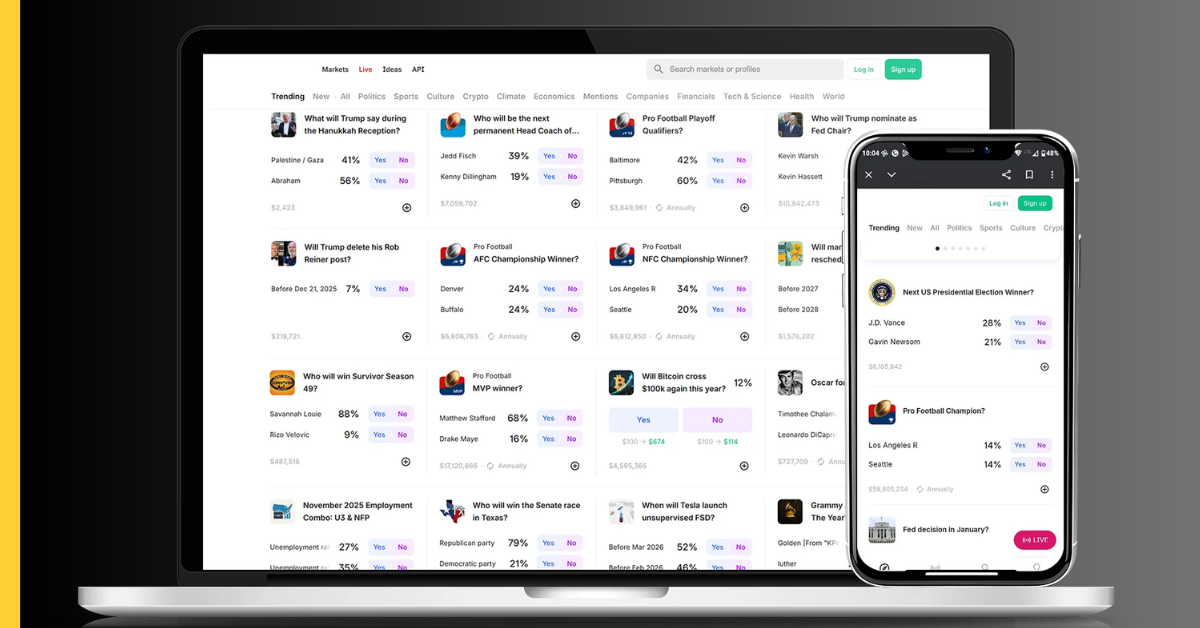
TRUEiGTECH has launched a unified API designed to connect fragmented prediction market systems through a single integration layer.
Operators continue to deal with a patchwork of options to connect platforms in the emerging space. Separate integrations remain the norm, especially when connecting to platforms such as Polymarket and Kalshi.
That approach tends to slow development and split liquidity across silos. Las Vegas-based TRUEiGTECH launched its API, in part, to remove that duplication. The company said that development timelines can fall by up to 70% under this model.
TRUEiGTECH digital marketing lead Naresh Parimi explained to NEXTPredict.io: “Each platform has different authentication models, data structures, and execution systems. Aggregation simplifies that into a single integration layer, which reduces development overhead and speeds up deployment.
“This unified access approach is where we’re seeing the strongest interest from operators looking to enter the space quickly without building everything from scratch.”
The company added that rollout timelines are shaped largely by two things: how much infrastructure is already in place and how heavily the system needs to be tailored.
In cases where operators adopt a turnkey model, deployment can be wrapped up in roughly four weeks. That shorter window is driven by pre-built infrastructure, which removes much of the early-stage setup and allows for a quicker move into the market.
More customised projects tend to take longer, and not always on a fixed schedule. Integration demands, regulatory checks, and feature adjustments all influence the pace.
In most situations, delivery lands somewhere between six and 12 weeks, depending on the scope involved.
Liquidity, often thin when markets sit apart, is expected to combine more efficiently when routed through a single layer like the API can provide.
API to include regulatory compliance tools
Regulatory dimensions are also being integrated into the API. Requirements vary widely across jurisdictions, especially around identity checks and transaction monitoring, and complying with all the differences simultaneously is challenging.
TRUEiGTECH has built the API to support multi-region deployment, with integrated compliance features covering KYC and AML processes. That doesn’t remove regulatory risk, but it reduces the friction of adapting to different markets.
Parimi added: “Compliance considerations are a core part of how we design and deploy infrastructure. This includes aligning with jurisdiction-specific requirements such as KYC, AML, and market access restrictions depending on where operators are launching.”
The broader issue has been fragmentation. Liquidity spreads thinly when platforms do not connect, and pricing becomes less efficient. This has been a persistent conundrum for operators trying to scale.
By aggregating access, the API attempts to address both liquidity depth and execution consistency without forcing firms into closed ecosystems.
The rollout is currently limited to early partners. Wider availability is expected once integration testing expands.
Parimi told NEXTPredict.io that while the company cannot reveal its partners, it is currently focusing on “operators already active in adjacent categories such as iGaming, trading, and engagement platforms who are exploring prediction market integrations as an expansion layer.”
For now, the platform is in a transitional phase, somewhere between controlled deployment and broader adoption.