
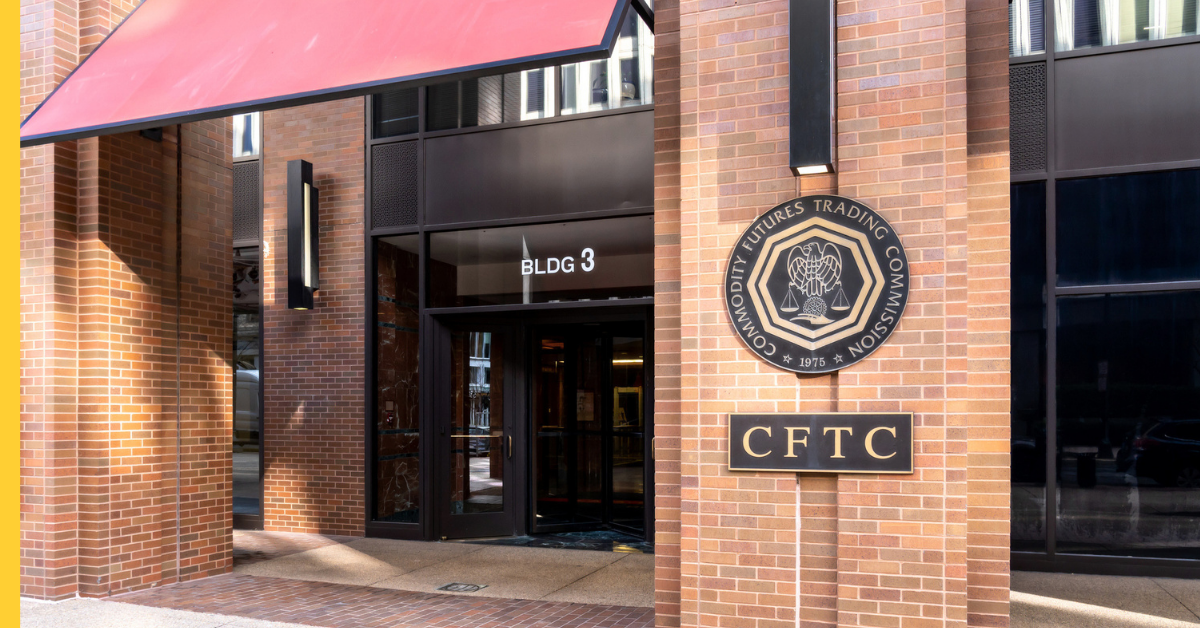
The Commodity Futures Trading Commission (CFTC) has filled out the roster of its newly formed Innovation Task Force, giving clearer shape to a unit that is expected to influence how Washington regulates prediction markets and cryptocurrency.
The task force, announced in March, will work with the CFTC on a regulatory framework for crypto assets and blockchain technologies, artificial intelligence and autonomous systems, and prediction markets and event contracts.
The line-up also offers an early signal of the agency’s priorities.
It especially focuses on the fast-moving debate over whether event contracts should be treated as legitimate financial products, restricted on public interest grounds, or pushed back towards state gambling law.
Michael J. Passalacqua is leading the task force, which draws from both inside the agency and private practice. The newly identified members are Sam Canavos, Mark Fajfar, Hank Balaban, Eugene Gonzalez IV and Dina Moussa.
The team is made up of expertise in issues including digital assets, regulations for securities and commodity transactions, enforcement risks, market integrity, and legal frameworks for creating innovative instruments.
This is important since the task force involves various topics that have traditionally been divided, where each has its own fights in terms of crypto, AI, and event-based contracts.
Sam Canavos
Canavos appears to bring the most direct background in prediction markets. Before joining the task force, he worked at Patomak Global Partners on regulatory, compliance and strategy matters for clients in financial services, fintech and digital assets.
Patomak is actively involved in advising and providing strategic counsel to firms operating in the prediction markets sector.
His earlier work also ran through the House Financial Services Committee’s subcommittee on digital assets, fintech and artificial intelligence, as well as roles with the DeFi Education Fund and the Blockchain Association.
That background places him near several of the policy fault lines now facing the CFTC, including how to distinguish regulated financial innovation from activity that critics describe as gambling under another name.
His work on prediction markets has been more visible than that of most other members. He co-authored a February 2026 Patomak piece on CFTC priorities for prediction markets and digital asset market structure.
He has also been associated with arguments that event contracts can function as information tools and, in some cases, hedging mechanisms tied to political or economic risk.
The CFTC’s choice to include someone with that profile is a sign that the agency expects prediction markets to remain central to its policy agenda.
Mark Fajfar
Fajfar brings deep institutional history from within the CFTC. He started his tenure in 2010 at the agency in its Office of the General Counsel.
He acquired even more importance in March 2026 when his name appeared as the primary contact for the Commission’s Advance Notice of Proposed Rulemaking on the subject of prediction markets.
This document sought comment from the public on how the commission could regulate event contracts with regards to public interest criteria, dangers of market manipulation, insider trading, and cost-benefit considerations.
His position on the task force reflects the efforts of the commission towards developing regulations for event contracts.
Hank Balaban
Balaban enters from Latham & Watkins, where he advised cryptocurrency and Web3 companies on corporate matters, financings and regulatory strategy, including securities law compliance.
His client work reportedly included advice for a major crypto exchange, a staking provider and venture capital firms involved in token rights and distributions.
He also wrote on digital assets policy and the changing approach of the SEC and CFTC to blockchain products.
There is no comparable public record tying him closely to prediction markets, but his background fits the task force’s wider crypto and blockchain brief.
In practice, that could prove important because the Commission appears to be structuring the group around overlapping technologies rather than treating crypto, AI and event contracts as isolated silos.
Eugene Gonzalez IV
Gonzalez adds a litigation and enforcement angle. He arrives from Sidley Austin, where he worked in securities enforcement and regulatory practice with involvement in blockchain matters.
His earlier experience included roles at major cryptocurrency exchanges, including Kraken and Coinbase, giving him exposure to the operational side of digital asset businesses as well as the external legal pressure they face.
He also contributed to analysis on SEC crypto policy and worked on matters involving Ava Labs.
That blend of private sector and law firm experience may be useful as the CFTC tries to eschew purely reactive regulation while still addressing the legal vulnerabilities that surround new financial products.
Dina Moussa
As special counsel in the CFTC’s Market Participants Division, Moussa worked on swap dealer compliance and margin requirements for uncleared swaps, an area far removed from the public rhetoric around crypto or sports event contracts but close to the core machinery of derivatives oversight.
Her earlier work at Cozen O’Connor in white-collar and investigative matters adds another layer of experience.
That background may help the task force as it tries to build rules that can be enforced in real markets without collapsing under legal challenge or overreaching against firms acting in good faith.
Regulatory battles heat up
The Commission is operating at a moment when several regulatory fights are starting to coalesce.
Crypto oversight remains contested between federal agencies, while artificial intelligence is becoming harder to separate from trading, surveillance and market operations.
Prediction markets, once a specialist topic, now sit at the centre of disputes about federal pre-emption, public interest limits and whether event contracts belong inside the derivatives framework at all.
By assembling a team with expertise across those lanes, the CFTC is signalling that it wants a more unified response.
That does not settle the underlying arguments. The agency still faces hard choices on where innovation ends and prohibited activity begins.
But, the list of task force members shows that the Commission is building from legal, policy and enforcement experience, rather than from a single ideological camp.