
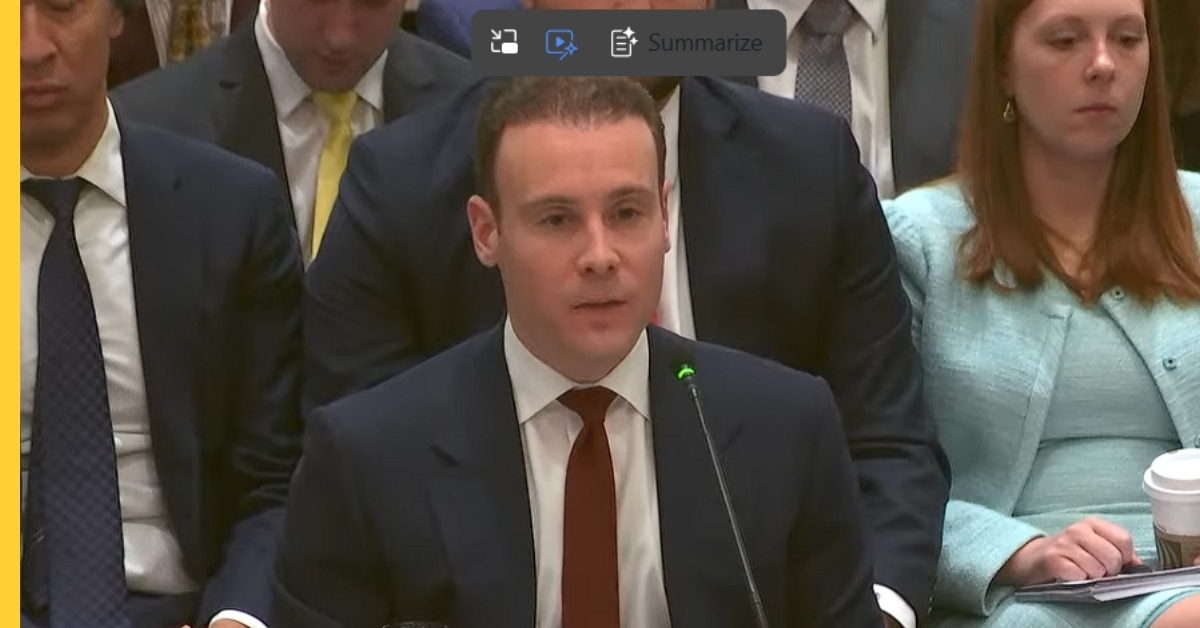
A House Agriculture Committee hearing on Thursday (16 April) featuring Commodity Futures Trading Commission (CFTC) Chairman Michael Selig exposed deep divisions over the regulation of prediction markets.
During the hearing, Selig calmly defended the agency’s authority while repeatedly declining to take positions on controversial use cases.
Lawmakers from both parties focused heavily on event-based contracts.
Echoing the opinion that has led to several prediction market lawsuits, several members argued these products resemble gambling rather than traditional derivatives, particularly when tied to war or political instability.
Selig maintained that prediction markets fall squarely within the CFTC’s jurisdiction.
He asserted: “[The CFTC’s] authorizing statute has a very broad definition of the term commodity. It includes virtually everything except for onions and motion picture box office receipts.
“And we take that broad authority very seriously when there are new creative instruments that are structured as derivatives, we, of course, have the authority to regulate those to the extent that the underlying asset is a commodity.”
He pointed to the Commodity Exchange Act’s broad definitions of commodities and swaps, stating that the agency has exclusive authority over such derivatives. He rejected claims that the markets operate in a regulatory loophole.
At the same time, he acknowledged that the current framework relies heavily on exchanges. Per existing regulations, designated contract markets function as self-regulating organizations and serve as the first level of regulation.
Exchange involvement an important component
These exchanges oversee trade operations, ensure that the contracts cannot be manipulated, and impose penalties for fraudulent and insider trading behavior.
While the CFTC oversees such certifications and has the authority to reject such contracts, it does not provide prior approvals for them.
Congressional members have questioned whether self-certification facilitates the entry of potentially hazardous contracts into the market.
According to Selig, the agency conducts regular evaluations and retains the discretion to disapprove listing requests; however, no numbers were provided.
He also said the CFTC is still developing a formal regulatory approach. The agency has issued an advisory and launched an advanced notice of proposed rulemaking to gather public input on prediction markets.
Selig described the issue as complex and said the commission is evaluating “virtually every question imaginable” before setting standards.
Several members pressed him on whether certain contracts should be prohibited outright. Congress has previously identified categories such as war, terrorism, assassination, and gaming as potentially contrary to the public interest.
Selig stated that there was no room for contracts involving war, terrorism, or assassination on the US exchanges, but refused to comment on whether other types of contracts should be prohibited as well.
He would not speculate about the outcome of the current rule-making process. The fear of insider trading was the predominant concern throughout the four-hour hearing.
Insider trading must be addressed
Several lawmakers pressed Selig over what they described as a pattern of suspicious, well-timed trades on platforms like Polymarket and Kalshi linked to sensitive government developments.
Massachusetts Rep. Jim McGovern pointed to about $500m in oil and equity futures positions placed shortly before President Trump announced on 23 March that the US had initiated ceasefire discussions with Iran.
Rep. April McClain Delaney and others also cited a Reuters report describing six newly created Polymarket accounts that generated roughly $1.2m by wagering on US airstrikes on Iran, with funding deposited within a day of the strikes.
Selig repeatedly emphasized that the agency has no tolerance for insider trading but would not say whether any specific trades are under investigation, stating that such disclosures could interfere with ongoing cases.
He added that the enforcement division, now headed by former CIA officer and Southern District of New York prosecutor David Miller, is in the process of expanding its staff, which will allow for better oversight.
However, he also pointed out that insider trading is not exclusive to prediction markets, stating at one point that “markets have been used to engage in fraud and manipulation insider trading for centuries.”
He added: “We will hold whoever’s engaging in fraudulent, manipulative, or insider trading activity accountable to the American people.”
CFTC wants to embrace crypto trading
Lawmakers also shifted attention to offshore crypto trading platforms that operate beyond US regulatory reach while offering perpetual futures products.
These venues have attracted both crypto-focused users and traditional traders, partly due to their ability to provide continuous exposure to commodities like oil.
Republican Rep. Austin Scott asked how the CFTC can realistically supervise activity on platforms structured outside US jurisdiction.
In response, Selig said the agency is actively tracking these markets and is working toward bringing more of that trading activity under US regulatory control.
Some questioning turned explicitly political during the hearing. Several members repeatedly raised concerns about potential conflicts of interest involving individuals connected to prediction market platforms.
References were made about ties between the Trump family and prediction market operators Kalshi and Polymarket.
The questions were seemingly intended to get Selig to concede that President Trump and his connections were directly benefiting from those ties.
He refused to speculate and argued that the agency does not “pick winners and losers,” nor should politics influence its regulatory processes.
Despite constant pressure, Selig stated that the agency is continuing with its regulatory process. He discussed the need for clarification and regulations to better protect investors, but without making any promises regarding outcomes or timelines.
It became evident from the discussion that there was an important conflict between the two sides.
While the CFTC considers prediction markets financial derivatives according to current legislation, lawmakers still have doubts and are considering new legislation to impose additional limitations.